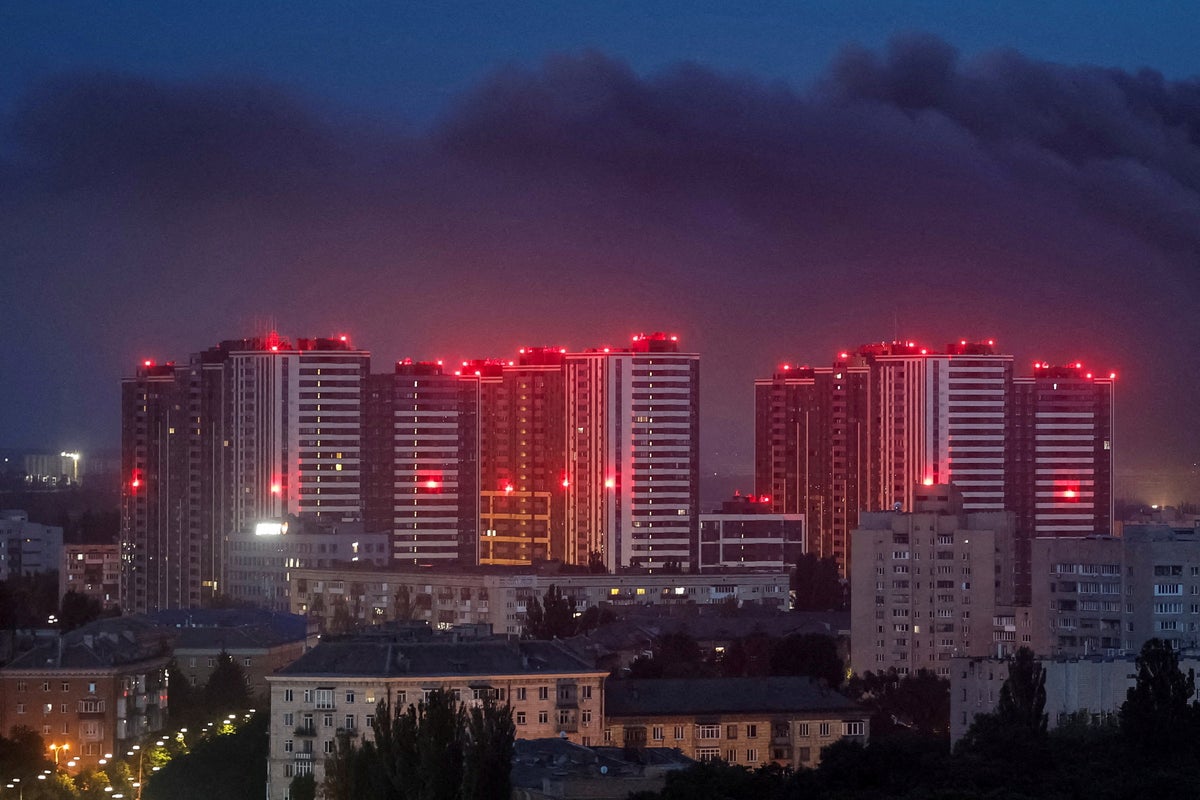
The fresh wave of Russian missile and drone strikes on Kyiv marks an escalation fueled by a raw, underlying economic vulnerability. Vladimir Putin's vow of a devastating response followed a massive Ukrainian campaign targeting Russian energy infrastructure, shadow fleet tankers, and transit links. While Moscow frames these aerial bombardments of the capital as standard retaliation, the reality points toward a deeper crisis: Ukraine's strategic deep strikes have triggered severe fuel shortages inside Russia, forcing the Kremlin to implement domestic rationing and look for an aggressive display of dominance to mask systemic domestic pain.
The Asymmetric Fuel Crisis Forcing the Kremlin's Hand
For months, the narrative of the war focused heavily on the grueling, slow-moving ground war in the Donbas. However, the real shifts are happening hundreds of miles behind the front lines. Ukraine's Unmanned Systems Forces have executed a highly coordinated, 40-day campaign designed to systematically dismantle the economic engine funding the Russian military.
By striking oil refineries, distribution hubs, and processing plants deep within Russian territory, Ukrainian drone swarms have accomplished what Western sanctions could not. They crippled a significant portion of Russia's domestic refining capacity. The impact was immediate and severe.
Faced with burning fuel depots from Samara to the edge of the Black Sea, Moscow was forced to introduce nationwide petrol rationing. For an autocracy that relies on the illusion of stability and infinite resources to maintain public compliance, visible shortages at gas stations represent a dangerous political liability.
Putin's public address to pro-Kremlin activists, where he promised that Russian responses would be several times more powerful, was not a declaration of strategic choice. It was an admission of panic. The overnight bombardment of Kyiv, which saw drones and cruise missiles striking storage areas and residential sectors in districts like Holosiivskyi and Darnytskyi, was designed primarily for domestic consumption. The Kremlin needed to show its own population that it could inflict pain equivalent to, or greater than, the economic disruption it is currently suffering.
The Sea of Azov Attrition Strategy
To understand why the Kremlin's reaction has turned so volatile, one must look at the waters of the Sea of Azov. Over a remarkably short period, Ukrainian forces targeted over a hundred Russian vessels, specifically focusing on the shadow fleet of tankers and ferries that keep military logistics flowing to occupied Crimea and the southern front.
This is a calculated strangulation. By taking out transshipment infrastructure and halting traffic through the Kerch Strait, Ukraine is isolating the southern theater of operations.
Consider the logistical nightmare this creates for the Russian general staff. Without reliable ferry transport and with major rail arteries vulnerable to long-range precision strikes, moving ammunition, heavy armor, and fuel to troops in Kherson and Zaporizhzhia becomes an unsustainable shell game.
The strategy does not rely on holding territory; it relies on making the occupation too expensive to maintain. Russia’s defense ministry claimed to have shot down hundreds of drones during these waves, but the sheer volume of the attacks ensures that critical hits land every single night.
Why Air Defenses are Reaching a Breaking Point
While Ukraine succeeds in choking Russian logistics, its own capital remains caught in a perilous numbers game. The latest strikes on Kyiv exposed a systemic vulnerability that Western allies have been slow to remedy: the critical depletion of interceptor missiles.
During the recent attacks, Ukrainian air defense teams managed an exceptionally high interception rate against incoming Shahed drones and standard cruise missiles. They used a mix of mobile fire groups, electronic warfare jamming, and tactical aviation.
But ballistic missiles remain a completely different problem.
When Moscow deploys ballistic systems, Ukraine's only reliable defense is the US-made Patriot system or equivalent high-end Western platforms. These systems are phenomenal, but they are entirely dependent on a finite supply of incredibly expensive interceptor missiles. Intelligence reports indicate that Ukraine's stocks of these interceptors have dropped to dangerous levels.
When a ballistic missile is detected, air defense crews face an agonizing mathematical equation. They must choose which targets to save and which to let through. If a missile is tracking toward an empty field or a non-essential structure, they must hold their fire to preserve ammo for the next strike aimed at a power plant or a high-rise apartment block.
Moscow knows this. The Russian military intentionally mixes cheap decoy drones with sophisticated ballistic missiles to force Ukrainian operators to waste their best interceptor stock. It is an aerial war of attrition where the side with the deeper manufacturing capacity eventually wins out unless supply chains change radically.
The Diplomatic Smoke and Mirrors
The escalation in the skies coincides with a frozen diplomatic theater. Recent attempts by European backers to push for face-to-face negotiations have been met with immediate rejection from the Kremlin.
Spokesmen in Moscow dismissed European diplomatic efforts as a coalition of warmongers, maintaining the rigid stance that any peace talks must begin with Ukraine ceding the entirety of the four regions Russia illegally claimed to annex, despite not fully controlling them.
This diplomatic intransigence is directly linked to the kinetic actions on the ground. Putin cannot afford to negotiate from a position where his domestic energy infrastructure is actively crumbling and his logistical grip on Crimea is slipping. The maximum pressure campaign in the air is designed to force Ukraine into a defensive posture, burning through its military hardware and air defense munitions, thereby reducing its leverage if formal talks ever materialize under international pressure.
The current strategy employed by Kyiv is high-risk. By bringing the war home to the Russian economy, they have provoked a wounded adversary into launching some of the most concentrated aerial assaults on civilian centers seen since the initial invasion. Yet, for Ukraine's military leadership, the alternative is a slow, agonizing war of position that they lack the manpower to win.
The coming weeks will not be decided by grand territorial offensives. They will be decided by whether Ukraine can completely collapse the Russian domestic fuel network before its own cities run entirely out of air defense interceptors to protect the sky.