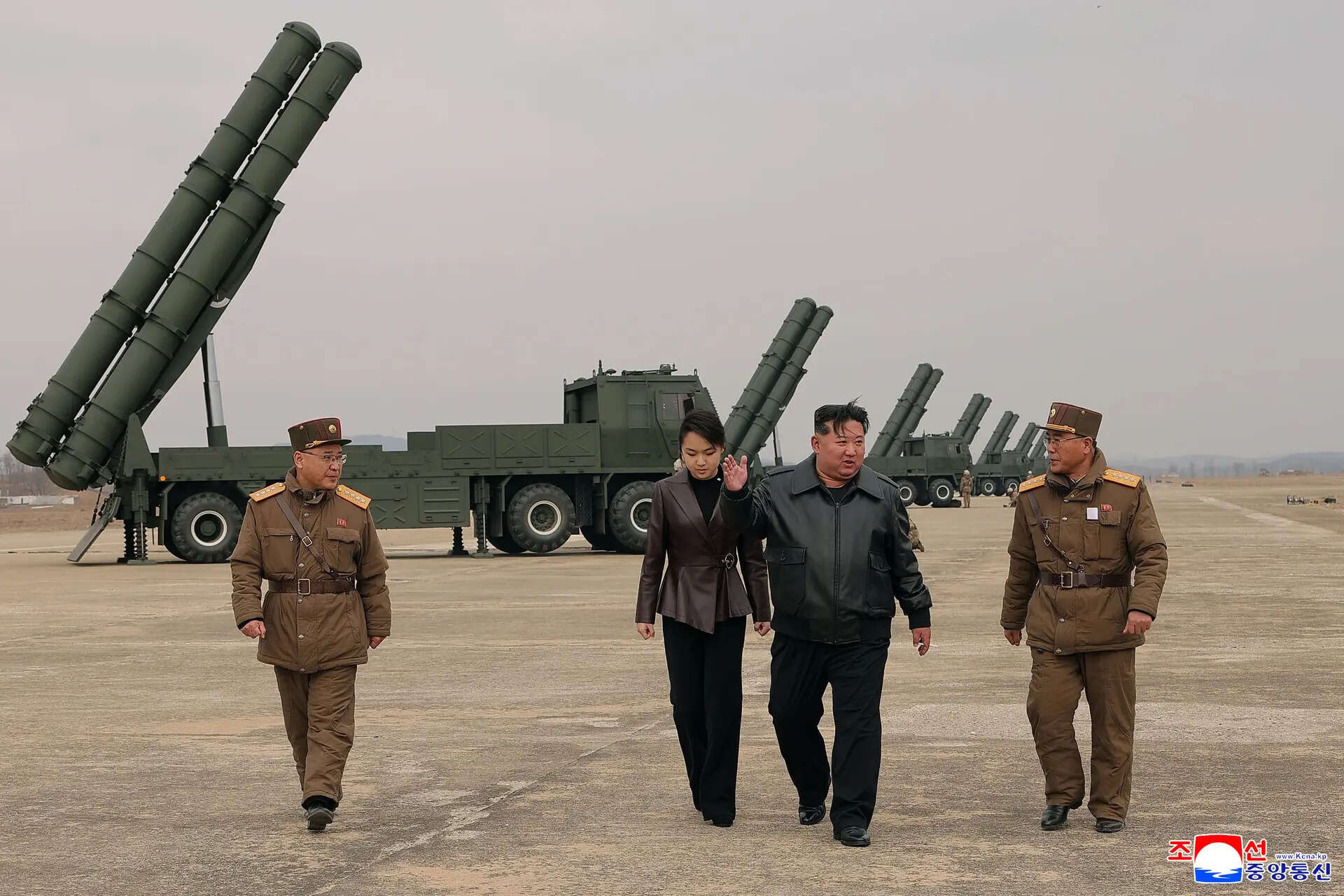
Pyongyang just signaled a shift in its tactical nuclear doctrine that should worry every military planner in the Pacific. On March 14, 2026, Kim Jong Un, accompanied by his teenage daughter Kim Ju Ae, oversaw a live-fire exercise of a 600mm "super-large" multiple rocket launcher system (MRLS). While state media focused on the "attractive" nature of the olive-green launch vehicles, the technical reality is far grimmer. These are not mere artillery pieces. They are hybrid weapons that blur the line between traditional barrages and precision-guided ballistic missiles, specifically designed to saturate South Korean and U.S. defenses with tactical nuclear warheads.
The test, involving twelve 600mm-caliber launchers, demonstrated a striking range of roughly 420 kilometers. This puts every major U.S. and South Korean military installation—including the sprawling Camp Humphreys and Osan Air Base—within a sudden, overwhelming crosshair. By launching ten projectiles in a single "volley" as detected by Seoul, North Korea is moving away from the "one missile, one target" philosophy toward a saturation model.
The Hybrid Threat of the 600mm MRLS
Traditional artillery relies on volume to compensate for inaccuracy. Modern ballistic missiles rely on precision but are expensive and relatively slow to reload. North Korea’s 600mm system attempts to solve both problems simultaneously. These rockets generate their own thrust and utilize guidance fins, allowing them to adjust their flight path in the dense lower atmosphere.
This maneuverability creates a nightmare for missile defense systems like the Patriot (PAC-3) and THAAD. Because these rockets fly at lower altitudes than traditional Scuds, they often stay beneath the "engagement ceiling" of high-altitude interceptors while moving too fast and in too great a number for point-defense systems to catch every one. In a conflict, Pyongyang would not fire one rocket; it would fire forty. Even a 90% intercept rate leaves four tactical nuclear strikes hitting their marks.
Weaponizing the Successor
The presence of Kim Ju Ae at these tests has shifted from a curiosity to a strategic communication tool. Her inclusion in the March 2026 tests, where she was photographed walking among the massive 8x8 transporter-erector-launchers (TELs), is a deliberate effort to link the Kim dynasty’s survival to its nuclear "sword."
By bringing his daughter to a live-fire exercise involving "tactical nuclear" assets, Kim Jong Un is signaling to the world—and his own elites—that the nuclear program is not a bargaining chip for his own tenure. It is a multigenerational inheritance. This "successor-branding" makes the prospect of denuclearization even more remote, as the regime has now woven these weapons into the very fabric of the Kim family’s legitimacy.
A Global Proving Ground in Ukraine
We cannot analyze these tests in a vacuum. Since late 2023, North Korea has been using the war in Ukraine as a massive, real-world laboratory for its missile and artillery technology. While the 600mm system hasn't been confirmed on the front lines yet, its smaller 240mm cousins and the KN-23 ballistic missiles have been.
Every time a North Korean missile is fired at a Ukrainian city, Pyongyang’s engineers receive data on how their guidance systems perform against Western-made radar and interceptors. They are learning how to bypass the very systems—like the Patriot—that protect Seoul today. The "state of the art" status Kim claimed for these launchers during the Saturday test isn't just rhetoric; it is likely a result of technical refinements made after watching Russian forces deploy North Korean hardware under combat conditions.
Strategic Saturation and the Defense Gap
The timing of this test coincided with the U.S.-South Korean "Freedom Shield" military exercises. While Pyongyang always protests these drills, the March 2026 response was notably high-volume. The decision to fire ten missiles at once suggests the North is confident in its domestic production capacity.
- Production Speed: New facilities at the March 16 Factory and other sites suggest North Korea can now mass-produce these large-diameter tubes.
- Tactical Warhead Integration: The Hwasan-31, a standardized tactical nuclear warhead, is designed to fit inside the nosecone of these 600mm rockets.
- Mobile Survivability: The use of wheeled TELs allows these batteries to hide in tunnels and forest cover, emerging only to fire a volley before relocating within minutes.
The Erosion of the Intercept Shield
For decades, the security of the Korean Peninsula rested on the "Shield of Seoul"—the belief that even if the North fired, advanced Western technology could swat the threat out of the sky. That shield is thinning. As North Korea moves toward ultra-precision MRLS, the cost-to-kill ratio flips heavily in their favor. An interceptor missile costs millions of dollars; a 600mm rocket costs a fraction of that.
Furthermore, the recent redeployment of U.S. air defense assets to other global flashpoints has left regional commanders in the Pacific wary. If North Korea can prove its "saturation" capability—firing more rockets than there are interceptors in a given sector—the deterrent value of the U.S. umbrella is effectively neutralized. Kim's description of the weapon as "deadly yet attractive" is a chillingly accurate assessment of its marketability to other rogue actors and its utility in a first-strike scenario.
The March 14 exercise was not a performance for the domestic crowd. It was a technical demonstration of a maturing capability to hold the South hostage with a nuclear barrage that cannot be stopped by current means. This is the new reality of the peninsula: the era of the "lone missile" is over, replaced by the era of the nuclear volley.
Would you like me to analyze the specific flight telemetry data from the March 14 launch to determine the exact maneuvering capabilities of the 600mm rockets?