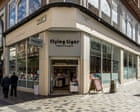
Modella Capital has finalized a deal to buy Flying Tiger Copenhagen from its creditor banks, Danske Bank and Nordea, following months of intense financial maneuvering. While the official narrative frames this as a routine handoff designed to fuel global expansion, the reality is far more precarious. Flying Tiger is a debt-laden business masquerading as a high street success story. By entering the portfolio of an aggressive, turnaround-focused private equity firm, the quirky Danish retailer has just stepped onto a well-worn path that frequently leads to store closures, heavy restructuring, and financial distress.
To understand why this acquisition occurred, one must look past Flying Tiger’s bustling aisles and cheerful, maze-like store layouts. The retailer operates roughly 900 locations globally, including 80 in the United Kingdom. On paper, parts of the operation look strong. The UK branch grew sales by 22% to £70.1 million, generating a modest pre-tax profit of £2.6 million.
Yet, the broader corporate structure has been structurally fragile for years. In early 2025, the company underwent a massive capital restructuring that effectively stripped control away from its previous owners, Treville & Co, handing majority ownership directly to its lenders and top executives.
The primary catalyst for this latest sale is a ticking financial time bomb. Flying Tiger’s UK operations alone are weighed down by more than £35 million in debt, while the global business has struggled to achieve self-sustaining stability without significant institutional life support. The banks did not want to be retailers; they wanted an exit strategy. Modella Capital provided that exit, but the track record of this specific buyer suggests that Flying Tiger's long-term survival is anything but guaranteed.
The Modella Playbook and the High Street Carnage
Modella Capital, led by chairman Steve Curtis and managing director Joseph Price, has quickly earned a reputation across the retail sector for execution style corporate turnarounds. The firm targets well-known brands that require capital injection, promises extensive transformations, and applies aggressive restructuring tactics.
The consequences of this playbook have been stark across the British retail sector over the last twelve months.
- Claire’s Accessories (UK & Ireland): Acquired by Modella in September 2025. By April 2026, the entire operation collapsed into administration, resulting in total store closures and 1,300 redundancies.
- The Original Factory Shop: Purchased by Modella in February 2025. It fell into administration in April 2026, shutting down every single outlet.
- TG Jones (Formerly WH Smith High Street): Modella bought WH Smith’s 480 high-street stores for £40 million last year and rebranded them. Currently, Modella is pushing an aggressive restructuring plan through the High Court, seeking steep rent cuts and planning to shut down up to 150 stores—a quarter of the estate—to avoid total bankruptcy.
- Hobbycraft: Acquired in August 2024. It has already used a company voluntary arrangement (CVA) to slash rents and shutter at least nine locations.
When Modella acquires a brand, it frequently blames macroeconomic pressures like weak consumer confidence and unfavorable government fiscal policies for subsequent downsizings. However, investigative digging reveals deeper structural mechanisms at play. For instance, during the ongoing TG Jones restructuring, it emerged that Modella has been charging the retail subsidiary millions of pounds simply for the rights to use its new, corporate-created brand name. This extraction of capital from struggling retail operations complicates the narrative that external economic forces are solely to blame for these downfalls.
Why Flying Tiger’s Impulse Model is Uniquely Vulnerable
The Danish variety chain built its empire on a concept called "hygge capitalism"—cheap umbrellas, quirky stationery, and impulse-buy home decorations priced low enough that shoppers don't think twice before checking out. It relies entirely on high footfall and spontaneous purchasing.
This model requires immense volume to offset razor-thin profit margins on individual items. When inflation bites, consumer footfall drops, or supply chain costs rise, a model built on selling £3 trinkets feels the squeeze instantly. While the company's current management team plans to open 700 new franchise locations globally by 2030, executing an aggressive expansion plan requires massive liquidity.
Modella claims it will back the current management team, led by chief executive Jens Aarup Mikkelsen, to provide the stability and capital needed for this growth. But private equity firms rarely fund massive expansions out of their own pockets without expecting immediate structural efficiencies. Given that Flying Tiger is already carrying significant debt, the strategy will likely involve deep cost-cutting across the existing corporate infrastructure to fund the speculative franchise push abroad.
The Looming Creditor Confrontation
The immediate future of Flying Tiger will depend heavily on how its current creditors and landlords respond to the change in ownership. In modern retail acquisitions, private equity firms rarely leave the real estate untouched. Landlords who currently host Flying Tiger stores across Europe are likely bracing for aggressive rent renegotiation demands, mirroring the tactics Modella deployed with TG Jones and Hobbycraft.
If landlords refuse to compromise on lease terms, or if the debt load proves too heavy to refinance under current interest rates, the risk of corporate insolvency rises dramatically. Modella has openly admitted in past corporate communications that it accepts it "won't win every battle" when taking on distressed high street assets. For the thousands of workers employed across Flying Tiger's global network, that philosophy offers very little comfort.
The acquisition is not a validation of Flying Tiger’s financial health; it is a high-stakes corporate rescue mission run by a firm that routinely uses insolvency courts to reshape its investments. The quirky Scandinavian retail experience that consumers love is now under the control of a strict financial architecture designed to prioritize debt clearance and structural engineering over high street nostalgia.