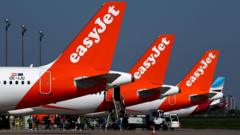
EasyJet has flatly rejected a preliminary £3 billion takeover approach from US private credit giant Castlelake, labeling the move highly opportunistic. The Minneapolis-based asset manager, which has quietly amassed a 2.14% stake in the Luton-based carrier, indicated it was considering a firm offer of no less than 403p per share. While the market reacted by sending EasyJet shares up 12% to 444p, the airline board quickly went on the defensive, appointing veteran City dealmakers Simon Robey and Simon Warshaw from Evercore to erect a financial fortress.
The primary catalyst for this sudden corporate raid is clear. EasyJet is suffering from a severely depressed valuation brought on by external geopolitical shocks, specifically the conflict in the Middle East and its subsequent impact on international jet fuel prices. Private capital has spotted a structural mismatch between the carrier's current stock price and its long-term asset value.
But this is not just another story of a cheap British asset being circled by American dollars. It reveals a fundamental tension in European aviation: a highly valuable network of primary airport slots pinned down by a volatile macro-environment.
The Valuation Disconnect and the Geopolitical Discount
Corporate raiders do not buy healthy airlines during periods of tranquil growth. They strike when the broader market panics over cyclical headwinds. For EasyJet, the last six months have been brutal. The outbreak of war in Iran severely disrupted global aviation corridors, causing jet fuel prices to nearly double since late February as flows through the Strait of Hormuz faced severe constraints.
For a low-cost carrier operating on thin margins, these energy spikes are devastating. EasyJet had already reported a pre-tax loss of over £540 million for the six months ending in March. The conflict further softened passenger booking visibility for the crucial summer period, triggering a 20% slide in the share price since the start of the year.
That slide created the perfect entry point. Castlelake, which manages $36 billion in assets and recently launched a dedicated $1.8 billion aviation lending platform called Merit AirFinance, recognized that EasyJet's physical infrastructure is worth far more than the equity market implies.
The airline holds a massive, crown-jewel portfolio of take-off and landing slots at capacity-constrained, tier-one European hubs like London Gatwick, Paris Charles de Gaulle, and Amsterdam Schiphol. These slots are effectively irreplaceable. While ultra-low-cost rivals like Ryanair and Wizz Air rely predominantly on secondary, far-flung airports to keep costs down, EasyJet has carved out a premium niche by flyable real estate close to major financial centers.
When a private equity firm looks at EasyJet, they are not just looking at a fleet of Airbus jets. They are looking at a premium infrastructure play trading at a deep discount.
The Regulatory Defense Wall
Even if Castlelake decides to formalize its bid before the statutory June 26 deadline, the execution path is riddled with regulatory landmines. The legacy of European protectionism remains deeply embedded in aviation law.
Under long-standing rules inherited from European Union frameworks, any airline holding a European operating license must be majority-owned and controlled by nationals of the region. For a US-headquartered asset manager acting alone, this rule presents an immediate structural barrier.
European Airline Ownership Framework:
┌────────────────────────────────────────┐
│  Minimum 50% + 1 Share Ownership       │
│  Must be held by EU/UK Nationals       │
└───────────────────┬────────────────────┘
                    │
                    ▼
┌────────────────────────────────────────┐
│  Castlelake (US-Based Asset Manager)    │
│  Requires local consortium partners    │
└────────────────────────────────────────┘
A foreign buyout could theoretically trigger the revocation of EasyJet’s operating certificates, grounding the fleet overnight. To bypass this, Castlelake would need to construct a highly complex consortium involving European equity partners, or establish a voting trust structure that strips the US entity of operational control while retaining economic interest.
Some industry observers argue these rules are occasionally interpreted with a degree of flexibility. They point to Ryanair, where non-EU ownership has historically fluctuated significantly without regulatory intervention.
However, a total buyout by a foreign private equity fund is an entirely different proposition than a widely dispersed public shareholder base. Regulatory bodies like the UK Civil Aviation Authority would scrutinize the capital structure with immense intensity, creating significant closing risks for any transaction.
The Precedent of Rejection
This is far from the first time EasyJet has had to fight off predators. The airline's strategic positioning has made it a perpetual consolidation target. Back in 2021, the board rejected an unsolicited, all-paper takeover bid from its Hungarian ultra-low-cost rival, Wizz Air.
That rejection was driven by a deep ideological divide. Wizz Air wanted to absorb EasyJet to create an ultra-low-cost behemoth capable of going toe-to-toe with Ryanair, utilizing a uniform fleet of tightly packed aircraft flying to secondary destinations. EasyJet’s board bet instead on its hybrid model, expanding its ancillary businesses like EasyJet Holidays to capture higher-margin consumer spend.
The current defense strategy relies on a similar premise of intrinsic value. The board points to an investment-grade balance sheet backed by a net cash position, alongside an explicit medium-term target of delivering over £1 billion in profit before tax once fuel markets stabilize.
Furthermore, the shadow of corporate history looms large over the share registry. Sir Stelios Haji-Ioannou, the iconic billionaire founder who launched the carrier in 1995, still controls roughly 15% of the equity. While his relationship with the board has frequently been litigious over fleet expansion plans, he has historically guarded his stake fiercely, viewing the airline as a generational asset rather than an exit vehicle for private capital.
The London Market Conundrum
The raid on EasyJet underscores a structural crisis occurring within the City of London. The UK stock market has increasingly become a cut-price supermarket for overseas institutional capital.
The list of high-profile departures from the London Stock Exchange has accelerated at an alarming rate. Multinational corporations like Flutter Entertainment, CRH, and Ashtead have moved their primary listings or faced private buyouts because UK equities consistently trade at a systemic discount compared to their international peers.
When domestic institutional investors flee equity markets in favor of defensive bonds, public companies are left exposed. High short positions—with bearish investors shorting 5.5% of EasyJet's outstanding shares prior to the Castlelake announcement—further depressed the stock, painting a target on the carrier's back.
Private capital funds are sitting on record amounts of unspent cash. They are systematically hunting for resilient businesses that are temporarily mispriced by public markets.
Fleet Dynamics and Financial Headwinds
The operational reality of running a post-pandemic airline requires massive capital expenditure. EasyJet is currently in the middle of a major fleet modernization program, transitioning away from older Airbus A319s toward highly efficient A320neo and A321neo aircraft.
These new variants offer significant reductions in fuel consumption and carbon emissions per seat mile. In an era of sustained high oil prices, fleet efficiency is the absolute difference between survival and liquidation.
But these aircraft order books require immense financial liquidity. This capital intensity explains why short-sellers have targeted the sector so aggressively. If fuel costs remain elevated above historical averages throughout the summer, EasyJet will be forced to draw down on its cash reserves to fund these capital commitments, delaying its return to the £1 billion net profit milestone.
Castlelake understands this pressure intimately. Through its existing ownership stakes and debt provisions in other distressed carriers like SAS and Virgin Atlantic, the private credit firm specializes in navigating the capital-heavy aviation ecosystem. They know that if they can take the airline private, they can absorb the short-term pain of high fuel prices away from the quarterly earnings scrutiny of public markets, emerging on the other side with a highly profitable, modern fleet operating from the best slots in Europe.
The board's immediate task is to convince institutional shareholders that the geopolitical discount is a passing shadow, and that selling out at 403p—or even a slightly sweetened revised offer—amounts to giving away the crown jewels at the bottom of the cycle. Shareholders must now decide whether to take a quick, guaranteed premium today or hold out for a long-term recovery that remains hostage to the price of oil and the stability of the Middle East.