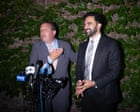
The Democratic establishment did not just lose three congressional seats in New York City on Tuesday night. They lost the structural machinery of the city itself. By sweeping all three contested federal primaries, the insurgent alliance led by Mayor Zohran Mamdani proved that the political center of gravity in America's largest metropolis has shifted decisively to the democratic socialist left.
This was a coordinated, high-stakes purge of the old guard. In the 13th Congressional District, political newcomer and doctoral student Darializa Avila Chevalier unseated Representative Adriano Espaillat, the powerful head of the Congressional Hispanic Caucus and a decade-long fixture in upper Manhattan and the Bronx. In the 10th District, former city Comptroller Brad Lander knocked off two-term incumbent Representative Dan Goldman, a billionaire heir and former impeachment prosecutor. In the 7th District, state Assembly Member Claire Valdez won the nomination to succeed the retiring Representative Nydia Velázquez, defeating Velázquez’s handpicked successor, Brooklyn Borough President Antonio Reynoso.
The immediate takeaway from Tuesday night is structural. Deep-blue congressional districts mean these primary winners are practically guaranteed seats in Washington. But the deeper truth reveals how a disciplined municipal machine, built from the bottom up over multiple election cycles, completely dismantled the institutional power of traditional labor unions, real estate donors, and party leadership.
The Disintegration of the Incumbent Advantage
For decades, the path to a congressional seat in New York ran through a predictable network of county organizations, senior labor leaders, and high-dollar fundraising networks. If you had House Democratic Leader Hakeem Jeffries campaigning for you, alongside endorsements from legacy labor unions, you won.
That rulebook is obsolete.
The defeat of Adriano Espaillat is the clearest indicator of this decay. Espaillat was the first formerly undocumented immigrant elected to Congress, an institutional titan who controlled a formidable voter turnout apparatus in Washington Heights, Inwood, and the Bronx. He was backed heavily by traditional fundraising networks and outside spending.
Avila Chevalier, a 32-year-old community organizer who helped lead pro-Palestinian protests at Columbia University, defeated him by running an unvarnished economic populist campaign. She turned Espaillat’s institutional backing against him, framing his campaign donations from groups like the American Israel Public Affairs Committee as proof of alignment with outside billionaires rather than working-class tenants in Harlem.
The strategy worked because the demographics of these neighborhoods are changing, and the older generation of voters who felt a personal loyalty to machine politicians is being eclipsed. The new electorate responds to immediate material grievances: soaring rents, stagnant wages, and food costs.
The Gaza Litmus Test and the Donor Backlash
The primary battles also exposed a massive ideological fracture over foreign policy, transforming local congressional races into proxy wars over the Middle East. Mayor Mamdani and his slate turned opposition to the war in Gaza into a non-negotiable litmus test for the urban working class.
In downtown Manhattan and brownstone Brooklyn, Brad Lander’s challenge against Dan Goldman focused directly on this divide. Goldman, one of the wealthiest members of Congress, maintained a staunchly pro-Israel stance. Lander, while not an official member of the Democratic Socialists of America, aligned closely with Mamdani's base and drew massive support from voters alienated by the Biden administration's foreign policy.
Foreign policy became a direct stand-in for domestic class war. Mamdani frequently attacked the heavy spending of pro-Israel PACs, using aggressive rhetoric to paint establishment donors as financial elites trying to buy working-class neighborhoods.
The establishment miscalculated the potency of this message. They believed that voters would view foreign policy as a secondary issue compared to local delivery. Instead, the insurgent campaigns successfully linked international anti-war sentiment with domestic anti-corporate sentiment. To a young, increasingly precarious electorate, the donor class funding the incumbents represented the exact same forces driving up their rent.
The Battle for the Progressive Succession
Nowhere was the generational and tactical rift cleaner than in the 7th Congressional District, a sprawling seat covering parts of Brooklyn and Queens that activists long ago nicknamed the city's "Commie Corridor."
This race was not a battle between a moderate and a radical. It was a civil war between two distinct eras of the left.
Antonio Reynoso, the Brooklyn Borough President, carried the endorsements of retiring progressive icon Nydia Velázquez, the Working Families Party, and several influential labor unions. On paper, his progressive credentials were impeccable.
Yet Claire Valdez, a United Auto Workers organizer and state Assembly member, beat him by positioning herself further to the left, backed by Mamdani and the institutional ground game of the DSA.
7th Congressional District Primary Alignment
===========================================================
Candidate:       Claire Valdez        | Antonio Reynoso
-----------------------------------------------------------
Key Backers:     Mayor Zohran Mamdani | Rep. Nydia Velázquez
                 DSA                  | Working Families Party
                 Sen. Bernie Sanders  | Major Labor Unions
===========================================================
The outcome proves that traditional progressive branding is no longer enough to satisfy the city's left-wing electorate. Voters rejected the institutional compromise that Reynoso represented. They opted instead for a candidate who promised explicit confrontation with the party structure, signaling that even established progressive leaders will be challenged if they are seen as too cozy with the existing party apparatus.
The Longevity of the Municipal Machine
A common critique of left-wing insurgencies is that they are flashes in the pan, reliant on charismatic individuals rather than durable organizations. Critics point to previous cycles where progressive momentum stalled after a few high-profile victories.
Mamdani has built something different. Just one year after his stunning mayoral victory over former Governor Andrew Cuomo, Mamdani has transformed his personal campaign apparatus into a permanent, highly disciplined municipal machine.
His operation does not just rely on standard television advertising or direct mail. It utilizes a vast network of highly motivated, young volunteers who treats door-knocking, tenant organizing, and digital outreach on platforms like TikTok as an ongoing project, not a seasonal activity. Mamdani’s endorsement carries structural weight. It brings an army of disciplined canvassers capable of overwhelming traditional political operations that rely on paid, unmotivated street teams.
This machine operates with a degree of internal discipline that rivals the old Tammany Hall, but with an ideological, rather than transactional, glue. By securing three additional congressional allies, Mamdani has not only insulated his administration from federal pressure but has positioned New York City as the intellectual and tactical capital of the American left ahead of the next federal election cycles.
The institutional leadership in Washington, including House Democratic Leader Hakeem Jeffries, downplayed the significance of these challenges before the polls closed, noting that a handful of seats do not change the overall composition of a 215-member caucus. That defense misses the point entirely. The national party depends on New York City as a financial engine and a safe laboratory for its national messaging. With the city's congressional delegation shifting rapidly into the hands of explicit democratic socialists, the national party faces a structural crisis: the ground beneath their feet in their most reliable stronghold has fundamentally transformed.