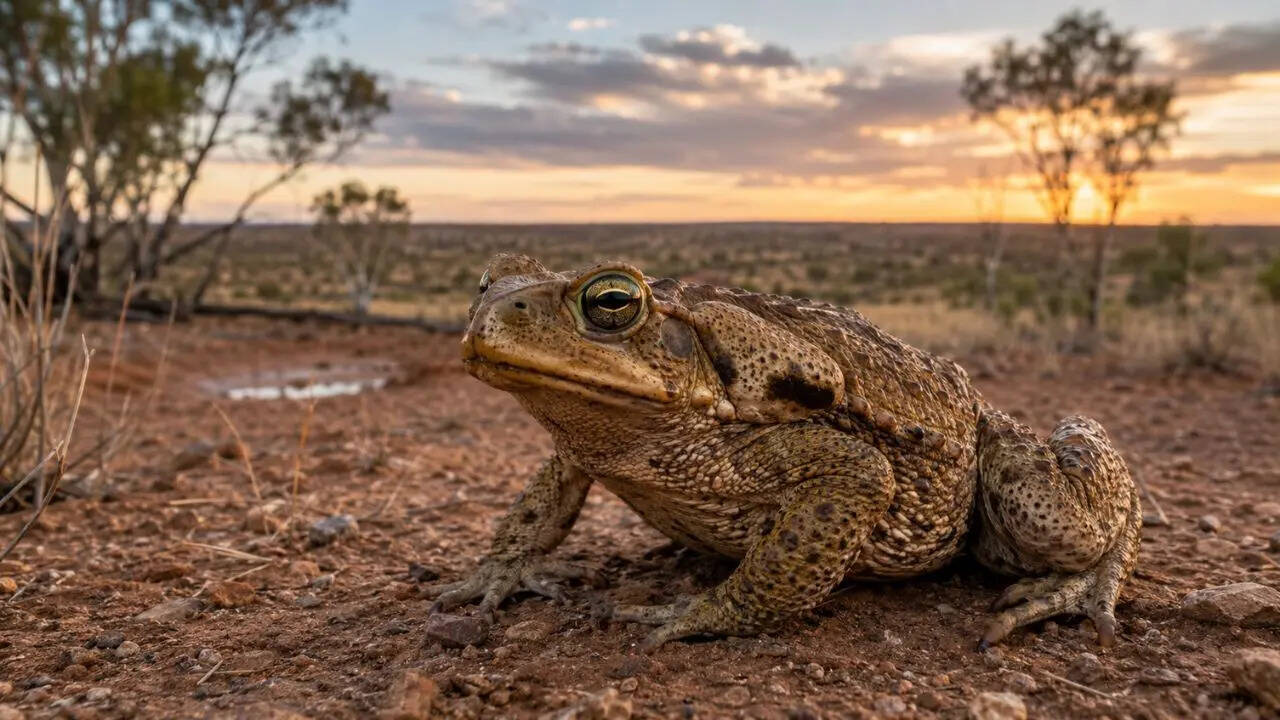
Bureaucratic arrogance, political expedience, and a fundamental misunderstanding of evolutionary biology created Australia's worst ecological disaster. The 1935 release of 101 Hawaiian cane toads to protect Queensland's sugar fields from cane beetles is widely cited as a classic cautionary tale of biological control gone wrong. Today, with the toxic amphibian population topping 200 million and relentlessly expanding across the continent, the real failure is not historical. It is modern. Decades of countermeasures have largely failed because institutions continue to rely on manual eradication and simplistic solutions while the toad itself evolves at an unprecedented, terrifying velocity.
The Illusion of the Quick Fix
The introduction of Rhinella marina was never a strictly scientific endeavor. It was a political panic response wrapped in the language of agriculture. In the early 1930s, Queensland’s lucrative sugar industry faced a severe threat from the native greyback cane beetle. Desperate for a solution that did not involve expensive or unavailable chemical treatments, the Bureau of Sugar Experiment Stations looked to Puerto Rico and Hawaii, where cane toads had been credited with suppressing crop pests.
The warning signs were immediate and explicit. Walter Froggatt, a prominent government entomologist, fought bitterly against the release. He warned that the generalist predators would inevitably abandon the cane fields, devour native fauna, and multiply without check.
His concerns were briefly validated when the federal government issued a ban on the introduction. However, the sugar lobby possessed immense leverage. Political pressure mounted swiftly, and the Prime Minister’s office personally intervened to overturn the ban. The initial cohort of 101 toads arrived in 1935, and within months, tens of thousands of captive-bred offspring were released into the wild.
The fundamental flaw in the logic was absurdly simple. Greyback cane beetles spend most of their lives high on the stalks of sugarcane plants or flying through the air. Cane toads cannot jump high, and they cannot fly. They live on the ground.
Data compiled by evolutionary biologist Rick Shine confirms that sugar production did not see any statistically significant increase after the introduction of the toads. Instead of hunting beetles, the toads targeted easier prey on the ground, disrupting existing ecological checks and balances.
The Ecological Domino Effect
The true catastrophe of the cane toad lies not in what it eats, but in what eats it. Because Australia has no native toads, local predators have spent millions of years evolving without developing a resistance to bufadienolides, the potent cardio-toxic steroids concentrated in the cane toad’s parotoid glands.
When a predator attacks a toad, it receives a lethal dose of venom almost instantly. This has resulted in a severe, systemic restructuring of Australian ecosystems.
- Apex Predator Collapse: In areas newly invaded by toads, populations of the northern quoll, freshwater crocodiles, and various species of goannas and monitor lizards routinely plummet by up to 90%.
- The Mesopredator Release: The sudden erasure of top predators triggers unpredictable chain reactions. For instance, the collapse of goanna populations—which traditionally raid nests—has caused an unnatural surge in brush turkey populations.
- Agricultural Backfire: Goannas and native lizards were highly effective natural predators of cane beetles. By poisoning the lizards, the toads actually removed a functional biological control agent. Furthermore, native rats proved immune to the toad’s toxin. With goannas gone, the cane-eating rodent population exploded, inflicting further damage on the very crops the toads were imported to protect.
The Physics of an Accelerated Invasion
If the initial release was a blunder, the ongoing expansion is an evolutionary marvel. The invasion front is not moving at a static pace. It is accelerating.
When first released in Queensland, the toads expanded their territory at a rate of roughly 10 to 15 kilometers per year. Today, the western front in Western Australia is advancing at a blistering 50 to 60 kilometers per year. Recent data indicates they are on a direct trajectory toward the water-rich Pilbara region, threatening another ecological shockwave within the next two decades.
This acceleration is driven by a phenomenon known as spatial sorting.
[Invasion Front] -----> Faster, long-legged toads breed with each other
                             |
                             v
                     [Next Generation] -----> Even faster endurance athletes
The individuals at the absolute edge of the geographic line are, by definition, the fastest, longest-legged, and most restless toads in the population. Because they only encounter other vanguard toads at the frontier, they breed exclusively with each other. This has selectively engineered a specialized strain of "olympic" toads optimized for rapid long-distance travel. These frontline amphibians possess longer legs, higher endurance, and a behavioral drive to travel in straight lines rather than meandering.
This rapid evolutionary shift has come at a physiological cost. The frontline toads exhibit severe spinal arthritis and compromised immune systems due to the physical toll of their relentless march. Yet, their reproductive output remains massive, with females laying up to 35,000 eggs per clutch.
Why the Current Strategy is Broken
For decades, the primary cultural response to the crisis has been community-led eradication campaigns. Events like the annual "Great Cane Toad Bust" see volunteers collect and humanely freeze thousands of adult toads. While these efforts are highly effective at fostering community engagement, they are statistically irrelevant on a continental scale.
Removing 10,000 toads from a local ecosystem does nothing to alter the trajectory of a 200-million-strong population. Biologists have long recognized that density-dependent compensation dynamics mean that removing adult toads simply frees up resources, allowing a higher percentage of tadpoles to survive to adulthood.
Furthermore, physical barriers are impractical given the vastness of the Australian outback. The toads are highly adaptable, utilizing artificial cattle watering points to cross naturally arid stretches of terrain that would otherwise act as impassable barriers.
The Shift to Genetic and Behavioral Warfare
Real progress against the invasion is finally emerging, not from physical traps, but from molecular biology and behavioral modification.
Targeted Pheromone Trapping
Researchers discovered that cane toad tadpoles are highly cannibalistic, actively seeking out and consuming the eggs of their own species to eliminate future competition. The tadpoles track these eggs using specific chemical cues. By isolating these alarm pheromones and using them as bait in specialized traps, conservationists can capture millions of cane toad tadpoles while leaving native frog tadpoles completely untouched. This strategy disrupts the reproductive cycle before the animals can mature and disperse.
Conditioned Taste Aversion
Instead of trying to eliminate the toads, scientists are now training native predators to avoid them. By deploying "teacher toads"—juvenile cane toads small enough to cause nausea but not death—or native meat laced with non-lethal toad toxin, researchers are teaching wild goannas and northern quolls to associate the smell and sight of a cane toad with violent illness.
[Deploy Non-Lethal "Teacher Toad"] ---> Predator Eats Toad ---> Suffers Severe Nausea ---> Avoids Toads for Life
The results are remarkably clear. Populations of quolls pre-trained with taste aversion show vastly higher survival rates when the actual invasion front arrives compared to untrained populations.
The Imperfect Road Ahead
These innovative methods are localized interventions, not a total cure. Conditioned taste aversion requires intensive field deployment and cannot easily scale across millions of square kilometers of rugged, inaccessible terrain. Genetic options, such as using CRISPR technology to engineer a "gene drive" that renders female offspring sterile, offer a theoretical continental solution but face immense regulatory hurdles and valid fears regarding biological containment. If an engineered sterile toad accidentally made its way back to the native habitats of Central or South America, it could trigger an extinction event in the species' home range.
The lesson of the cane toad is that human intervention in complex biological systems creates unpredictable cascades. The initial mistake was born of a desire for a cheap, effortless shortcut to pest management. Resolving the crisis will require accepting that there is no single master stroke that can undo a century of evolutionary acceleration. The focus must shift completely away from the futile goal of total eradication and toward targeted, data-driven containment and predator preservation.



:max_bytes(150000):strip_icc()/how-many-types-of-dwarfism-are-there-2860725-v1-8dae2c531b4b47d9ae36ae404d3308a0.png)