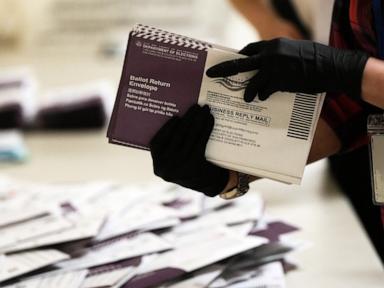
The fluorescent lights in a county registrar’s office hum at a frequency you only notice at two in the morning. I spent three election cycles working as a temporary ballot clerk in Southern California, and I still remember the smell of those nights—burnt drip coffee, damp cardboard, and the sharp metallic tang of high-speed optical scanners chewing through thousands of thick cardstock envelopes.
At the table next to mine sat a retired high school teacher named Arthur. Across from him sat Elena, a twenty-two-year-old community college student paying for her nursing textbooks with overtime shifts. Neither of them cared who won the White House or the local water board. They cared about signature curves. They cared about whether the loop on a "J" matched the scanned DMV record from 2014, and whether a ballot postmarked on Tuesday morning arrived before the statutory deadline.
That mundane, fluorescent-lit room is the exact terrain at the center of a fierce legal collision now heading to a federal appeals court. On one side stands the Trump administration’s Department of Justice, arguing that California’s voting laws and federal compliance records violate national standards of election integrity. On the other stands the State of California, defending its expansive mail-in ballot infrastructure and voter roll maintenance as a constitutional exercise of state authority.
Most coverage of this lawsuit treats it like a dry chess match between lawyers in dark suits. It isn't. Beneath the dense statutory citations of the National Voter Registration Act and the Help America Vote Act lies a fundamental question about American democracy: Who holds the keys to the ballot box, and how much friction should exist between a citizen and their vote?
The Anatomy of a Constitutional Tug-of-War
To understand why a federal appeals court is stepping into this fight, you have to strip away the partisan noise and look at the architecture of American elections. The U.S. Constitution splits the power over elections in a way that virtually guarantees friction. Under the Elections Clause, states hold the primary authority to set the "Times, Places and Manner" of holding elections. Yet that very same sentence grants Congress the power to "make or alter such Regulations."
Think of it like a house where the state lays the foundation and builds the walls, while the federal government holds the master building code. For decades, that arrangement held together through mutual restraint. Then came the modern era of hyper-polarized election litigation.
According to legal filings from the Justice Department, the federal government’s lawsuit challenges specific aspects of how California administers federal elections—focusing intensely on voter registration list maintenance, data-sharing transparency, and the rules governing mail-in ballots. Federal attorneys contend that California has failed to adequately purge ineligible voters from its rolls or provide the granular data required under federal transparency statutes to verify compliance. In the government's framing, bloated or unverified voter rolls erode public confidence and create vulnerabilities that federal law was explicitly designed to prevent.
California’s Attorney General and Secretary of State see an entirely different picture. In their court briefs, state officials argue that the federal lawsuit is an unconstitutional overreach—an attempt by the executive branch to weaponize federal statutes to micromanage a state’s sovereign election procedures. California maintains that its automated registration systems, such as the Motor Voter program, and its universal mail-in ballot framework fully comply with federal law while maximizing lawful participation.
Wait. Stop and look at what both sides are actually arguing. Neither side is claiming that the law doesn't matter. Both are claiming to be the true guardians of the law.
Two Voters, One Enormous Divide
Abstract legal theories become much clearer when you place them on a kitchen table. Consider two hypothetical voters—let’s call them Marcus and Diane—who represent the competing anxieties driving this courtroom battle.
Marcus is a seventy-four-year-old retired machinist living in the Central Valley. He has voted in person at the same elementary school gymnasium for forty years. Last autumn, two mail-in ballots arrived at his address—one for him, and one for a previous tenant who moved out of state three years ago. Marcus didn't commit fraud; he threw the extra ballot in the shredder. Yet that stray envelope left him deeply unsettled. To Marcus, a system that mails live ballots to outdated addresses feels careless. When he reads that the Justice Department is suing California to force stricter maintenance of voter registration rolls, he sees federal officials finally demanding basic accountability.
Now consider Diane. She is a thirty-eight-year-old single mother working double shifts at a hospital in Oakland. Her work schedule changes weekly, and public transit to her polling place takes forty-five minutes each way. Under California’s current rules, Diane receives her ballot automatically in the mail weeks before Election Day. She fills it out at her kitchen table after putting her kids to bed, signs the security envelope, and drops it into a secure county drop box on her way to a morning shift. When Diane hears about federal lawsuits challenging state mail-in procedures or demanding aggressive purges of voter lists, she doesn't hear "accountability." She hears an attempt to dismantle the exact system that allows her to participate in democracy without sacrificing a paycheck.
Marcus and Diane are not enemies. Both want a clean, fair, accurate election. Yet the legal doctrines currently being debated before the appellate judges treat their priorities as a zero-sum game.
What Happens Inside the Appellate Courtroom
When a case moves from a federal district court to a U.S. Court of Appeals, the atmosphere changes completely. There are no witnesses taking the stand. There is no jury box filled with local citizens. There are only three appellate judges sitting behind an elevated mahogany bench, firing rapid-fire hypothetical questions at attorneys who have thirty minutes to defend years of legislative and administrative policy.
The central legal questions before the panel hinge on statutory interpretation and standing. Does the federal government have the statutory authority under existing laws like the National Voter Registration Act to compel California to alter its specific administrative practices, or is the administration attempting to stretch those statutes beyond what Congress ever intended?
Legal scholars watching the docket point to a crucial distinction in how federal courts evaluate election rules. Under the Anderson-Burdick balancing test—a foundational doctrine in election law—judges weigh the character and magnitude of the asserted injury to a voter's rights against the precise interests put forward by the state as justifications for the burden imposed by its rule. Here, the dynamic is inverted: the federal government is accusing the state of failing to enforce federal guardrails, while the state accuses the federal government of disrupting settled election administration.
During oral arguments in cases like this, judges routinely press attorneys on the practical consequences of a ruling. If the appeals court sides with the Justice Department and orders immediate changes to how California verifies or maintains its voter rolls, what happens to eligible voters who might be swept up in an automated purge? Conversely, if the court sides entirely with California and narrows federal oversight powers, what recourse does the Justice Department have if a state genuinely ignores federal transparency mandates?
These are not easy questions. Honestly, even seasoned election law attorneys admit that the boundary between legitimate federal oversight and unconstitutional federal commandeering has grown blurry over the last decade.
The Invisible Labor Behind Every Counted Vote
What rarely makes it into the appellate briefs—or the evening news broadcasts—is the sheer mechanical reality of how elections actually work on the ground.
Back in that fluorescent-lit county office where I worked alongside Arthur and Elena, we weren't dealing with grand constitutional abstractions. We were dealing with paper, ink, and human error. Every single mail-in ballot envelope that enters a California county facility goes through a multi-step verification pipeline before the ballot inside is ever separated from the outer envelope.
First, an automated sorter photographs the signature on the outside of the envelope and weighs the packet to ensure only one ballot is inside. Next, human clerks compare that signature against the voter's historical registration signatures on file. If the signature is missing or doesn't match, the ballot isn't tossed in the trash—and it isn't automatically counted either. State law requires county officials to notify the voter by mail, email, or text message, giving them a window to "cure" the discrepancy by submitting a signed verification statement.
Meanwhile, maintaining the voter rolls—the very issue at the heart of the federal complaint—is a continuous, messy logistical puzzle. People move without filing change-of-address forms. People pass away in one state while registered in another. California participates in interstate data-sharing networks and cross-references state DMV and vital statistics records to identify outdated registrations, placing inactive voters on a separate status before eventual removal under strict federal timelines.
Why does that timeline matter so much? Because the National Voter Registration Act specifically prohibits states from systematically removing voters from the rolls within ninety days of a federal election, and requires a multi-year waiting period after a voter fails to respond to an address confirmation notice. Federal law itself intentionally builds in a buffer to prevent eligible citizens from showing up on Election Day only to discover their names were erased by a clerical glitch.
The tension in the Trump administration’s suit lies right inside that buffer zone. Critics of California’s administration argue that the state leans too heavily toward keeping questionable records active, inflating voter rolls and complicating oversight. Defenders of the state argue that aggressive purging inevitably disenfranchises real people—particularly renters, students, and low-income workers who move frequently.
A History of Friction Over the Franchise
If this courtroom battle feels unprecedented, a look backward reveals it is simply the latest chapter in an argument as old as the republic itself.
In 1787, the framers of the Constitution deliberately punted on establishing uniform national voting rules because the thirteen states couldn't agree on who deserved the franchise. For over a century, states guarded that power jealously—sometimes using it to expand democracy, and far too often using it to restrict access through poll taxes, literacy tests, and arbitrary registration purges.
It took monumental federal interventions—the Fifteenth Amendment, the Nineteenth Amendment, the Voting Rights Act of 1965, and the National Voter Registration Act of 1993—to establish a national floor of voting rights and administrative standards. Every single one of those federal laws sparked fierce lawsuits claiming Washington was trampling on states' rights.
Today, the political polarity of that argument has flipped in striking ways, yet the underlying constitutional mechanics remain identical. Whenever the federal government and a state government clash over election rules, the courts are forced to act as referees in a game where both players claim to be protecting the integrity of the scoreboard.
What makes the current moment uniquely volatile is the erosion of institutional trust. Thirty years ago, an administrative lawsuit over voter list maintenance rules would have been buried on page fourteen of a legal journal. Today, every procedural motion becomes a referendum on whether the entire electoral system is legitimate.
What the Ruling Will Actually Change
When the three-judge appellate panel eventually issues its written opinion, the immediate fallout won't look like a Hollywood courtroom drama. It will look like a stack of administrative directives landing on the desks of fifty-eight county registrars across California.
If the appeals court reverses or narrows lower court rulings in favor of the Justice Department, California election officials could face strict federal court orders compelling the release of detailed voter roll records, accelerating data audits, or modifying specific administrative procedures ahead of upcoming federal cycles. Depending on the breadth of the ruling, it could also establish a powerful appellate precedent empowering the Justice Department to bring similar enforcement actions against other states with expansive mail-in or automatic registration laws.
If the appeals court affirms California’s position, it will reinforce the broad latitude states enjoy under the Elections Clause to design their own voter access systems—effectively telling the federal executive branch that disagreements over state election policy belong in Congress, not in federal courtrooms.
Either way, the losing side will almost certainly petition for an en banc rehearing before a larger panel of appellate judges, or appeal directly to the U.S. Supreme Court. In modern election litigation, an appellate hearing is rarely the final word; it is simply the midpoint of a marathon that often stretches right up to the eve of the next national election.
Back at the Counting Table
Think back to that room at two in the morning.
When Arthur, the retired teacher, spotted an envelope where a voter’s hand had clearly trembled while signing—a jagged, uncertain line compared to the fluid cursive on their 2016 registration card—he didn't guess. He flagged it for secondary review by a bipartisan supervisor team. When Elena, the nursing student, found an envelope without a signature at all, she logged the barcode so the county could send a cure notice the very next morning.
They weren't thinking about the Elections Clause, the National Voter Registration Act, or press releases from Washington and Sacramento. They were protecting two fragile things at once: the certainty that every valid vote counted, and the certainty that no invalid vote slipped through.
Long after the lawyers pack their briefcases and walk down the granite steps of the federal courthouse, the survival of American democracy will still rest on those quiet, fluorescent-lit tables—and on whether millions of ordinary people like Marcus and Diane still believe the hands sitting around them can be trusted.