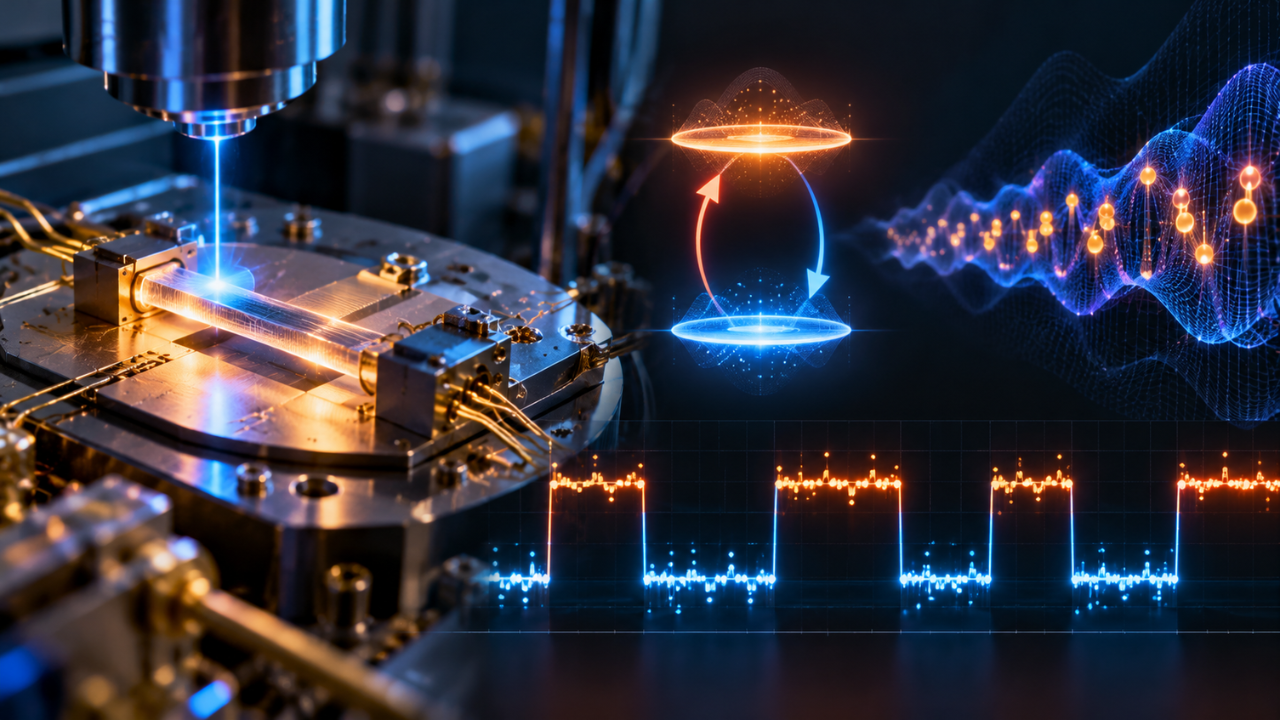
Researchers have tracked quantum jumps in sound by monitoring discrete energy shifts inside mechanical vibrations in real time, proving that acoustic energy behaves in quantized packets rather than a smooth, continuous wave. At the microscopic scale, sound is not a gentle ripple moving effortlessly through air or steel. It is a series of individual energy quanta called phonons, and catching a single transition as it happens exposes how fragile and noisy quantum hardware truly is.
For decades, textbooks treated sound as a classical phenomenon in everyday life and treated quantization as an abstract mathematical convenience in solid-state physics. You speak, air molecules push against one another, and the pressure wave rolls outward. Even in crystals, physicists talked about lattice vibrations as collective modes with quantized energy levels, yet watching a single mechanical oscillator leap from one energy state to another in real time remained largely out of reach. Measuring a single phonon is notoriously difficult because acoustic energy is tiny, easily drowned out by thermal agitation, and hard to isolate without destroying the very state you want to observe.
Why Tracking Acoustic Energy Changes Matters Beyond Lab Curiosity
Sound feels familiar. That familiarity breeds complacency.
Engineers building quantum computers, precision sensors, and low-temperature detectors spend billions of dollars fighting invisible enemies. Electromagnetic stray fields get shielding. Laser frequency drift gets feedback loops. Mechanical vibrations, by contrast, often get treated as background weather—something to damp with springs, isolation tables, or vacuum chambers until the numbers look quiet enough to publish.
Tracking quantum jumps in sound in real time changes that posture from guesswork to direct accounting. When a mechanical resonator jumps between discrete energy states—say from zero phonons to one, or from one to two—you are watching energy enter or leave a vibrating structure one quantum at a time. Instead of inferring average heating rates over thousands of cycles, researchers can see the exact moments when a tiny mechanical mode absorbs energy from its surroundings or dumps it into a neighboring circuit.
That matters because modern quantum processors are crowded neighborhoods. A superconducting qubit sitting on a chip does not live in a vacuum free of mechanical coupling. Piezoelectric effects, stress gradients, microscopic defects in substrates, and acoustic waves traveling across the wafer can all link electrical states to mechanical motion. If a stray acoustic mode hops up an energy rung, it can carry heat, induce decoherence, or trigger correlated errors that look like mysterious glitches in a qubit readout.
Consider a hypothetical example to see how easily average measurements mislead an engineer. Suppose a mechanical oscillator sits inside a dilution refrigerator at millikelvin temperatures. Over an hour, its average energy looks nearly flat, suggesting the system is calm and well-isolated. Yet if you zoom in on real-time energy trajectories, that calm average could hide rare, sudden jumps caused by microscopic two-level systems flipping inside the material or brief bursts of acoustic energy leaking through mounting hardware. An average hides the spike. Real-time tracking catches the leap in the act.
How Physicists Catch a Single Quantum Leap Without Breaking It
Measuring something small usually ruins it. That is the oldest headache in quantum mechanics.
If you poke a fragile mechanical system too hard to see which energy state it occupies, your measurement apparatus injects energy, shifts frequencies, or knocks the oscillator right out of the state you hoped to observe. To watch quantum jumps in sound unfold continuously, experimentalists rely on dispersive coupling and quantum non-demolition style strategies, where a probe—often a superconducting circuit or microwave cavity—shifts its frequency slightly depending on the phonon number rather than absorbing the acoustic quantum outright.
Think of it like listening to a bell by watching how a nearby pendulum swings slightly faster or slower when the bell rings, instead of grabbing the clapper with your bare hand. The pendulum does not stop the bell. It reveals the bell's state indirectly.
To make those subtle shifts readable above noise, experiments push acoustic frequencies up into the gigahertz range—far higher than the rumble of a passing truck or the hum of a cooling fan. At gigahertz frequencies, the energy spacing between adjacent phonon states is large enough compared to thermal energy at ultra-low temperatures that the system does not constantly blur across dozens of states at once. Cooling suppresses thermal noise. High frequency widens the rungs on the energy ladder. Put those two together, and discrete steps start to stand out.
Even then, real-time detection is a race against time. A mechanical mode might hold a phonon for microseconds or milliseconds before energy leaks away into clamping points, anchors, or internal material defects. If your readout is too slow, you see a smeared average instead of crisp steps. If your readout is too noisy, every jitter looks like a jump. Getting clean, time-resolved trajectories requires fast electronics, low-noise amplifiers, and careful engineering of how the acoustic mode couples to its readout circuit.
The Trap of Confusing Quantum Jumps With Random Glitches
When a signal hops from one level to another on an oscilloscope screen, excitement comes cheap and skepticism comes hard.
Not every sudden step in a real-time trace is a clean, textbook quantum jump between pure energy states. Real hardware is messy. Gain drifts in amplifiers can shift baselines. Charge fluctuations or shifting defects near a junction can cause telegraph noise—random switching between two levels that mimics a physical transition if you do not cross-check the signal against other observables.
Serious experimentalists spend grueling months ruling out artifacts before claiming a true jump. They check whether the step sizes match the expected energy quantum of the mechanical mode. They test whether changing drive powers or readout frequencies alters the jump statistics in ways predicted by quantum mechanics rather than classical electronics. They look at jump rates when cooling the fridge or changing how the device is biased.
There is another subtlety that seasoned observers rarely gloss over. A "quantum jump" in a monitored open quantum system is not always a magical, instantaneous teleportation independent of measurement. Under continuous monitoring, what looks like a sharp jump on a coarse timescale can be a rapid, continuous evolution driven by the interplay between coherent drive, dissipation, and measurement backaction. Calling every step a jump without examining the measurement record risks turning a nuanced physical process into a neat soundbite.
What Real-Time Phonon Tracking Reveals About Materials and Noise
Every material has skeletons in its closet. Acoustic measurements rattle them.
For years, material science in quantum devices has focused heavily on surfaces and interfaces—oxide layers on aluminum, etched trenches on silicon, metal-substrate boundaries where microscopic two-level systems live. Those defects act like tiny, stubborn switches that absorb microwave photons or acoustic phonons and then release their energy unpredictably.
By watching quantum jumps in sound happen in real time, researchers gain a diagnostic lens into how energy moves through solid matter at scales where conventional acoustics cannot reach. A sudden upward jump in acoustic energy tells you a quantum of vibrational energy arrived in that mode. A sudden downward jump tells you a quantum left—either decaying into the bath or transferring into a coupled system.
| Aspect | Classical Sound Waves | Quantized Acoustic Modes |
|---|---|---|
| Energy picture | Continuous wave amplitude and intensity | Discrete phonons with step-wise energy levels |
| Typical observability | Macroscopic microphones, pressure sensors, laser vibrometers | Cryogenic resonators, circuit quantum acoustodynamics, fast readouts |
| Primary noise enemy | Ambient air turbulence, structural vibration, thermal noise | Thermal phonons, material defects, anchor clamping loss, amplifier noise |
| Engineering payoff | Acoustics, structural testing, ultrasound imaging | Quantum interconnects, mechanical memories, low-noise sensing |
Notice how this reframes mechanical design. In classical engineering, if a beam vibrates a little, you add mass or damping and move on. In quantum acoustics, damping is a double-edged sword. Couple a mechanical resonator too strongly to an external bath so it sheds unwanted heat quickly, and you also give its fragile quantum state an escape route that shortens coherence times. Isolate it too tightly to preserve coherence, and trapped energy or slow defect flips can linger longer than you want.
That trade-off is brutal, and there is no free lunch. Every design choice pushes on one side of a ledger while tugging on the other.
Why Mechanical Modes Are Tempting Couplers and Tough Customers
Look at why engineers keep coming back to sound at the quantum scale despite the headaches.
Electromagnetic waves travel fast—at the speed of light—which is great for long-distance communication, terrible if you want to compress a wavelength onto a tiny chip. Acoustic waves travel roughly five orders of magnitude slower in solids than light travels in vacuum. Because their speed is so much lower, their wavelength at a given frequency is vastly shorter.
Short wavelengths mean compact devices. You can pack acoustic resonators into tight spaces on a chip, build high-Q mechanical modes that store energy efficiently, and potentially use phonons as a bridge between different physical platforms—linking superconducting qubits, optical photons, or spin systems that do not naturally talk to one another on equal terms.
That promise is real, yet the gap between a clean lab demonstration and a scalable engineering building block remains wide. Scaling from one carefully tuned mechanical mode to dozens or thousands on a chip introduces frequency crowding, fabrication variation, cross-talk, and thermal load challenges. A trick that works when you isolate a single resonator in a quiet corner of a cryostat often gets much harder once you wire up a larger array.
The Industry Reality Check Behind Quantum Hype
Whenever a headline pairs "quantum" with "real time," hype cycles start warming up their engines.
Having worked around emerging technologies long enough to watch dozens of breathless breakthroughs cool into decades of grinding engineering, one rule holds up better than almost any prediction. Detecting a fundamental physical effect in a tightly controlled experiment is a major scientific milestone. Turning that effect into reliable commercial hardware is a completely different marathon.
Many observers still treat quantum jumps in sound as a novelty—proof that sound has a quantum side just like light. That understates the stakes. Understanding energy exchange at the single-phonon level hits directly at decoherence and error budgets, two bottlenecks that determine whether quantum processors and ultra-sensitive detectors can scale without drowning in noise.
At the same time, overpromising that real-time phonon tracking will immediately solve quantum error correction or replace existing sensors would be dishonest. Real-time tracking gives you sharper eyes. Sharp eyes help you diagnose leaks, test physical models of dissipation, and engineer quieter materials. They do not magically eliminate fabrication flaws, thermal limits, or the laws of thermodynamics.
Progress in this space rarely arrives as a single lightning bolt. It arrives through unglamorous improvements—cleaner substrates, better acoustic isolation, faster cryogenic electronics, and tighter alignment between theoretical models and time-resolved data. When researchers track quantum jumps in sound in real time, they are building a microscope for energy flow itself.
What Engineers and Researchers Should Do Next
If you work on quantum hardware, precision sensing, or low-temperature materials, stop treating mechanical vibrations as an afterthought once a device passes basic room-temperature or crude low-temperature checks. Build time-resolved energy diagnostics into your test bench early so rare jumps and transient heating events do not hide inside long-term averages.
Audit every physical path where energy can enter or leave your resonator—tethers, anchors, substrates, and readout lines—and treat each one as an active channel until real-time measurements prove otherwise.
Share your raw jump statistics and drift anomalies openly with materials and device teams rather than polishing only the cleanest traces for publication. Quiet machines are not born by accident; they are hunted down one quantum step at a time.