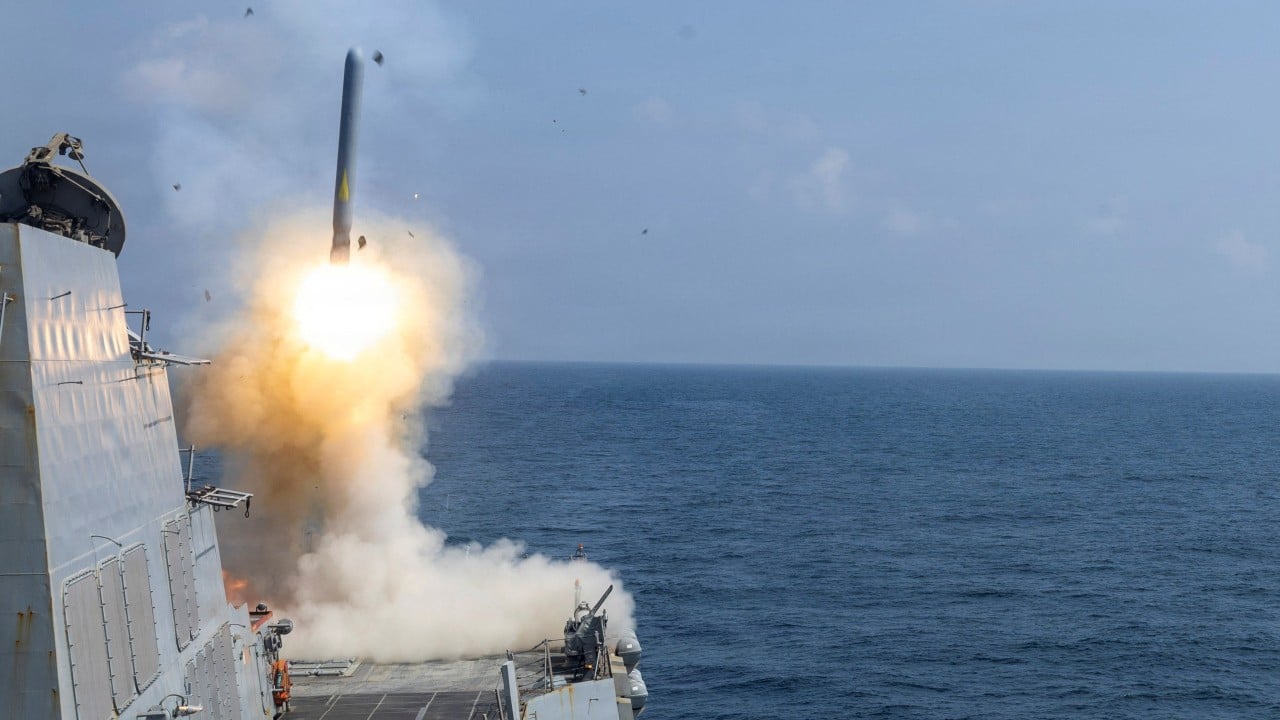
Japan’s transition from a purely defensive posture to one incorporating long-range "counterstrike" capabilities hinges on a fragile procurement timeline that is currently under-optimized. The acquisition of 400 U.S.-made Tomahawk Land Attack Missiles (TLAM) is not merely a purchase; it is a structural shift in East Asian security dynamics. Any friction in the delivery of these assets—specifically the Block IV and Block V variants—creates a window of vulnerability where Japan’s stated policy outpaces its physical capacity to enforce it. The strategic bottleneck is not the intent of the Japanese Ministry of Defense, but the industrial throughput of the American defense industrial base and the integration requirements of the Japan Maritime Self-Defense Force (JMSDF).
The Triad of Strike Integration
To evaluate if delivery delays will "slow" Japan’s plans, we must first define what those plans actually are. Japan’s Long-Range Strike Program is built on three distinct pillars:
- Immediate Capability Acquisition (The Tomahawk Bridge): The purchase of 400 TLAMs serves as a stopgap. Because domestic missile development—specifically the Type 12 Surface-to-Ship Missile (SSM) upgrade—requires years of testing and refinement, the Tomahawk provides an "off-the-shelf" solution to reach a baseline level of deterrence by 2025–2027.
- Domestic Industrial Scaling: Japan is simultaneously extending the range of its Type 12 SSM from 200km to over 1,000km. This involves a fundamental redesign of the airframe, engine, and stealth profile.
- Platform Readiness: A missile is inert without a launch platform. This requires the vertical launch system (VLS) integration onto Aegis-equipped destroyers and the development of "standoff" capabilities for air and submarine assets.
A delay in Pillar 1 does not just postpone a delivery date; it creates a "Deterrence Gap" where Japan has signaled its willingness to strike back at regional threats but lacks the kinetic tools to do so effectively.
The Mechanics of the Deterrence Gap
Deterrence is a function of capability and credibility. If a regional adversary perceives that Japan’s inventory of long-range munitions is insufficient to saturate their integrated air defense systems (IADS), the deterrent effect of the 2022 National Security Strategy evaporates.
The "Delay Impact Function" can be visualized as a relationship between time and risk. As the delivery date for the first batch of 200 Block IV Tomahawks shifts from 2026 to 2027 or beyond, the following systemic risks increase:
- Platform Idleness: JMSDF destroyers undergo scheduled maintenance and upgrade cycles. If a ship is retrofitted to handle Tomahawk software and hardware but the missiles are not delivered, that vessel represents a sunk cost in terms of specialized labor and dry-dock time without an immediate increase in lethality.
- Inventory Exhaustion: In a high-intensity conflict scenario, 400 missiles is a surprisingly low number. Military planners often use a "Probabilistic Kill" ($P_k$) ratio to determine how many missiles are needed per target. If a target requires a 2-missile salvo to guarantee a 90% destruction probability, 400 missiles only cover 200 high-priority targets. Any delay in building this initial stockpile leaves Japan with zero depth in its magazine.
- Adversary Adaptation: The window provided by delivery delays allows regional competitors to accelerate their own hardening of command-and-control (C2) nodes or improve their electronic warfare (EW) capabilities specifically tuned to the Tomahawk’s signature.
Strategic Bottlenecks in the Defense Industrial Base
The primary driver of potential delays is the "Capacity Constraint" of the U.S. defense sector. The Raytheon production lines for Tomahawks are currently balancing three competing demands:
- U.S. Navy Replenishment: Ongoing operations in the Middle East and the need to maintain Pacific stockpiles.
- Foreign Military Sales (FMS) Backlogs: Japan is not the only ally seeking these weapons; Australia and the UK are also in the queue.
- Supply Chain Fragility: The production of solid rocket motors, specialized semiconductors, and guidance sensors has not yet returned to pre-pandemic throughput levels.
Japan’s decision to mix 200 older Block IV missiles with 200 newer Block V missiles was a tactical pivot to mitigate these delays. By accepting the Block IV—which is already in the U.S. inventory—Japan effectively jumped the queue. However, the Block IVs require "recertification"—a process of refurbishing the missiles to extend their shelf life and updating their communication suites. This recertification process is itself a bottleneck, as it uses the same facilities and technical expertise required for new-build Block Vs.
The Software Integration Variable
A common misconception in defense analysis is treating a missile like a round of ammunition. A Tomahawk is a complex drone that requires a sophisticated digital ecosystem.
For Japan to utilize these missiles, it must integrate the Tactical Tomahawk Weapon Control System (TTWCS) into its existing Aegis Baseline systems. This integration involves:
- Geospatial Data Processing: The ability to process and upload high-resolution terrain contour matching (TERCOM) and Digital Scene Matching Area Correlation (DSMAC) data.
- Mission Planning Nodes: Establishing a dedicated C2 structure that can select targets and deconflict airspace in real-time.
- Training and Doctrine: Shifting the mindset of JMSDF officers from "defense-only" radar tracking to long-range kinetic targeting.
Even if the physical missiles arrive on schedule, a delay in the delivery of the TTWCS software or the training of Japanese mission planners would render the hardware useless. The "True Deployment Date" is the intersection of hardware arrival and operator proficiency.
Quantifying the Type 12 Upgrade Synergy
While the Tomahawk captures headlines, the true measure of Japan’s strike plan is the Type 12 SSM upgrade. The Tomahawk is a "purchased capability," while the Type 12 is a "sovereign capability."
The upgraded Type 12 is expected to have a reduced Radar Cross Section (RCS) and a modular payload. The strategic logic here is "Diversity of Threat." By fielding both Tomahawks (turbojet-powered, sea-skimming) and upgraded Type 12s (potentially featuring different flight profiles and seeker heads), Japan forces an adversary to defend against multiple types of incoming threats simultaneously.
If Tomahawk deliveries are delayed, the pressure on the Type 12 program becomes immense. There is no room for the typical "teething problems" associated with new aerospace hardware. If the Type 12 encounters testing failures at the same time Tomahawk deliveries slip, Japan’s long-range strike plan doesn't just slow down—it enters a period of structural paralysis.
The Cost Function of Regional Deterrence
The financial aspect of these delays involves more than just the purchase price of approximately $2.35 billion. There is a "Security Opportunity Cost." Every yen spent on a delayed missile program is a yen not spent on:
- Unmanned Underwater Vehicles (UUVs): Critical for protecting the First Island Chain.
- Hardened Infrastructure: Protecting airbases and fuel depots from the very missiles Japan is now trying to acquire.
- Satellite Constellations: Enhancing the targeting data necessary for long-range strikes.
If the Tomahawk program faces significant delays, the Japanese government may be forced to choose between paying "expediting fees" (investing in U.S. production lines) or diverting funds to accelerate domestic alternatives.
Assessing the Tactical Outlook
The assumption that Japan’s plans will "slow" due to delays is partially accurate but misses the broader strategic adaptation. The Japanese Ministry of Defense has already signaled an "Acceleration Strategy" by moving up the start of Tomahawk procurement by one year. This was a preemptive move to account for the very delays currently being discussed.
However, the "Execution Risk" remains concentrated in the technical integration. The most critical period will be 2025. If the first batch of recertified Block IVs does not begin arriving in late 2025, the JMSDF will face a capability gap as older assets are retired or sidelined for upgrades that lack the final piece of the puzzle.
The strategic play for Japan is to decouple its strike doctrine from a single weapon system. This requires:
- Aggressive Parallelism: Treating the Tomahawk and the Type 12 as interchangeable nodes in a broader "Strike Grid" rather than sequential projects.
- Intellectual Interoperability: Prioritizing the data-sharing and C2 links with U.S. forces so that, in the event of a delay, Japanese platforms can still provide targeting data for U.S. assets or vice versa.
- Domestic Industrial Resilience: Investing in the "Tier 2" and "Tier 3" suppliers within Japan—the companies making the actuators, sensors, and composite materials—to ensure that once the Type 12 design is finalized, production can scale at a rate the U.S. industrial base currently cannot match.
The success of Japan’s long-range strike capability will not be measured by the date the first missile is crated in a warehouse in Kentucky, but by the date a Japanese commander can autonomously prosecute a target at 1,000km with a verified kill chain. Any delay in hardware is a setback, but a failure in system integration is a defeat.