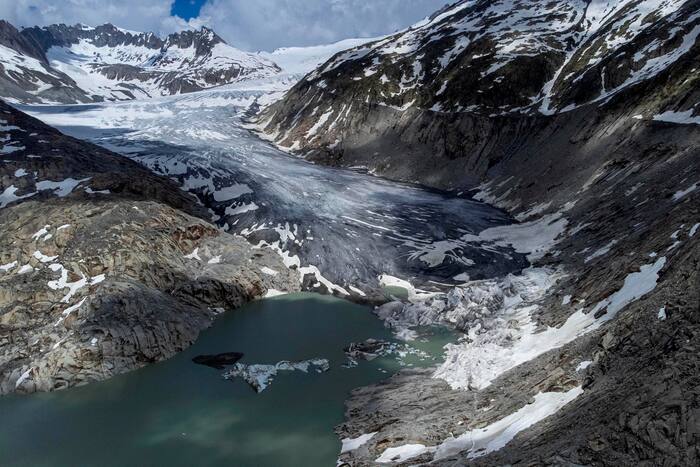
The degradation of the European cryosphere has transitioned from a localized environmental observation into a systemic structural failure. Data released by the Swiss Glacier Monitoring Network document that Swiss glaciers shed more than 5 percent of their total ice volume in a single observational cycle. This magnitude of loss follows an established compounding trajectory: over a five-year window, nearly 20 percent of Switzerland's entire glacial mass has vanished. Treating these metrics as seasonal anomalies misdiagnoses the reality. The system is operating under a structural deficit where historical baseline assumptions no longer govern physical outcomes.
The Mechanics of Mass Balance Deficit
Glacial survival depends on a strict mass balance equation: the net accumulation of solid precipitation during cold cycles must offset the ablation or melt during thermal cycles. The current operational environment violates this equilibrium through two concurrent failure modes.
First, winter accumulation metrics have degraded. Low precipitation combined with elevated thermal baselines results in an insufficient snowpack. This initial state variable is critical. Snow possesses a high albedo, reflecting incoming solar radiation. When the snowpack is thin or absent early in the ablation season, high-albedo surfaces are replaced by exposed ice and surrounding rock, which absorb thermal energy at a much higher rate.
Second, summer thermal duration has expanded. Persistent atmospheric high-pressure systems have anchored zero-degree isotherms at extreme elevations. Freezing levels exceeding 4,000 meters for unprecedented durations drive thermal energy deep into high-altitude accumulation zones that previously acted as stable ice vaults. This elevates the melting gradient across the entire topographical profile. Smaller alpine formations, lacking the mass buffer to absorb multi-year deficits, cross critical tipping points and experience total structural collapse, as observed with the complete disappearance of minor formations like Bella Tola and Griessfirn.
Internal Degradation and Feedback Loops
The visual retreat of a glacier tongue represents only the terminal symptom of a broader internal failure. Glaciological analysis highlights an acceleration of internal drainage dynamics. Meltwater infiltrating crevasses and structural fissures carves sub-glacial cave systems and internal conduits. This internal excavation compromises structural integrity from within, causing catastrophic structural failure of ice blocks independent of surface melting rates.
Albedo modifications introduce secondary feedback loops. While historical years suffered from heavy deposition of Saharan mineral dust that lowered surface reflectance, the dominant driver remains the exposure of dark underlying bedrock. Once bare rock is exposed, local sensible heat fluxes increase, creating micro-climatic anomalies that accelerate the lateral and vertical retreat of adjacent ice walls.
Hydrological and Economic Thresholds
The physical retreat of ice mass alters regional hydrology through a distinct functional curve. Initially, accelerated melting generates a temporary surplus of runoff, artificially inflating discharge volumes in major river basins. However, this output follows a non-linear decay function known as peak water.
As total ice volume contracts below critical thresholds, the absolute volume of meltwater declines sharply. This reduction transforms seasonal runoff patterns. Downstream municipal water management, agricultural irrigation, and hydroelectric generation infrastructure—optimized for predictable glacial discharge during summer dry spells—face severe volume constraints. The economic cost function shifts from managing excess water hazard to mitigating chronic scarcity during high-demand windows.
Strategic Forecasting
The empirical trajectory indicates that stabilization of the current Alpine ice volume is decoupled from short-term meteorological variability. Even anomalous winter precipitation events provide temporary mitigation rather than systemic recovery, because the elevated summer thermal baselines rapidly strip away thin seasonal accumulations.
Long-term modeling requires treating remaining glaciers not as permanent geographical fixtures, but as transient assets undergoing terminal depletion. Infrastructure planning across Alpine river basins must immediately decouple from historical flow permanence, shifting capital allocation toward closed-loop water storage, artificial recharge of groundwater aquifers, and redrawn zoning parameters for geologically unstable, post-glacial terrain.
This video provides visual context and expert commentary on the extreme melt rates and environmental factors driving ice loss across Swiss glaciers.