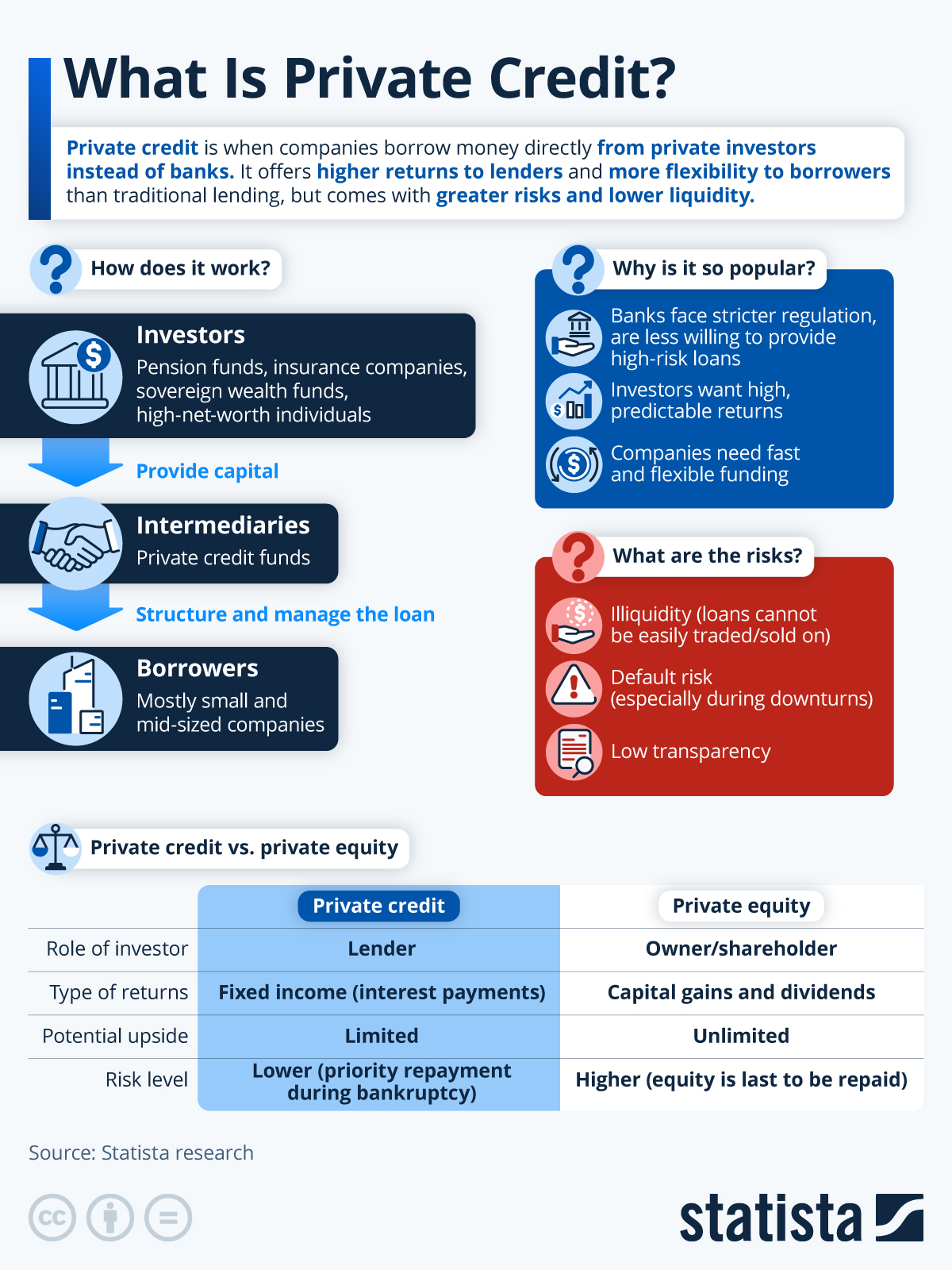
Defaults are rarely loud at first. They arrive wrapped in amendments, covenant waivers, and quiet extensions granted over late-night conference calls. For the past decade, private credit has pitched itself as the unshakeable titan of modern finance, stepping into the void left by retreating traditional banks.
Yet beneath the polished marketing decks and double-digit yield promises, troubled loans are swelling across the direct lending ecosystem. Borrowers face higher interest expenses, cash flows are tightening, and the structural safety nets designed to protect investors are being tested by prolonged macroeconomic pressure.
Direct lenders have spent years expanding into a multi-trillion-dollar asset class largely away from public scrutiny. Unlike syndicated loans traded daily on open markets, private credit deals are bilateral agreements negotiated in private rooms.
This opacity served everyone well during the zero-interest-rate era. Funds posted steady, upward-sloping valuations quarter after quarter, drawing institutional capital from pensions and endowments desperate for yield.
Now, the math has fundamentally inverted. Base rates remain elevated, turning floating-rate debt into an anchor dragging down mid-market corporate borrowers. When a company's earnings before interest, taxes, depreciation, and amortization fail to cover its debt service, the cracks in the private credit model begin to show.
The Illusion of Stable Valuations
Mark-to-model accounting creates a dangerous lag between economic reality and reported performance. Public equity and debt markets react instantly to bad news, repricing risk within seconds.
Private credit funds, by contrast, frequently rely on internal valuations or subjective third-party marks that update quarterly or annually. This creates a psychological buffer for investors who believe their capital is insulated from public market volatility.
Consider a hypothetical mid-market software firm that borrowed fifty million dollars from a direct lending fund two years ago at a secured overnight financing rate plus six hundred basis points. When base rates hovered near zero, the business easily serviced its obligations while investing in growth.
Today, with base rates significantly higher, annual interest payments have doubled. The company's cash runway shrinks, forcing the sponsor—the private equity firm that bought the business—to inject emergency equity or seek a restructuring.
Instead of marking the loan down to fair market value or forcing a bankruptcy proceeding, lenders often agree to payment-in-kind arrangements. Under a payment-in-kind structure, the borrower does not pay cash interest. Instead, the interest is added to the principal balance, increasing the total debt burden while keeping the loan technically performing on paper.
This mechanism allows funds to avoid recognizing losses immediately. It kicks the accounting can down the road, transforming a liquidity crunch into a compounding solvency problem.
Covenant-Lite and the Erosion of Lender Protections
The proliferation of covenant-lite terms in private lending represents a structural shift in risk allocation. Traditional corporate lending relied heavily on maintenance covenants, which required borrowers to maintain specific financial ratios—such as leverage ceilings or interest coverage floors—tested quarterly. Violating these metrics gave lenders immediate enforcement rights, allowing them to demand capital repayments, raise pricing, or trigger a default.
Competition among direct lenders has eroded these safeguards. To win mandates from private equity sponsors, funds frequently agreed to incurrence-only covenants or loose documentation that leaves lenders with few triggers until a missed payment occurs.
Without early warning indicators, problems fester out of sight. By the time a borrower hits a wall, operational turnaround options have narrowed. Lenders find themselves holding the keys to distressed assets they never intended to operate, ranging from sluggish logistics providers to over-leveraged healthcare roll-ups.
The Sponsor-Backed Backstop
Most private credit loans share a common thread: they are backed by private equity sponsors. During past downturns, these sponsors functioned as reliable rescuers, writing equity checks to shore up struggling portfolio companies and protect their initial investments.
The current cycle looks different because dry powder is concentrated at the top, while smaller and mid-sized funds face a fundraising slowdown. Many private equity firms are managing multiple portfolio companies simultaneously bleeding cash.
Writing a rescue check for one struggling asset drains liquidity needed elsewhere in the portfolio. When sponsors lack the capital or the appetite to rescue a floundering company, the friction between lenders and owners intensifies.
Lenders accustomed to collaborative relationships with sponsors are suddenly finding themselves adversaries in complex restructuring negotiations. Some funds have begun forming ad-hoc creditor groups to protect their recovery values, signaling a breakdown in the cozy consensus that defined the asset class during its expansion phase.
Systemic Interconnections and the Banking Shadow
Regulators are watching these dynamics with growing unevevenness. While direct lenders do not take retail deposits, their capital structures are deeply intertwined with the broader financial system through leverage facilities provided by commercial banks.
Major global banks extend subscription lines and asset-backed credit facilities to private credit funds, allowing them to boost their internal rates of return. If defaults in the underlying loan portfolios mount, the value of the collateral backing these bank loans diminishes.
A localized distress event in middle-market corporate debt can quickly propagate through the financial plumbing, affecting bank balance sheets and altering risk appetites across the entire credit spectrum.
Liquidity mismatch compounds the vulnerability. Many retail-focused evergreen funds offer periodic liquidity windows, allowing individual investors to redeem shares quarterly. If a wave of redemption requests hits a fund holding illiquid, distressed corporate loans, managers face a grim choice. They must either gate the fund to halt withdrawals or sell performing assets at steep discounts to meet redemptions, leaving the remaining investors holding the deteriorating tail of the portfolio.
The Reckoning Ahead
The expansion phase of private credit is over. What follows is a rigorous sorting process where underwriting discipline, workout expertise, and portfolio transparency separate resilient managers from those who merely rode a wave of cheap money.
Funds that relied on aggressive financial engineering and lax documentation will face painful write-downs as troubled loans transition from deferred payments to permanent impairments. The market will demand proof of cash generation rather than paper yields, and the true cost of illiquidity will become impossible to ignore.
Recovery rates in a distressed cycle rarely match initial underwriting assumptions, particularly when senior tranches are crowded and enterprise values have deteriorated. Institutional investors are beginning to ask harder questions about asset quality, portfolio concentration, and valuation methodologies.
As restructuring advisors and distressed debt specialists ramp up their hiring, the illusion of friction-free lending is dissolving. The private credit market is about to discover whether its structural innovations were genuine risk mitigants or merely sophisticated ways of delaying the inevitable.

.full.3529161.png)
