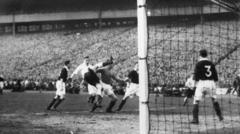
The rain in Glasgow doesn’t just fall. It haunts. In the spring of 1950, it slicked the cobblestones and soaked into the heavy wool coats of men standing outside Hampden Park, men who were convinced they were watching the best football team on the planet. Scotland had just played England. They had lost 1-0, a narrow, bruising affair decided by a single goal. Most nations would have seen that result, shrugged, and started packing their suitcases for Brazil. After all, they had finished second in the British Home Championship. They had qualified for the World Cup.
But the suitcases stayed in the attic. The players stayed home. A nation’s pride became its own cage.
George Young, the massive, barrel-chested captain known as "The Cork," stood in the dressing room with the steam of the showers rising around him. He was the literal and figurative heart of the defense. He was ready to lead his country across the Atlantic to face the likes of Yugoslavia and Brazil. He had the talent, the lungs, and the mandate. What he didn't have was the permission of a few men in suits who cared more about a promise than a world stage.
The Self-Inflicted Wound
To understand why Scotland stayed home, you have to understand the Scottish Football Association (SFA) of 1950. These were men of Victorian sensibilities living in a post-war world. Before the qualifying tournament even began, George Graham, the SFA Secretary, made a public declaration that would haunt Scottish football for seventy years. He stated, with a rigidity that bordered on the religious, that Scotland would only travel to the World Cup if they went as champions of the British Isles.
Anything less than first place was, in his eyes, a humiliation.
Think about the sheer, stubborn audacity of that position. FIFA had offered two spots to the British Home Championship. First place and second place both got a ticket to Rio de Janeiro. England won the group. Scotland came in second. By every rule of the game, by every metric of logic, they were in. But Graham and the SFA committee viewed the second-place spot as a "handout." They were the proud Scots. They didn't take handouts.
The players begged. They pleaded. Even the England captain, Billy Wright, reportedly expressed his disbelief, urging the Scots to join them on the boat. The fans, who had endured the rationing and the grayness of the post-war years, desperately wanted something to cheer for. They wanted to see their stars under the South American sun.
The SFA blinked, looked at their own self-imposed ultimatum, and decided that "integrity" was more important than the World Cup. They withdrew.
The Ghost of 1950
Imagine being a young boy in a tenement flat in Govan, listening to the wireless, waiting to hear about the adventures of his heroes in the Maracanã. Instead, he hears silence.
The 1950 World Cup became the great "What If" of Scottish history. While Scotland sat in the drizzle, the tournament in Brazil turned into a theater of the unexpected. The United States beat England in one of the greatest upsets of all time. Uruguay stunned the world by defeating Brazil in the final.
Experts and historians have spent decades crunching the numbers. That Scotland team was elite. They featured stars like Billy Steel, a playmaker of such vision that he commanded a British record transfer fee, and the legendary Willie Waddell. On paper, they were better than many of the teams that actually made the trip. There is a very real, mathematically supported argument that Scotland could have reached the final four.
Instead of a bronze or silver medal, they ended up with a dusty sense of moral superiority.
A Culture of Glorious Failure
This wasn't just a scheduling conflict. It was the birth of a psychological blueprint that would define Scottish sports for generations: the concept of the "Glorious Failure."
By choosing not to go, the SFA didn't protect Scotland's honor; they stunted its growth. They signaled to the players and the public that the fear of not being the absolute best was a valid reason to stop trying altogether. It created a vacuum where experience should have been.
Consider the logistical nightmare of 1950. Traveling to Brazil back then wasn't a matter of a few hours on a luxury jet. It was a multi-day odyssey. The heat was punishing. The pitches were different. The style of play in South America was rhythmic and alien compared to the "kick and rush" of the British leagues. By staying home, the Scottish players missed out on a tactical education that would have been brought back to the domestic game.
When Scotland finally did decide to grace the World Cup with their presence in 1954, they were woefully unprepared. They were tourists in a professional's game. They were hammered 7-0 by Uruguay. That drubbing was the direct interest paid on the debt of 1950.
The Weight of the Suit
We often talk about sports as being decided by the athletes on the grass, but the 1950 debacle proves that the most devastating tackles often happen in the boardroom. The SFA officials weren't villains in their own minds. They thought they were upholding the dignity of the "Lion Rampant."
They were wrong.
There is a specific kind of pain in losing because you weren't good enough. It’s a clean pain. You lick your wounds, you train harder, and you come back. But the pain of not competing at all—the pain of being disqualified by your own side—is a slow-acting poison. It creates a narrative of "we could have been," which is always much more seductive and dangerous than "we were."
The players of that era are mostly gone now. George Young passed away in 1997, never having led his team out onto the grass in Brazil. He lived through the 1954 and 1958 tournaments, seeing the world move on while Scotland tried to find its feet.
The missed opportunity of 1950 remains a cautionary tale about the cost of rigid pride. It serves as a reminder that in the theater of human achievement, showing up is the only thing that makes the dream real. Everything else is just a story told in the rain.
The 1950 World Cup moved forward without the skirl of the pipes. The Maracanã roared, the goals flew in, and the history books were written. In Glasgow, the clouds remained heavy, and the greatest team Scotland never sent faded into the mist of the Clyde, victims of a principle that helped no one and broke the hearts of a nation.
A man stands on a street corner in 1950, folding a newspaper that carries the final confirmation of the withdrawal. He looks at the gray sky and wonders what it feels like to see a golden sun over a green pitch three thousand miles away. He will never know.