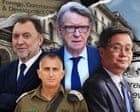
The room where the British state decides its own safety is rarely as cinematic as the movies suggest. There are no holographic displays or ticking countdowns. Instead, there is the smell of old paper, the low hum of a ventilation system struggling against the London damp, and the terrifyingly quiet scratching of a pen. In 2024, that pen was hovering over a folder belonging to Peter Mandelson.
To the public, he is Lord Mandelson—the "Prince of Darkness," the architect of New Labour, a man whose career has been a masterclass in staying relevant long after the lights should have gone out. But to the civil servants tasked with vetting him for a sensitive government role, he was something else. He was a series of red flags bound in a leather portfolio.
They weren't looking for a smoking gun. Vetting in the modern age isn't about finding out if someone is a spy; it is about mapping the gravity of their influence. It is about asking a single, piercing question: Who does this person owe, and what would they do to collect?
The vetting report, a document that was never supposed to breathe the air of the morning news cycle, painted a picture of a man whose Rolodex functioned like a private diplomatic service. It warned of deep, intricate ties to senior figures in Russia, China, and Israel. These weren't just casual acquaintances made over a glass of lukewarm Chardonnay at a gallery opening. These were relationships built on the hard currency of power, business, and mutual benefit.
Consider for a moment the weight of a phone call. Most of us pick up the phone and speak to a friend about the weather or a bill. When a man in Mandelson’s position picks up the phone, the ripples move through global markets and legislative chambers. The vetting officials saw those ripples. They saw a web that stretched from the oligarch-heavy boardrooms of Moscow to the tech hubs of Haifa and the strategic inner circles of Beijing.
The danger wasn't necessarily a lack of patriotism. The danger was the blur.
In the world of high-level politics, the line between "consulting" and "influence peddling" is often a thin, translucent thread. Mandelson had spent years navigating this gray zone. He operated in a space where being a former Cabinet minister provided the keys to doors that are usually locked to the private sector. But once you walk through those doors and accept the hospitality, the information, or the investment of a foreign power, you carry a piece of that room with you forever.
The intelligence officials were worried about the "accumulated weight" of these connections. It is one thing to know a Russian billionaire. It is another to have your professional life so intertwined with the elite of a hostile or competing state that your judgment becomes a hostage to your history. They looked at his work with Global Counsel, his strategic advisory firm, and they saw a map of global interests that didn't always align with the Union Jack.
Imagine a hypothetical junior analyst sitting in a windowless office in Whitehall. Let’s call her Sarah. Sarah isn't interested in the glamour of the Lords or the sharp cut of a Savile Row suit. She is trained to look for "leverage points." She sees Mandelson’s history with Oleg Deripaska—the Russian aluminum magnate—not as a social anecdote, but as a structural vulnerability. She looks at the meetings in China and doesn't see "trade facilitation"; she sees the potential for "elite capture," a strategy where a foreign power makes itself so useful to a nation’s leaders that the nation's policy begins to drift, almost imperceptibly, in a new direction.
Sarah’s job is to be paranoid so the rest of us don't have to be. But the report she and her colleagues produced was more than a warning. It was a mirror held up to the British establishment. It asked how much "private" business a public figure can do before they cease to be a public servant.
The revelations about Mandelson’s vetting are uncomfortable because they expose the machinery of the "revolving door." This is the process where yesterday’s regulator becomes today’s consultant, and today’s consultant becomes tomorrow’s special envoy. We are told this is a good thing—that it brings "real-world experience" into the dusty corridors of power.
The reality is more complicated. It creates a class of people who are essentially stateless. Their loyalty is not to a map, but to a network. They are the citizens of the Departure Lounge, comfortable in any capital city, as long as the suite is five-star and the person on the other side of the table has the authority to sign a deal.
When the vetting process flagged Mandelson’s ties to Israel, it wasn't an indictment of the country itself. It was a recognition that in the current geopolitical climate, a man with significant, undisclosed, or overly intimate connections to senior Israeli figures might find himself in a conflict of interest when the British government has to take a stand on Middle Eastern policy. It’s about the optics of independence. If the public suspects that a policy was written to satisfy a friend rather than a principle, the entire structure of democratic trust begins to rot.
The tragedy of the "Prince of Darkness" moniker is that it makes Mandelson sound like a villain in a children’s story. It masks the banality of the problem. This isn't about secret handshakes in shadows. It’s about the sheer, overwhelming power of being "the man who knows people."
Wealth and influence at this level create a vacuum. They suck in information, access, and deference. The vetting report was an attempt to create a seal around that vacuum. It was a rare moment where the state tried to say "no" to one of its most skilled practitioners of the "yes."
But why does this matter to someone sitting at a kitchen table in Manchester or a bus stop in Birmingham?
It matters because the decisions these people influence affect the price of the energy in your pipes, the security of the data on your phone, and the likelihood of your country being pulled into a conflict it didn't choose. When a senior figure’s background is a "tangled thicket" of foreign interests, the average citizen loses their seat at the table. Your voice is drowned out by the heavy, silent weight of a multi-million-pound consultancy agreement signed three years ago in a hotel in Shanghai.
The vetting officials were ultimately ignored or overruled in various capacities over the years as Mandelson continued to orbit the sun of British power. This highlights the most uncomfortable truth of all: the rules are often different for those who know how to rewrite them.
Vetting is supposed to be a gate. But for the elite, it often functions more like a revolving turnstile. You might get stuck for a second, the alarm might beep, but eventually, someone with a higher security clearance comes along and taps their card to let you through.
The documents reveal a struggle between two different versions of Britain. One version is the old-school, institutional state that believes in barriers, checks, and the clear separation of private gain and public duty. The other is the modern, globalized "UK PLC" that sees the world as a marketplace and political influence as just another commodity to be traded.
Mandelson is the ultimate avatar of this second Britain. He is talented, tireless, and profoundly well-connected. He is also a reminder that in the 21st century, the most dangerous threats to a nation’s integrity aren't usually found at the end of a gun barrel. They are found in the fine print of a contract, the shared board seats of a multinational corporation, and the long, deep shadows cast by the people who have spent their lives making sure they are too important to be told "no."
As the sun sets over the Thames, the folders are tucked away. The "Prince" continues his work. The warnings remain in the files, a silent testament to a system that saw the danger coming and decided, in the end, that it liked the company of the danger too much to walk away.
The ink on the report is dry, but the story is far from over. It is written every time a former leader takes a paycheck from a regime they once criticized, and every time a vetting officer looks at a red flag and is told to see it as green.
The web remains. The scratch of the pen continues. The ripples move outward, crossing borders and oceans, while the rest of us simply watch the water, wondering what exactly is moving beneath the surface.