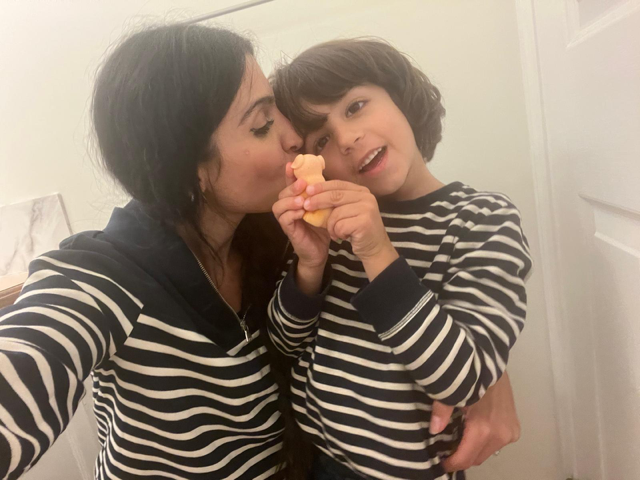
The fluorescent lights of a hospital corridor have a specific hum. It is a low, persistent vibration that sounds like the mechanical breathing of a system designed to save lives, yet for those caught in the gears of bureaucracy, that sound starts to mimic a countdown. For nine-year-old Carter Lawrence and his parents, that hum has become the soundtrack to a slow-motion catastrophe.
Carter isn’t a statistic. He isn’t a "case file" or a "funding request." He is a boy who likes LEGO and dreams of a future that his own body is trying to steal from him. He suffers from a rare, aggressive form of cancer—neuroblastoma. It is the kind of predator that doesn’t just attack; it hides, lingers, and returns with a vengeance.
His parents, Shari and Daryl, have spent the last few years living in a state of hyper-vigilance that most of us couldn't endure for a week. They have watched their son endure rounds of chemotherapy that would level a grown man. They have sat by his bed through surgeries and radiation, counting every breath, praying for a reprieve that the standard Canadian medical system seems unable to guarantee.
Then came the hope. It wasn't found in a local clinic or a Vancouver specialist’s office. It was found across the Atlantic, in Germany.
The Invisible Wall
There is a specific treatment in Greifswald, Germany, known as the bivalent vaccine. It isn’t a miracle cure, but for children like Carter, it is the closest thing to a shield. It is designed to train the immune system to recognize and destroy neuroblastoma cells before they can form a new tumor. In the world of pediatric oncology, this is the frontier. It is where science meets the desperate will to live.
The cost for this chance? $300,000.
In a country that prides itself on universal healthcare, you might assume that a child’s life would be worth the investment. You might think that the Ministry of Health would see a boy standing on the edge of a precipice and reach out a hand. But the Lawrences discovered that the "universal" in our healthcare system has a very rigid boundary.
When they applied for out-of-province funding, the answer wasn't a sympathetic "we're trying." It was a cold, bureaucratic "no." The reason cited was as dry as bone: the treatment is considered experimental. Because it hasn't passed through the specific, decade-long gauntlet of Canadian clinical trials, the provincial government views it as a luxury rather than a necessity.
Imagine standing in a burning building. You see a fire exit, but a man in a suit blocks your path. He tells you that while the exit exists, the handle hasn't been officially "safety-rated" by his specific department yet. He suggests you stay in the room and wait for the official department-approved water buckets to arrive, even as the floor turns to ash beneath your feet.
That is the reality for the Lawrence family.
The Weight of a Signature
We often talk about "the system" as if it’s a weather pattern—something vast and impersonal that just happens to us. But the system is made of people. It is made of committees that meet in boardrooms with ergonomic chairs and catered lunches. They look at spreadsheets where a child’s life is represented by a line item.
The BC Ministry of Health operates on a framework of evidence-based medicine. On paper, this makes sense. We don't want public funds spent on snake oil or unproven rituals. But when the "evidence" is being gathered in world-class German facilities, and when children who receive this treatment are showing survival rates that dwarf the standard of care, the word "experimental" starts to feel like a legal shield used to protect a budget.
Consider the logic of the denial. The government argued that since the treatment isn't available in Canada, they shouldn't have to pay for it elsewhere. This creates a terrifying Catch-22. If a treatment is too new to be here, you can’t have it. By the time it is "proven" enough to be here, it might be ten years too late for the child who needs it today.
Carter doesn't have ten years. He doesn't even have ten months to wait for a policy review.
The Community as a Safety Net
When the government pulled the ladder up, the community of B.C. tried to build a new one. This is the heart-wrenching beauty of the story—and its deepest tragedy. Within days of the news breaking that the funding was denied, neighbors, strangers, and people from across the country began to chip in. GoFundMe pages blossomed. People held bake sales and bottle drives.
They raised over $200,000.
It is an incredible testament to human empathy. But why is it necessary? Why is a family that is already battling the physical and emotional exhaustion of terminal illness forced to become professional fundraisers? Why is a father, who should be focused on holding his son’s hand during a blood transfusion, instead staring at a laptop, tracking donations and wondering if they’ll hit the mark before the next flight to Frankfurt?
There is a psychological toll to this kind of "crowdfunded survival." It sends a message that your life is only worth saving if you can market your misery well enough to strangers. It turns medical necessity into a popularity contest.
The Global Gap
Canada often looks south to the United States and scoffs at their medical system, where people go bankrupt over insulin or broken legs. We pat ourselves on the back for our "free" care. But the Lawrence case exposes the cracks in our own pedestal. In the U.S., while the costs are predatory, the speed of innovation and the access to "experimental" trials are often much faster for those with insurance. In Germany, the integration of research and clinical practice is more fluid.
Canada sits in a strange middle ground. We have the high taxes of a social safety net, but when a case falls outside the average, the net is full of holes. We are excellent at treating the common. We are failing the exceptional.
The Ministry’s refusal isn't just about $300,000. It’s about precedent. If they pay for Carter, they have to pay for the next child. And the one after that. They are terrified of the "floodgates." But when did we decide that the floodgates of saving children’s lives were something to be feared?
A House Made of Paper
Shari Lawrence described the feeling of the denial as being "defeated and devastated." Those aren't just words. They are physical states. Defeat is the heaviness in the limbs when you realize the people who are supposed to protect your family have turned their backs. Devastation is the sight of your son playing with his toys, unaware that his survival is being debated by people who have never met him.
Metaphorically, the Lawrence family has been told to live in a house made of paper during a hurricane. Every time they try to reinforce the walls with something stronger—something from Germany, something innovative—the authorities tell them that the new material isn't "code-compliant" and force them to take it down.
We are watching a collision between the rigid speed of law and the lightning speed of a mutation.
The facts are these: The treatment exists. The doctors in Germany are ready. The child is fighting. The only thing standing in the way is a signature on a piece of government letterhead.
The Cost of Doing Nothing
There is a hidden cost to these denials that never shows up on a provincial audit. It is the erosion of trust. When a citizen sees a family like the Lawrences abandoned, they stop seeing the government as a collective agreement for mutual care. They start seeing it as an obstacle.
If the "system" won't save a nine-year-old with cancer, what is it actually for?
We spend billions on infrastructure, on pipelines, on consultants, and on rebranded government slogans. Yet, $300,000 for a child’s life is treated as an insurmountable fiscal hurdle. It is a choice. It is always a choice.
Daryl and Shari haven't given up. They can't. They are currently navigating the logistics of a trip that shouldn't be this hard. They are packing bags for a journey fueled by the spare change of kind strangers because the "best healthcare system in the world" decided their son wasn't a high-priority investment.
The hum of the hospital lights continues. In Germany, the doctors are preparing the vials. In British Columbia, a boy is waiting to see if his country thinks he is worth the flight.
The silence from the Ministry of Health isn't just a lack of funding. It is the sound of a system that has forgotten how to be human.
Carter Lawrence is still smiling in his photos. He is still fighting. He is still here. For now.
We measure a society not by how it treats the healthy and the productive, but by how far it is willing to go to catch the ones who are falling. Right now, Carter is mid-air. The net is lying on the ground, folded neatly in a government office, waiting for more "evidence" before it’s allowed to be unfurled.