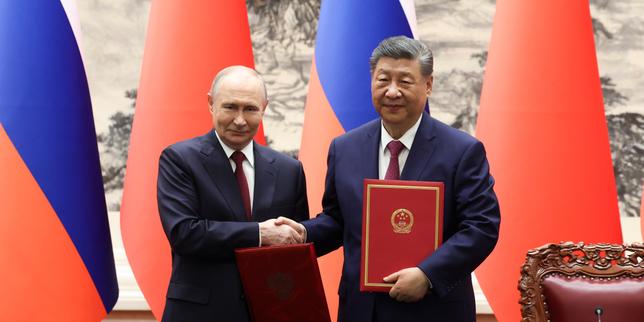
The carefully choreographed pageantry at the Great Hall of the People in Beijing broadcasts a clear message of defiance to the West. When Xi Jinping and Vladimir Putin signed their sprawling 47-page joint declaration on a multipolar world order, the performance was designed to project an unshakeable, permanent alignment.
Beneath the diplomatic theater lies a far more transactional reality. China is systematically extracting steep economic and strategic concessions from a cornered Russia, converting Moscow's diplomatic isolation into raw geopolitical leverage for Beijing. The "no limits" partnership has very real limits, and they are drawn entirely by the People's Bank of China and the state planners of the Communist Party.
The High Cost of Beijing's Lifeline
The official trade data looks triumphant. Bilateral trade hit a historic peak of $244 billion, turning China into Russia’s undisputed economic oxygen supply. Look closer at the ledger and the cracks become visible. The trade boom has flattened out.
Moscow's leverage in energy negotiations is deteriorating rapidly. While Russian oil exports to China jumped 35% in early 2026, this volume comes at a painful cost. Beijing demands steep, below-market discounts, taking full advantage of the fact that European markets remain firmly shut to the Kremlin.
The ultimate symbol of this asymmetric power dynamic is the Power of Siberia 2 gas pipeline.
The project remains frozen. Putin needs this pipeline to replace lost European revenue, but Xi is in no hurry to sign. Beijing is holding out for gas prices that mimic Russia's heavily subsidized domestic market rates, alongside demands that China only purchase limited, flexible volumes. It is a masterclass in predatory diplomacy. Beijing knows Moscow has nowhere else to turn.
The Silent Financial Retreat
For all the rhetoric about bypassing Western financial hegemony and moving 99% of bilateral settlements to the yuan and ruble, the financial architecture supporting this alliance is quietly fracturing under the weight of Western pressure.
Throughout late 2025 and early 2026, the threat of US and European secondary sanctions fundamentally altered how Chinese banks handle Russian capital. Major Chinese state-owned lenders, including the Industrial & Commercial Bank of China and the Bank of China, have aggressively tightened restrictions on financing Russian clients.
A quiet banking exodus has crippled small and medium-sized Russian businesses:
- The Last Channels Close: In mid-2025, regional institutions like Heihe Rural Commercial Bank and Suifenhe Rural Commercial Bank became the final lifelines for Russian businesses locked out of the global financial system.
- The Sanctions Hammer: By August 2025, the European Union slapped these specific regional banks with severe penalties for facilitating crypto-asset services and bypassing anti-Russian measures.
- The Resulting Freeze: Both banks abruptly stopped accepting payments from Russia, citing internal infrastructure adjustments.
The reality on the ground is that Russian entities cannot easily raise cheap capital in China. Plans to float ruble- and yuan-denominated bonds in China’s domestic debt market have collapsed. Local investors simply refuse to risk their access to the global financial system for the sake of the Kremlin's war chest.
Moscow's Protectionist Pushback
The imbalance has become so acute that Russia is actively trying to protect its remaining domestic industries from being entirely swallowed by Chinese capital. This creates an unspoken but intense point of friction between the two capitals.
Consider the automotive industry. Following the exit of Western automakers, Chinese brands captured over half of the Russian car market. The Kremlin quickly realized it was trading dependency on Europe for total dependency on Beijing.
Russian Import Tariffs on Chinese Cars (2025-2026)
--------------------------------------------------
Before 2025: Standard baseline rates
After 2025:  Raised sharply to 38%
Result:      Chinese car imports fell 52% in H1 2025
This massive tariff hike, which hit up to 85% for certain vehicle categories, sent shockwaves through Chinese manufacturing hubs. It was a blunt protectionist maneuver by a Russian government desperate to save its domestic manufacturing base and halt the bleeding of consumer purchasing power. Combined with the Russian Central Bank's aggressive interest rate environment, the booming export market for Chinese consumer goods has suddenly chilled.
The Dual Heartland Myth
Geopolitical theorists aligned with the Kremlin like to talk about a dual heartland, imagining a balanced partnership where Russia manages Eurasian security while China handles global economic expansion.
Beijing does not see Russia as an equal partner in a dual heartland. It views Russia as a highly useful, heavily armed buffer state that absorbs Western diplomatic energy and military focus.
By welcoming Putin just days after hosting a high-profile visit from US leaders, Xi Jinping demonstrated his true strategic intent. The sequencing was deliberate. It signaled to the world that China is the true independent superpower, capable of balancing relations with Washington while simultaneously keeping the Russian president on a short, profitable leash.
The joint declaration's warnings against a return to the "law of the jungle" are aimed squarely at American dominance, but they also serve as a reminder of the realpolitik governing the Eurasian continent. In this jungle, the bear is wounded, and the dragon is setting the terms of survival.