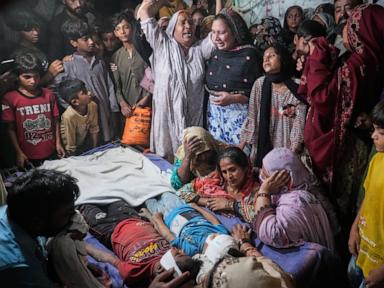
The afternoon heat in eastern Pakistan does not just sit; it presses. It weighs down on the heavy green fields of the Punjab, turns the open-air markets into slow-motion blurs of dust, and bakes the brick buildings until they radiate heat long after the sun dips below the horizon. On a Tuesday just like any other, forty children crammed into a small, makeshift tutoring center to escape that heat and chase something better. They brought worn notebooks, pencils sharpened down to the stubs, and the fierce, quiet ambition that belongs uniquely to families who view education not as a chore, but as a lifeline.
Then, the ceiling fell.
It did not creak. It did not give a warning groan that might have allowed a quick-witted teacher to scramble the children toward the doorway. Structural failures in unreinforced brick and poorly mixed concrete do not negotiate. Gravity collected its debt all at once. In a single, deafening roar, tonnes of mortar, iron rods, and baked earth came crashing down into the classroom, erasing the voices, the books, and the futures of at least fourteen children in less than three seconds.
When the dust settled, the silence was louder than the collapse.
The Anatomy of an Avoidable Disaster
To understand why fourteen children died while trying to learn fractions, you have to look closely at the physical environment of communities experiencing rapid, unregulated growth. This was not an act of God. It was a failure of engineering, oversight, and basic human responsibility.
In many towns across the region, demand for education vastly outstrips the capacity of state-funded schools. Private tutoring centers—often called academies—fill the gap. They set up shop anywhere they can find a roof and four walls. Sometimes it is a rented storefront. Sometimes it is an upper floor hastily built on top of a residential home that was never engineered to hold the weight of an upper floor.
Consider the mechanics of a standard building in these locales. Builders frequently use a traditional mix of brick and lime mortar, or low-grade cement stretched thin with too much sand to save money. The steel reinforcement bars, meant to give concrete its tensile strength, are sometimes spaced too far apart or omitted entirely from critical load-bearing joints.
Over time, water seeps into the roof from the monsoon rains. The moisture sits, unseen, slowly rusting the iron supports from the inside out. The weight increases. The strength decreases. The building becomes a trap door waiting for the right amount of vibration or atmospheric pressure to spring open.
On that Tuesday, the weight of the roof simply overcame the ability of the decaying walls to hold it up. The sheer physics of the event meant that those underneath stood almost no chance. Concrete blocks falling from a height of ten feet strike with the force of a moving vehicle. For a child's fragile frame, the impact is absolute.
Beyond the Numbers on the Screen
When the international wire services picked up the story, it was reduced to a sterile headline. A body count. A location. A quote from a local police official confirming the statistics.
But a statistic cannot capture the smell of jasmine mixed with pulverized concrete that hung over the rescue site. It cannot replicate the sound of bare hands scraping against jagged stone as parents, neighbors, and first responders dug through the rubble, desperate for the sound of a cough or a whimper.
Let us look at what was actually lost under that debris.
There is a specific kind of sacrifice made by working-class families in Pakistan to send their children to these tutoring centers. The fees might seem trivial in Western currency—perhaps a few hundred rupees a month—but to a laborer earning daily wages, that money represents skipped meals or delayed medical care. Parents willingly pay it because they believe they are buying their children a ticket out of generational poverty. They are buying them a future where their hands are stained with ink rather than calloused by fields or brick kilns.
When a child goes to school, they carry the hope of an entire household on their shoulders. When that child does not come home, the collapse does not just destroy a building; it flattens the entire trajectory of a family. The notebooks recovered from the scene, torn and covered in grey dust, contained neat handwriting, carefully practiced English verbs, and mathematics homework that would never be graded. These are the artifacts of a promise broken by structural neglect.
The Hidden Pattern of the Collapse
This tragedy belongs to a much larger, global pattern of infrastructure failure that rarely receives sustained attention until the body count reaches double digits. Across developing economies, urban migration and population booms have created an insatiable demand for physical structures, leading to a dangerous phenomenon: the normalization of shortcuts.
Building codes exist on paper. In practice, enforcement is a luxury that local municipalities rarely have the resources or the political will to provide. Inspectors are few, the territory is vast, and the pressure to build quickly and cheaply is immense.
Think of a building as a financial ledger. Every bag of cement saved, every cheaper grade of steel substituted, and every extra floor added without strengthening the foundation represents pure profit for a negligent contractor. But that profit is borrowed against human lives. The building functions perfectly well for a year, five years, maybe a decade, masking the deficit. Then, the ledger balances itself out in an instant of catastrophic failure.
The problem lies in how society views these structures. A school or a tutoring center should be a sanctuary. It is a space where children are explicitly told to trust the adults in charge. When society fails to secure the literal roof over their heads, it violates the most fundamental social contract that exists between generations.
The Mechanics of the Aftermath
What happens after the dust settles and the cameras leave is a predictable, agonizing cycle.
First comes the grief, sharp and public. Funerals are held in rapid succession, the small wooden coffins carried through narrow streets lined with weeping neighbors. The community demands answers.
Next comes the political theater. High-ranking officials issue statements of condolence. They promise swift investigations and transparent reports. They announce financial compensation for the families of the victims—a grim calculation that attempts to put a monetary value on a vanished life.
Then, police arrest a landlord or a low-level contractor. The public anger is directed at a single villain.
But the real problem lies elsewhere, rooted deeply in the systemic lack of routine structural audits. Arresting the man who rented out the room does not fix the thousands of other compromised buildings currently operating as schools, clinics, and apartments across the country. It does not change the fact that tomorrow morning, millions of children will walk into classrooms that have never been inspected by a structural engineer.
To prevent the next collapse, the approach to public safety must shift entirely from reactionary outrage to systemic prevention.
Consider what happens next if a nation decides to change this narrative. It requires a massive, unglamorous effort to catalog and inspect every commercial and educational structure in rapidly growing towns. It means training local mechanics and builders in basic structural safety principles. It means establishing clear, unbribable channels for reporting structural cracks and sagging ceilings before they give way.
The Long Shadow
The true cost of the disaster in eastern Pakistan will not be fully realized this week, or even this year. It will be felt decades from now, in the quiet spaces of the homes that were emptied on a hot Tuesday afternoon.
It will be felt by the surviving children who walked out of that rubble with physical scars and an enduring terror of enclosed spaces, wondering why the ceiling above them should be trusted to stay where it belongs.
We are left with an image that refuses to fade: a rescue worker sitting on a pile of broken concrete, holding a blue plastic pencil case covered in white dust. Inside, the pencils are still whole, ready to write. The child who owned them is gone, a casualty not of war or disease, but of a world that failed to ensure that a place of learning was, above all else, safe.


