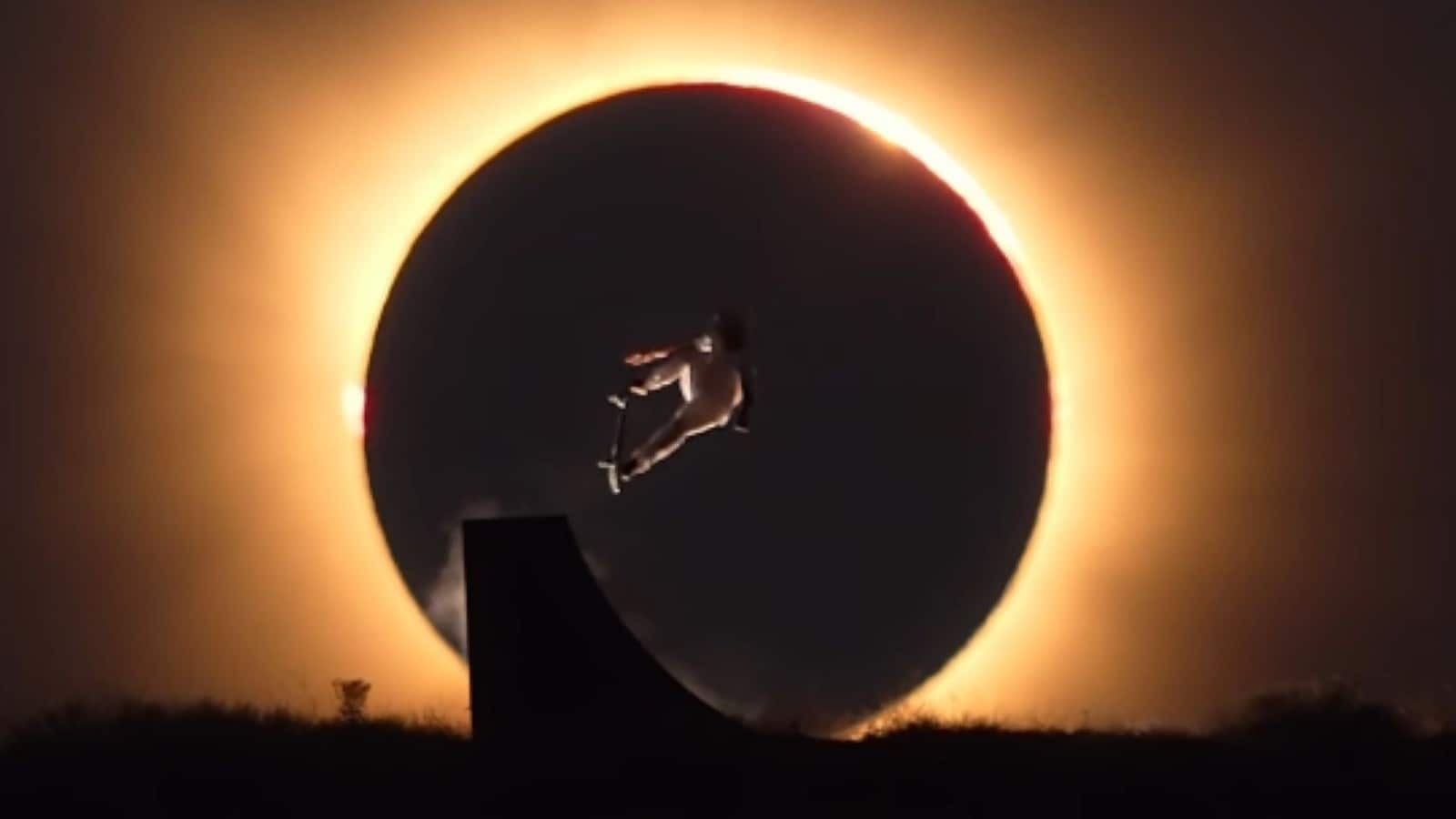
Capturing a transient astronomical phenomenon while tracking an independent, high-velocity human trajectory represents a severe constraint satisfaction problem. When a skateboarder executes a mid-air maneuver precisely during a total solar eclipse, observers frequently attribute the result to luck or artistic intuition. This perspective mistakes variance for methodology. Producing such an image requires controlling spatial positioning, temporal synchronization, and optical variables within margins measured in fractions of a second and millimeters of arc.
Achieving this level of coordination demands breaking down the event into distinct physical variables. The intersection of celestial mechanics, human kinetic output, and photographic framing exposes the exact mechanics behind rare visual captures. For another perspective, consider: this related article.
The Temporal Constraint Matrix
A total solar eclipse operates on an immutable celestial timeline dictated by orbital mechanics. Totality lasts for a strictly bounded duration depending on geographic coordinates, typically ranging from seconds to a few minutes. Within this narrow window, the subject must occupy a specific point in three-dimensional space to satisfy the compositional geometry of the frame.
The temporal error margin for the trick execution is exceptionally tight. A skateboarder launching from a ramp or obstacle remains airborne for a predictable duration governed by the physics of projectile motion. Further coverage on the subject has been published by Bleacher Report.
$$t = \frac{2v_y}{g}$$
Where $v_y$ represents the initial vertical velocity and $g$ is the acceleration due to gravity. For a standard transition air reaching an apex of two meters, total hang time hovers near 1.2 seconds.
The photographer and skater must synchronize their operations so that the apex of this vertical trajectory aligns with the exact midpoint of totality. A variance of three tenths of a second results in the subject appearing either pre-apex against an un-eclipsed sky or post-apex during the rapid return of direct solar radiation. Because the celestial clock cannot be paused or adjusted to match athlete error, the human element must adapt to absolute planetary timing.
Spatial Positioning and Parallax Error
Positioning the camera relative to the skater and the sun introduces severe geometric constraints. The composition relies on scale manipulation, placing the human silhouette directly across the solar disc. This requires precise alignment along a single optical vector.
Parallax error creates significant complications when multiple observers or cameras are involved. If the camera shifts by even a few centimeters relative to the skater's takeoff point, the relative position of the sun shifts entirely out of alignment due to the extreme distance of the celestial body.
[Sun at 150M km]
       |
       | (Optical Vector)
       v
[Camera Lens] ---> [Skater at Apex] ---> [Ramp/Obstacle]
To maintain this vector, the photographer must establish a fixed station point and utilize high focal length compression, stepping back while magnifying the subject. This technique compresses the background celestial field, making the sun appear vastly larger relative to the foreground athlete than it would to the naked eye. The operational challenge lies in the skater's approach vector. A deviation of five degrees in the skater's takeoff trajectory moves them entirely out of the optical axis, rendering the silhouette misaligned with the corona.
Kinetic Energy and Execution Variance
Skaters do not execute tricks with mechanical consistency. Muscle fatigue, surface friction, and minor shifts in weight distribution introduce variance into every maneuver.
When attempting a trick designed for visual alignment with a celestial event, the athlete faces a high failure rate. Complex flips or rotations introduce rotational blur or unpredictable limb placement, which can obscure the clean lines required for a striking silhouette. Selecting a simpler, highly controlled trick—such as a standard ollie, grab, or air—minimizes rotational variables and maximizes profile clarity against the solar backdrop.
The kinetic energy expenditure must be precisely calibrated to the ramp radius and transition angle. If the skater generates too much velocity, they clear the optimal framing zone. Too little velocity results in an insufficient apex height, placing the skater below the horizon line or outside the focal plane of the telephoto lens.
Optical and Environmental Variables
Environmental factors during a total solar eclipse introduce sudden operational hazards for imaging equipment. The rapid drop in ambient temperature causes immediate changes in air density and can induce dew formation on optical glass surfaces.
Simultaneously, the camera sensor faces a wide dynamic range challenge. The solar corona exhibits extreme brightness variations, while the silhouetted skateboarder presents zero internal illumination.
- Exposure Bracketing Limitations: High-speed shutter settings are mandatory to freeze the motion of a skateboarder traveling at several meters per second, yet fast shutters restrict the light gathering needed to capture the faint wisps of the solar corona.
- Focus Acquisition Failure: Autofocus systems rely on contrast detection. During totality, ambient light drops to levels resembling deep twilight, causing phase-detection and contrast-detection algorithms to hunt, potentially failing to lock focus on a fast-moving human subject. Manual pre-focusing on a fixed spatial coordinate is the only viable countermeasure.
Operational Redundancy and Risk Management
To mitigate the high probability of failure inherent in single-attempt phenomena, production teams rely on system redundancy. Because a total solar eclipse cannot be reshot, the workflow must account for equipment failure, misfires, and human error.
Multiple camera bodies configured with different focal lengths hedge against framing errors. Remote triggers operated by the skater or automated via motion sensors eliminate human reaction time delays between the photographer and the athlete. However, automation introduces vulnerability to mechanical or wireless interference.
Execution demands treating the environment as a closed, predictable system while acknowledging that biological timing contains irreducible variance. The intersection of sports photography and astronomy leaves zero room for recovery once the shadow passes. Success stems from treating the stunt not as a spontaneous artistic expression, but as a rigidly engineered choreography where every variable—from gravitational pull to focal length—is calculated, tested, and executed under strict tolerances.
.jpg?width=1200&auto=webp&trim=0%2C100%2C0%2C100)