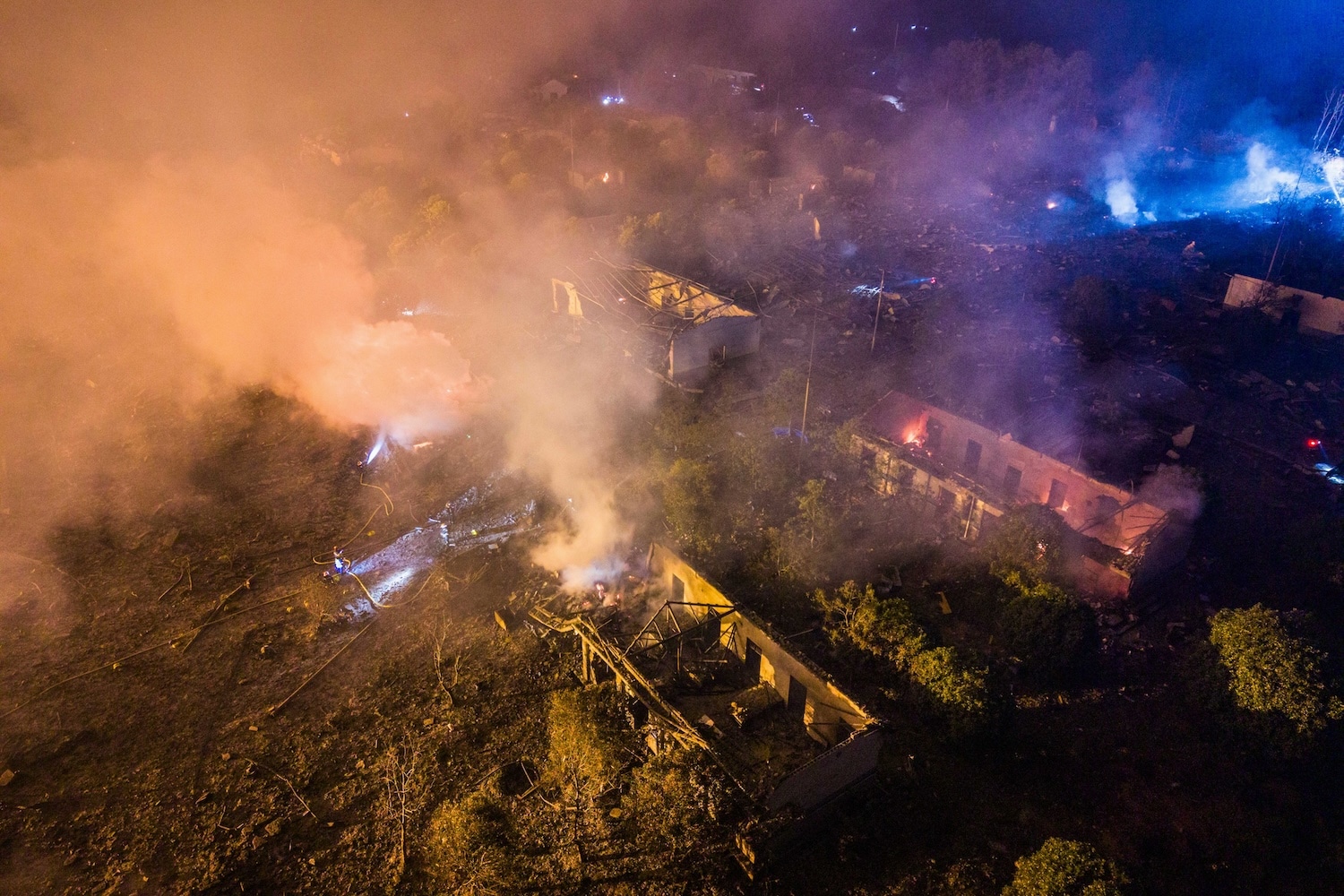
The air in the Jiangxi province usually tastes of damp earth and woodsmoke. It is a quiet, industrious humidity. In the town of Shangli, that stillness is the baseline of existence, the steady rhythm of a community that builds its life around the very thing meant to celebrate it: light. But light, when contained in cardboard tubes and packed with potassium perchlorate, has a terrifying weight.
It happened at 11 a.m. on a Tuesday.
The morning shift was well underway at the fireworks plant. Imagine a worker—let’s call him Chen—moving through the cooling shadows of the factory floor. He isn't thinking about the chemical volatility of his cargo. He is thinking about his daughter's school fees or the heat of the midday sun. For Chen and his colleagues, the danger isn't a theory; it’s the wallpaper of their lives. They live in the tension between a paycheck and a powder keg.
Then, the world tore open.
A series of explosions ripped through the facility, a violent staccato that turned a place of employment into a kiln. The first blast likely felt like a physical blow to the chest, a wall of displaced air that moved faster than sound. It wasn't just noise. It was a transformation of matter. Metal beams twisted like wet paper. Concrete shattered into shrapnel. In a heartbeat, the vibrant reds and golds of ceremonial pyrotechnics were replaced by the blinding white of an uncontrolled chemical fire.
The Anatomy of a Disaster
Twenty-one people did not go home that evening.
That number is a statistic in a news ticker, but in Shangli, it is twenty-one empty chairs at dinner tables. It is sixty-one others lying in hospital beds, their skin mapped by burns and their lungs scarred by the inhalation of toxic particulates. When a fireworks plant goes up, it doesn't just burn. It erupts. The fire feeds on its own oxygen supply, creating a self-sustaining hell that resists the standard efforts of those trying to douse it.
The scale of the response tells the story of the chaos. Five hundred rescuers descended on the site. Think about that headcount. Five hundred sets of boots marching into a landscape where the ground is still hot and the air is thick with the scent of sulfur and burnt plastic. Firefighters, medics, and heavy machinery operators worked through the debris, not just fighting flames, but navigating a minefield. In a fireworks disaster, the danger persists long after the initial blast. Unexploded canisters hide beneath the rubble, sensitive to heat, friction, or even the weight of a rescuer’s step.
The Invisible Stakes of Celebration
We see fireworks as the punctuation marks of our happiest memories. They are the climax of a wedding, the heartbeat of New Year’s Eve, the shimmering canopy of a national holiday. We rarely look at the supply chain of joy.
China produces the vast majority of the world's pyrotechnics. It is an industry rooted in ancient tradition, dating back to the Han Dynasty, where bamboo stalks were thrown into fires to ward off evil spirits. Over centuries, that spiritual practice evolved into a global economic powerhouse. But the chemistry remains unforgiving. To get those brilliant blues and deep crimsons, you need copper compounds and strontium. To get the lift, you need black powder.
The pressure to produce is relentless. Safety regulations exist, written in the ink of previous tragedies, but the reality of the factory floor is often a different story. When global demand spikes, corners can be rounded. A stray spark, a dropped tool, or even static electricity from a polyester shirt can be enough to trigger a chain reaction.
Consider the physics of the blast. An explosion is essentially a rapid expansion of gases. In the confined spaces of a manufacturing plant, that expansion has nowhere to go but out, through walls and ceilings. The 61 injured survivors didn't just suffer from burns; they suffered from the kinetic energy of the blast. Eardrums ruptured. Lungs collapsed under the pressure wave. The "minor injuries" reported in official tallies often mask a lifetime of chronic pain and psychological trauma.
The Aftermath in the Soil
Beyond the immediate human toll, there is a lingering shadow. A blast of this magnitude releases a cocktail of heavy metals into the local environment. Lead, barium, and chromium settle into the dust and wash into the local water tables. While the five hundred rescuers cleared the physical wreckage, the chemical wreckage remains, invisible and persistent.
The town of Shangli now faces a long, silent reckoning. The factory was likely a primary employer, a source of stability in a rural economy. Now, it is a graveyard and a liability. The community must balance their grief with the terrifying reality of lost livelihoods. How do you return to work in an industry that just claimed the lives of your neighbors?
The investigation will eventually point to a cause. Perhaps it was faulty storage. Maybe it was a mechanical failure in the mixing room. A high-ranking official will issue a statement about "resolute measures" and "strict oversight." New inspections will be ordered across the province.
But for the families of the twenty-one, the "why" matters less than the "who."
They remember the person who liked their tea extra strong, the one who always whistled while walking to the gates, the one who was planning to retire in the spring. Those details are the first things lost in a dry news report, yet they are the only things that truly matter.
The sky over Jiangxi is clear now. The smoke has dissipated, carried away by the wind toward the mountains. The five hundred rescuers have largely packed their gear and moved on to the next emergency. What remains is a jagged hole in the earth and an even deeper one in the heart of a small town.
We look at the stars and see light. They look at the sky and remember the day the light turned against them.