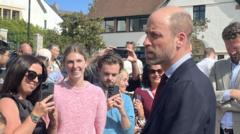
When Prince William showed up in Cornwall this week to tour a newly built suburb, the cameras captured exactly what you'd expect. There were handshakes on a pristine new high street, conversations with local business owners, and plenty of praise for a 24-bed development designed to tackle homelessness. It looks like a perfect royal photo opportunity.
But if you look closer, this trip isn't just about a royal checking in on his real estate. It's actually a fascinating, somewhat messy experiment in modern land ownership, extreme wealth, and a local housing market that is completely broken.
The site of his visit was Nansledan. It's an urban extension of Newquay, sitting on land owned by the Duchy of Cornwall. The Duchy is a massive, historic estate valued at over £1 billion that funds the heir to the throne. For decades, the estate functioned essentially as a traditional, high-end landlord. Now, under William, it's trying to pivot into a socially conscious developer.
But can a medieval estate actually solve a modern housing crisis? Or is it all just brilliant PR?
The answer lies somewhere in the middle. To really understand what happened during the Prince's visit to Nansledan, you have to look past the official press releases and dive into the economics of the region.
The Reality of Nansledan and the New High Street
Nansledan doesn't look like your typical British housing estate. It features pastel-colored cottages, slate roofs, and narrow, pedestrian-friendly streets designed under strict architectural codes. It was originally championed by King Charles when he ran the Duchy, built on the philosophy of New Urbanism. The idea is simple: build communities where people can walk to work, buy their groceries, and send their kids to school without relying on cars.
During his visit on May 21, 2026, Prince William toured Market Street, a brand-new high street within the suburb that won't be fully completed until 2028. The goal here is to provide affordable commercial spaces for local artisans and independent shops.
Right now, Nansledan has roughly 900 homes, a primary school, and about 40 local businesses. The Prince also spent time walking through the development's first Build-to-Rent properties, chatting with early residents like Nick and Jess Dunsten to see how the neighborhood actually functions for normal families.
On paper, it sounds idyllic. But Cornwall has a deep, painful housing problem, and Nansledan sits right at the center of the debate.
The Homelessness Project Versus a Massive Waiting List
The real focus of William’s visit was a pioneering temporary housing project built in partnership with Cornish charity St Petrocs. Back in early 2024, the Prince announced the Homewards initiative, pledging £3 million to build 24 low-carbon, high-quality homes to give local homeless people a dignified place to live with wrap-around support.
William checked on the progress of these specific homes, which are nearing completion and should welcome their first residents this summer. Local residents like Max Hedges, who has been supported by St Petrocs, openly praised the initiative, noting that having a stable place to live changes everything for someone trying to get back on their feet.
But while the project is genuinely life-changing for the 24 people who will move in, local activists aren't entirely thrilled. When the project was first announced, Cornish councillors pointed out that there are over 23,000 people on the waiting list for council housing in Cornwall. Critics like former Home Office minister Norman Baker have openly labeled the estate a "royal fruit machine," arguing that building a few dozen homes is a drop in the ocean when the wider local population is priced out of their own hometowns by holiday rentals and second-home buyers.
The Five Hundred Million Pound Strategy
What makes this specific visit different from past royal tours is the massive financial shift happening behind the scenes. Just days before arriving in Cornwall, the Duchy announced a major policy change: William plans to sell off 20% of the Duchy of Cornwall’s historic property portfolio over the next ten years.
This massive sell-off is expected to raise roughly £500 million. The money won't go into the royal bank accounts. Instead, the estate claims it will be entirely reinvested into community projects across five key regions, including Cornwall, Dartmoor, and parts of London.
The cash breakdown tells you exactly where the estate is placing its bets:
- £161 million earmarked strictly for affordable housing.
- £123 million dedicated to local workplaces and rural employment.
- £20 million for environmental restoration, including peatland recovery and biodiversity.
The goal is to build 12,000 new homes by 2040, with about a third of them locked in at affordable price points. It's an aggressive move for an organization that historically focused on preservation and steady rental income.
The Moving Parts of Local Skepticism
If you talk to people living in Newquay or the wider Cornwall area, you quickly realize opinion is split.
On one hand, the Duchy is using its own land and its own money to build high-standard, energy-efficient housing. The homes feature incredible insulation, rooftop solar panels, and connection to local car-share schemes. They aren't throwing up cheap, ugly towers; they're building things meant to last.
On the other hand, the Duchy remains a private estate that paid Prince William an income of over £20 million last year. When the estate builds more housing, it creates more tenants, which ultimately secures more long-term income for the Duchy. Skeptics argue that if the royal family truly wants to fix the housing crisis, they should offer the land to local councils at cost, rather than managing the developments themselves.
There's also the reality that Cornwall's economy is seasonal. People need well-paying, steady jobs just as much as they need four walls and a roof. While Nansledan's Market Street aims to fix this by creating space for local businesses, it takes years for these economies to mature.
What Happens Next
If you are following the evolution of the British monarchy or just interested in how large landowners can impact local communities, watch what happens next in Nansledan over the next twelve months.
Look out for the opening of the St Petrocs homelessness facility this summer. Pay attention to how quickly those 24 beds are filled and whether the wrap-around support services actually help residents transition into permanent independent living.
Keep an eye on the upcoming community engagement events hosted by the Duchy this autumn. This is where locals get to voice their concerns about infrastructure, school capacities, and whether the incoming "affordable" homes are actually affordable for people earning local Cornish wages.
The glossy royal photos tell one story, but the true success of William's Cornish experiment will be measured by whether local families can actually afford to live in the communities he is building.

