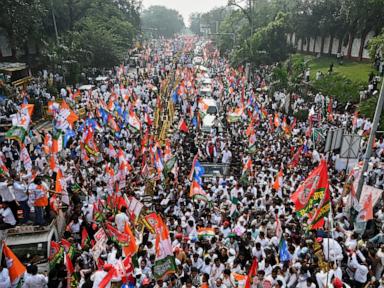
Tens of thousands of protesters flooded New Delhi's Ramlila Maidan on November 1, 2026, chanting for Chief Election Commissioner Gyanesh Kumar to resign and face arrest. If you only skimmed the mainstream headlines, it looks like standard partisan theater. Opposition parties lose a few rounds, cry foul, and accuse the referee of rigging the game.
That surface-level reading misses the actual story entirely.
The demonstrations shaking India's capital aren't just about sore losers or routine election-season bickering. They're the boiling point of a massive administrative exercise called the Special Intensive Revision (SIR) of electoral rolls—a nationwide voter verification drive that has stripped roughly 130 million names from India's voter lists, triggered internal dissent inside the Election Commission itself, and forced the Supreme Court of India to step in.
Why India's Opposition Parties Are Targeting the Election Chief
Let's be clear about what sparked the November 1 rally led by Rahul Gandhi and the INDIA opposition bloc. For months, anger has been building over how the Election Commission of India (ECI) executed its 2025–2026 Special Intensive Revision.
On paper, cleaning up voter rolls sounds completely reasonable. Every democracy needs to remove deceased voters, duplicate entries, and people who permanently moved away. Nobody argues with basic electoral hygiene.
The problem is how it happened in practice. Instead of routine updates, the SIR required millions of citizens to actively prove their citizenship and residency using a narrow list of approved documents. Election officials scrutinized those papers and decided whether to keep or cut voters. By September 2026, 130 million names were gone. Roughly 95 million of those deletions fell under the vague catch-all category of "absent, shifted, or others," alongside 27 million marked deceased and 10 million flagged as duplicates.
When an administrative cleanup wipes out more voters than the entire population of most countries, people notice.
Opposition leaders—including Congress party figurehead Rahul Gandhi, Mallikarjun Kharge, Mamata Banerjee, and Arvind Kejriwal—argue the purge disproportionately hit poor, marginalized, and minority voters who lack legacy paperwork. During the November 1 rally, Gandhi didn't mince words, telling the crowd in Hindi that India had faced "vote theft" for years and predicting that Gyanesh Kumar would have to step down and go to jail.
The Ramlila Maidan Shift and Heavy Surveillance
Even the location of the protest tells you how tense things have gotten in New Delhi. For decades, Jantar Mantar—a historic 18th-century observatory in central Delhi—served as the capital's default venue for political demonstrations. In October 2026, Delhi police abruptly removed Jantar Mantar from the list of officially designated protest sites after youth-led movements like the Cockroach Janta Party (CJP) and student unions staged relentless sit-ins there.
When the INDIA bloc moved its November 1 show of strength to Ramlila Maidan, authorities didn't take chances. Police and paramilitary units locked down the perimeter using more than 200 CCTV cameras, aerial drones, and body-worn cameras along the march route. By late October, over 7,000 protesters across the country had already been detained during earlier waves of anti-CEC demonstrations.
What Actually Went Wrong With the Voter Roll Revision
If you want to understand why this blew up beyond typical political mudslinging, you have to look at the mechanics of the SIR exercise. When you examine the ground reality, three specific flashpoints turned an administrative project into a national crisis.
- The West Bengal Shockwave: In West Bengal—a politically crucial state where Prime Minister Narendra Modi's Bharatiya Janata Party (BJP) has never won a state assembly election—around nine million people were initially excluded from the rolls. That's roughly 12% of the entire state electorate. Millions were flagged for "logical discrepancies" or labeled "unmapped" voters, forcing everyday citizens into bureaucratic hearings just to keep their voting rights.
- The VIP Portal Backlash: In Delhi, the purge accidentally swept up several prominent, well-connected citizens. The resulting public embarrassment prompted the Election Commission to introduce a special "VIP portal" so high-profile figures could get their names restored quickly. Nothing destroys public trust faster than creating an express lane for elites while working-class laborers wait months in appeal queues.
- Retroactive Paperwork Hurdles: Changes to online Form-6 registration rules forced applicants to declare their parents' and grandparents' standing in the previous 2002–2005 intensive revision. For migrant workers, women who changed names after marriage, or families without generational land records, digging up 20-year-old electoral proof is nearly impossible.
The clearest proof that the initial sweep cut too deep comes from the appeals data itself. According to reporting on the West Bengal and nationwide reviews, decided appeals have seen an 80% to 90% success rate. Think about what that number means. Nearly nine out of ten people who had the time, money, and legal help to challenge their deletion turned out to be completely legitimate voters. The people without those resources simply stayed off the rolls.
The Crack Inside the Election Commission Nobody Expected
Normally, the Election Commission of India presents a unified, institutional front. Even when opposition parties attack the body, the three-member commission closes ranks.
Not this time.
In late September 2026, media reports revealed serious internal friction within the commission itself. Two Election Commissioners reportedly raised formal objections regarding how Chief Election Commissioner Gyanesh Kumar was handling key decisions around the Special Intensive Revision, irregular meeting schedules, and internal work reallocation orders.
That leak changed the political math overnight.
Before those reports surfaced, the ruling BJP could easily dismiss the protests as desperate opposition propaganda. Once news broke that senior officials inside Nirvachan Sadan (the ECI headquarters) were questioning the process, civil society groups and youth activists gained massive credibility. The ECI officially responded that all major decisions regarding the SIR were taken unanimously and that internal discussions are normal. Still, the damage to public perception was done.
How the Ruling Party and Election Commission Defend the Exercise
To be fair, looking at this strictly through the opposition's lens ignores the legal and administrative arguments on the other side. Both the Election Commission and the ruling BJP have pushed back hard against the "vote theft" narrative.
First, the ECI points out that India's voter rolls genuinely suffered from severe bloat. Urban migration, duplicate registrations across state lines, and unrecorded deaths had left millions of ghost entries on the books. Chief Election Commissioner Gyanesh Kumar has repeatedly defended Booth Level Officers (BLOs) as the "foundational pillars" of Indian democracy, insisting that every verification step followed constitutional guidelines.
Second, the Supreme Court of India actually upheld the Election Commission's constitutional authority to conduct the Special Intensive Revision and verify voter eligibility in a May 2026 ruling. The court didn't declare the exercise illegal. Instead, judges stepped in to put guardrails on it—ordering the ECI to accept Aadhaar cards as valid identification, publish accessible lists of deleted names, and streamline restoration procedures.
Third, BJP leaders have accused Rahul Gandhi and the Congress party of hypocrisy and reckless institutional sabotage. Ruling party spokespeople argue that the opposition only attacks the Election Commission when it loses elections, while happily accepting victories overseen by the exact same body. They've also raised counter-allegations of voter roll irregularities in opposition-held constituencies like Rae Bareli, Wayanad, and Diamond Harbour, claiming the opposition wants to protect bloated rolls for political gain.
What Happens Next for India's Electoral System
The standoff in New Delhi isn't ending anytime soon, largely because the Election Commission has begun rolling back some of its strictest rules under judicial and street pressure. In early November 2026, the ECI allowed deleted voters in ongoing revision states to reapply using the simpler Form-8 correction process rather than starting from scratch as first-time applicants on Form-6. It also brought in independent technical panels from IIT-Bombay and IISc to review its digital management systems, even while keeping proprietary software algorithms confidential.
Whether those concessions calm the streets remains an open question. Youth organizations like the Cockroach Janta Party and major opposition parties are treating the voter roll fight as a make-or-break battle ahead of upcoming state elections.
If you're following Indian politics—or if you're an Indian citizen trying to protect your own voting rights—don't get distracted by the daily shouting matches on cable news. Watch three concrete developments over the coming weeks:
- Check your registration status directly: If you or your family live in a state that underwent the 2025–2026 Special Intensive Revision, verify your name on the official Election Commission of India portal immediately rather than waiting until polling day. If your name was dropped, use Form-8 for restoration as permitted under the November 2026 guidelines.
- Track the Supreme Court's review of the 2023 appointment law: The deeper legal battle isn't just about Gyanesh Kumar—it's about how Election Commissioners are chosen. The Supreme Court is actively examining the 2023 law that removed the Chief Justice of India from the selection panel, a ruling that will determine how independent future commissions actually are.
- Watch the appeal clearance rates in poll-bound states: Keep an eye on how fast local election offices clear pending restoration claims in states like West Bengal and Uttar Pradesh. High deletion numbers paired with slow appeal processing will tell you far more about electoral fairness than any speech at Ramlila Maidan.
For further background on the demonstrations and the timeline of events, you can review the AP News coverage of the Ramlila Maidan rally, which captures the on-ground youth mobilization and police response in New Delhi.