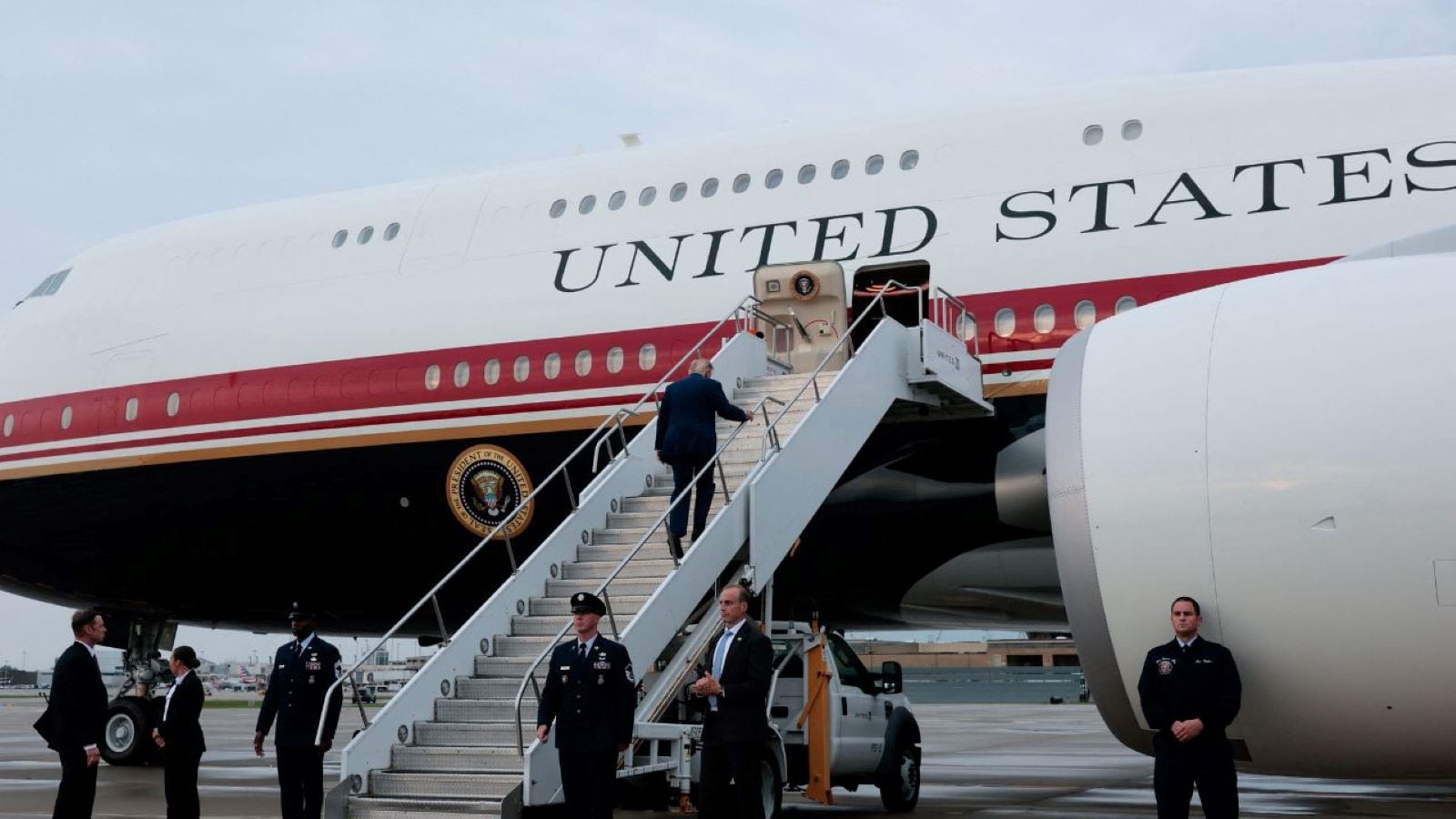
People think Air Force One is a single, bulletproof luxury jet that can outrun a missile. They picture a sleek private plane flying solo across the globe, wrapped in an impenetrable force field of high-tech defense gear.
The reality is much stranger. Learn more on a connected subject: this related article.
First off, Air Force One isn't even a specific airplane. It is simply the designated radio call sign given to any U.S. Air Force aircraft carrying the sitting president. If the president boards a tiny Gulfstream or a standard military transport, that vehicle instantly becomes Air Force One for the duration of the trip.
When people talk about the iconic blue-and-white jumbo jet, they are usually referring to one of two heavily modified Boeing 747-200B aircraft carrying the military designation VC-25A. These flying fortresses have served since 1990, and they are far more than luxury transit. They operate as floating command centers designed to keep the government running if the entire country goes dark. Further analysis by Reuters highlights related views on this issue.
The Flying White House Has 238 Miles of Wiring
You can't just slap leather seats inside a commercial airliner and call it presidential transport. The internal infrastructure of a VC-25A is mind-bogglingly complex.
The interior packs roughly 238 miles of onboard electrical wiring. That is more than double the wiring found in a standard commercial Boeing 747. Every single wire is shielded and isolated to protect against interference and sabotage.
Communication is everything during a crisis. The plane features 87 onboard telephones, multi-frequency radios, and secure computer networks that let the commander-in-chief coordinate with the Pentagon and the White House Situation Room from 35,000 feet. Three separate communication tiers handle everything from routine scheduling to encrypted top-secret intelligence traffic.
If disaster strikes on the ground, the president doesn't lose touch. They can address the nation live via secure broadcast systems or order military strikes without ever touching down.
Defensive Countermeasures That Sound Like Sci-Fi
You won't find civilian airliners equipped with military-grade electronic warfare suites, but Air Force One is an entirely different beast.
While the exact defensive specs remain heavily classified, aviation experts and official Air Force disclosures point to a robust lineup of security features. The aircraft is designed to shrug off unexpected threats using active countermeasures.
- Infrared countermeasures: Systems like the AN/ALQ-204 Matador actively disrupt incoming heat-seeking missiles by confusing their thermal tracking software.
- Chaff and flares: The plane can deploy physical decoys to trick radar-guided weapons and missile defense systems away from the fuselage.
- EMP hardening: The electronics are physically shielded against electromagnetic pulses. If a nuclear weapon detonates below, the plane's flight computers and avionics are engineered to keep running.
Beyond active defense, the plane features an unrefueled range of roughly 7,800 statute miles. If ground facilities are compromised or unsafe, it can accept fuel mid-air via a flying boom system, theoretically staying airborne indefinitely during a national emergency.
Why Replacing the Fleet Is a Multi-Billion-Dollar Nightmare
The current VC-25A jets are getting old. Maintaining decades-old airframes takes an army of specialized technicians and millions of spare parts.
Enter the VC-25B program. The U.S. Air Force has been working to replace the aging 747-200Bs with newer, more modern Boeing 747-8 airframes.
It has turned into an expensive, delayed disaster.
The project has cost Boeing billions in unexpected losses. Strict fixed-price contract rules mean the corporation eats the cost overruns, which has strained manufacturing lines and pushed delivery timelines back years. Supply chain bottlenecks, high turnover rates for workers with high-level security clearances, and intense technical requirements have all slowed progress to a crawl.
To help ease the pressure, the defense ecosystem has explored interim solutions, including adapting specialized bridge aircraft to serve until the main fleet achieves full operational capability.
Self-Sufficiency on the Tarmac
Air Force One doesn't rely on local airport infrastructure when it lands in foreign countries or remote military bases.
Commercial jumbo jets require massive external stairs, specialized baggage loaders, and local ground crews to function at a civilian terminal. Air Force One carries its own gear.
Built-in forward and aft airstairs allow the president and staff to disembark directly onto the tarmac without waiting for airport bridge connections. A self-contained baggage loader in the cargo hold handles luggage independently, keeping security tight and logistics streamlined.
Inside, two massive galleys can prepare up to 100 meals at a single sitting. There is an onboard medical suite equipped to handle surgical procedures and minor emergencies, complete with a dedicated doctor who travels on every single flight.
Air Force One is an engineering marvel born out of Cold War paranoia and modern tactical necessity. It is part luxury office, part military bunker, and part high-altitude command post, proving that when the leader of the free world takes to the skies, standard commercial aviation rules simply do not apply.