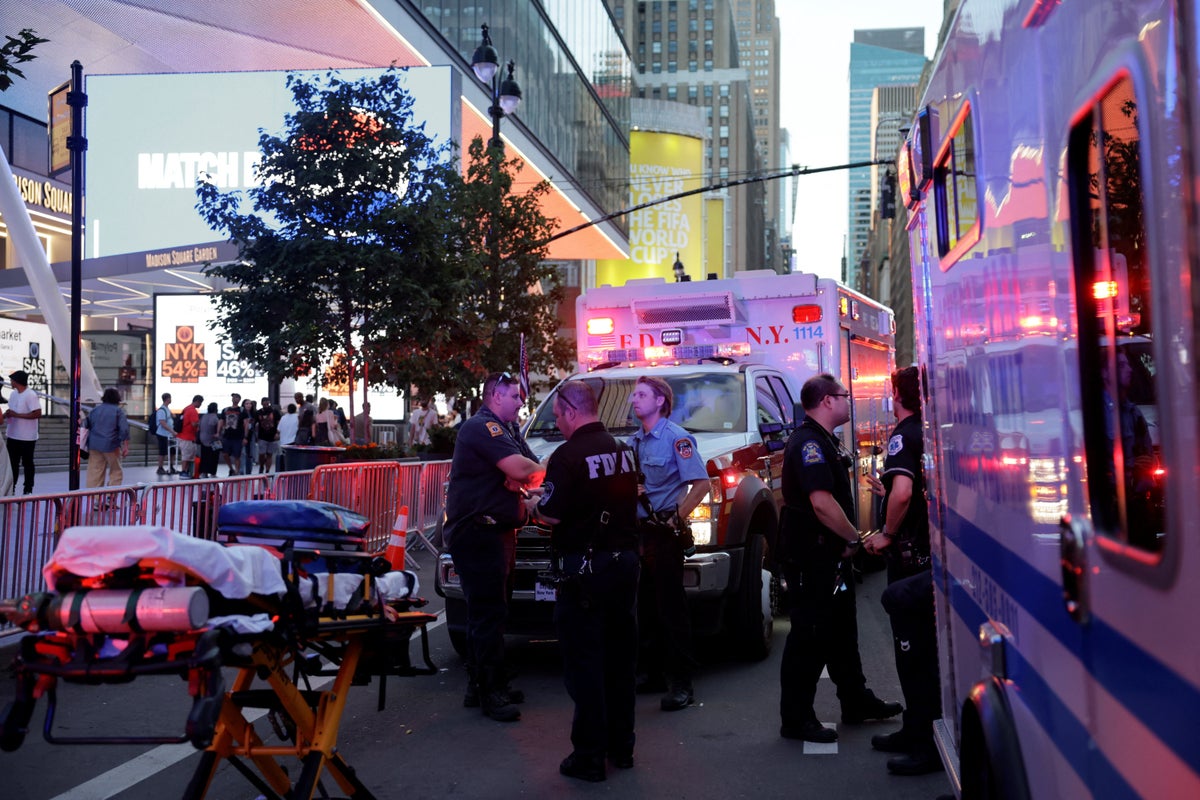
Six people bleed on the concrete floor of a transit terminal while thousands of law enforcement agents secure the arena directly above it.
On Sunday evening, an unidentified assailant armed with a knife executed a rapid, multi-victim stabbing spree inside New York’s Penn Station. The attack occurred near the Amtrak terminal by Tracks 5 and 6 at approximately 7:00 p.m., leaving five victims rushed to Bellevue Hospital and a sixth to New York-Presbyterian/Weill Cornell Medical Center. Amtrak police managed to tackle and subdue the suspect, later described as emotionally disturbed.
The incident unfolded less than twenty-four hours before Madison Square Garden, which sits directly on top of the subterranean station, hosts Game 3 of the NBA Finals. With Donald Trump and Mayor Zohran Mandami scheduled to attend the high-profile matchup between the New York Knicks and the San Antonio Spurs, Midtown Manhattan was already under a massive security lockdown. The Secret Service and the New York Police Department had poured massive resources into the perimeter.
Yet, six individuals were stabbed in the very belly of the hub they were guarding. This disconnect exposes the persistent vulnerability of America's open transit systems, where surface-level political operations do little to protect the subterranean arteries beneath them.
The Underbelly of the Perimeter
For days, federal and local agencies have been constructing an invisible fortress around Seventh Avenue. Security protocols for the upcoming game include TSA-style checkpoints, strict bag bans, and an overwhelming presence of heavily armed tactical units on the street level.
None of it mattered at 7:00 p.m. inside the Amtrak concourse.
Open transit systems are inherently designed for high-throughput civilian movement. You cannot secure a sprawling rail complex that feeds Amtrak, Long Island Rail Road, NJ Transit, and multiple subway lines using the same logic applied to a sports arena. The moment you implement airport-style screening at a Penn Station turnstile, the entire transit network of the northeastern United States grinds to a halt.
The suspect exploited this structural vulnerability. Eyewitnesses described a scene of sudden, frantic movement as commuters ran from the tracks. Medics left behind a trail of discarded bandages and blood-stained floor tiles just steps away from where basketball fans will line up on Monday night. The attack shows that massive security deployment often functions as a shell rather than a shield. It protects specific VIP targets and high-dollar events while leaving the thousands of everyday citizens moving through the infrastructure below exposed to random violence.
The Fragmented Jurisdictions of Penn Station
To understand why a major transportation hub remains so difficult to police, one must look at the bureaucratic nightmare of its layout. Penn Station is not governed by a single entity. It is a patchwork of overlapping jurisdictions, each with its own radio frequencies, command structures, and institutional priorities.
- Amtrak Police: Responsible for the main concourse and the interstate rail platforms where the attack occurred.
- NYPD Transit Bureau: Responsible for the sprawling subway lines feeding into the lower levels.
- MTA Police: Tasked with protecting the Long Island Rail Road corridors.
- NJ Transit Police: Governing the western sectors of the station.
When an emergency happens, communication across these agencies relies on inter-agency cooperation rather than a unified command. Amtrak police acted swiftly to arrest the suspect in this instance, but the structural fragmentation complicates proactive policing.
While the NYPD and Secret Service spent Sunday coordinating barricades on the pavement outside Madison Square Garden, the underground network remained under its standard, baseline weekend staffing. This division of labor creates blind spots. An asset-heavy deployment on the street level can push street-level chaos downward, driving unstable individuals into the subterranean tunnels where crowds are dense and sightlines are poor.
The Myth of Total Security
Every major violent incident in a American transit hub is met with a familiar political playbook. Politicians promise more boots on the ground, National Guard deployments are staged for the cameras, and public announcements urge passengers to remain vigilant.
These measures treat a systemic infrastructure problem as a simple public relations issue. The reality is that the city cannot afford, logistically or financially, to turn every subway platform and train platform into a secure checkpoint. The economic life of New York relies entirely on the rapid, frictionless movement of hundreds of thousands of people every hour.
This creates an irreconcilable tension between mobility and security. The perimeter constructed for the NBA Finals and the presidential visit is an artificial environment, an expensive illusion of total control that exists for a few hours over a few square blocks. Below the floorboards, the city remains exactly what it has always been: a dense, unpredictable, and open ecosystem where safety depends on the speed of emergency response rather than the prevention of the crime.
The blood on the floor near Track 5 was covered with plastic tape while workers continued to sweep the platforms for the morning rush. The game above will proceed exactly as planned. The Secret Service will secure the arena, the fans will pass through the metal detectors, and the basketball game will fill the television screens. But the six victims in Bellevue Hospital serve as a stark reminder of the price paid for an open society, and the limitations of the forces that claim to protect it.