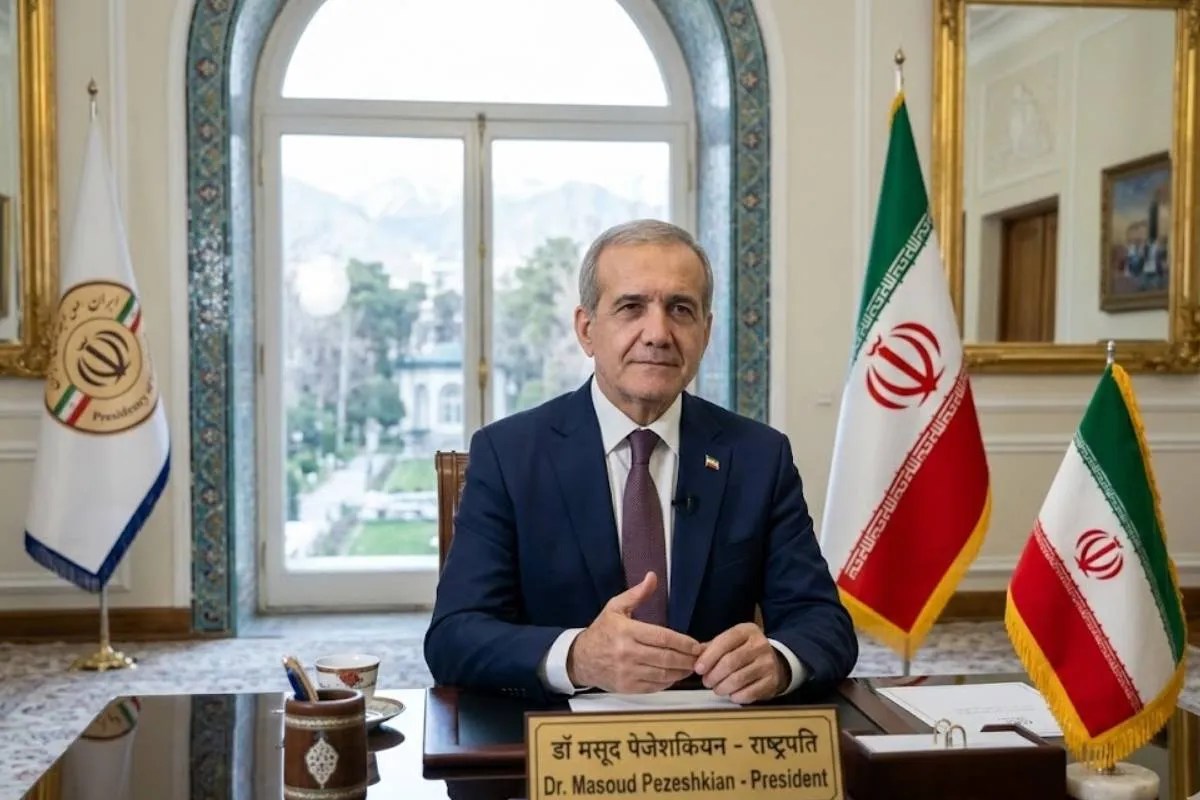
The global diplomatic press is currently obsessed with a ghost. They are chasing the specter of a "moderate" Iranian president, Masoud Pezeshkian, who claims he can de-escalate the Middle East through reasonable conditions and Western engagement. They see his recent rhetoric—his calls for an end to Israeli "aggression" and his stated desire for a return to the nuclear table—as a roadmap to peace.
They are wrong. They are misreading the hardware of the Iranian state by staring at the desktop wallpaper.
The "lazy consensus" suggests that if Israel simply stops its operations in Gaza and Lebanon, the Islamic Republic will pivot toward stability. This ignores the structural reality of the region. Pezeshkian is not an architect; he is a spokesperson. In Tehran, the presidency is a middle-management position. The real power, the Velayat-e Faqih, and the Islamic Revolutionary Guard Corps (IRGC) do not view the current conflict as a series of negotiable grievances. They view it as a totalizing ideological investment that has been forty years in the making.
The Myth of the Moderate President
Pezeshkian’s "conditions" for peace are not a peace plan. They are a demand for total victory by other means. When he asks for the cessation of Israeli military operations, he isn't asking for a ceasefire; he is asking for the survival of his regional assets.
I have watched diplomats fall for this trick for two decades. They mistake a change in tone for a change in trajectory. Pezeshkian’s role is to provide a soft front for a hard state. By presenting "conditions" that he knows are non-starters for the Israeli security establishment, he shifts the blame for continued escalation onto Jerusalem while buying time for the IRGC to replenish the proxy networks—Hezbollah, Hamas, and the Houthis—that have been decimated by the IDF's recent precision strikes.
If you think a heart surgeon-turned-politician can dismantle the "Axis of Resistance" from a desk in Tehran, you don’t understand how the IRGC’s budget works. They are an autonomous economic and military empire. They do not take orders from the President; the President manages the fallout of their decisions.
The Asymmetric Advantage Is Dead
For years, Iran’s strategy was "Strategic Patience." They fought through proxies to avoid direct kinetic confrontation with Israel and the United States. This allowed them to claim a degree of plausible deniability while slowly tightening a "Ring of Fire" around Israeli borders.
That era ended in April 2024. Then it was buried in October 2024.
The moment Iran launched hundreds of ballistic missiles directly from its own soil, the mask of the "rational, detached actor" vanished. Pezeshkian inherited a state that has finally exhausted its asymmetric options. Israel’s intelligence apparatus has proven it can penetrate the highest levels of Iranian security—evidenced by the assassination of Ismail Haniyeh in a secure IRGC guesthouse in the heart of Tehran.
When Pezeshkian speaks of "peace," he is speaking from a position of unprecedented vulnerability. The status quo has shifted because the technical gap between the two nations' capabilities has widened into a canyon.
- Intelligence Dominance: Israel isn't just winning on the battlefield; they are winning inside the IRGC's own communication loops.
- Kinetic Precision: The destruction of Hezbollah’s leadership in a single bunker strike proved that the "deterrence" Iran thought it had was an illusion.
- Economic Ruin: Pezeshkian’s primary job is to fix an economy with triple-digit inflation. He cannot afford a war, but he also cannot afford to stop the "Resistance" because it is the only thing keeping the regime's hardliners from devouring his administration.
Why "De-escalation" Is a Fantasy
The West loves the word "de-escalation." It sounds sophisticated. In reality, it is a vacuum. In the Middle East, there is no such thing as a neutral gear. You are either advancing or retreating.
If Israel stops now, it leaves the Iranian-backed infrastructure partially intact, allowing it to regenerate like a virus. If Iran stops now, it admits that its forty-year investment in the "liberation of Jerusalem" was a catastrophic failure that resulted only in the poverty of its own citizens.
Pezeshkian’s "conditions"—which include a return to the 2015 nuclear deal (JCPOA) and the lifting of sanctions—are a desperate attempt to trade a temporary pause in violence for the long-term survival of the regime's nuclear ambitions. It is a trade Israel will never make again. The 2023 attacks proved to the Israeli public that "containment" is a death sentence.
The Nuclear Trap
Let’s talk about the math. Pezeshkian suggests that diplomacy can solve the nuclear standoff. However, the breakout time for Iran to produce weapon-grade uranium is now measured in days, not months.
$$T_{breakout} \approx 0$$
At this stage, the technical knowledge is decentralized. You cannot "un-learn" how to build a centrifuge or how to trigger a warhead. Pezeshkian is offering a diplomatic solution to a technical reality that has already passed the point of no return. Any "peace" based on a new treaty is simply a managed surrender to a nuclear-capable Iran.
The Brutal Reality for the Region
Everyone asks: "How does this end?"
The uncomfortable truth that Pezeshkian won't admit, and the competitor article failed to grasp, is that it ends with the collapse of one of two things: the Iranian proxy network or the current Iranian government.
There is no middle ground where Hezbollah remains a standing army on the border and Israel lives in peace. There is no scenario where the IRGC continues to fund the Houthis to disrupt global shipping while the West lifts sanctions to "foster" Iranian moderation.
Stop looking for a diplomatic masterstroke. Peace isn't coming through a press release from Pezeshkian. It is coming through the systematic dismantling of the infrastructure that makes war possible.
The President of Iran is currently trying to sell a "return to normalcy" to a world that has finally realized the old "normal" was just a slow-motion countdown to the current explosion. He is a man holding a fire extinguisher in a volcano. His conditions are irrelevant because he is not the one holding the matches.
The regional war isn't happening because of a lack of dialogue. It’s happening because the strategic objectives of the Iranian state and the survival of the Israeli state are now mutually exclusive.
Accept the reality. The diplomacy you are cheering for is just a tactical pause. The real conflict hasn't even reached its climax.
Go ahead and hope for a breakthrough in Tehran. Just don't be surprised when the hardware ignores the software.