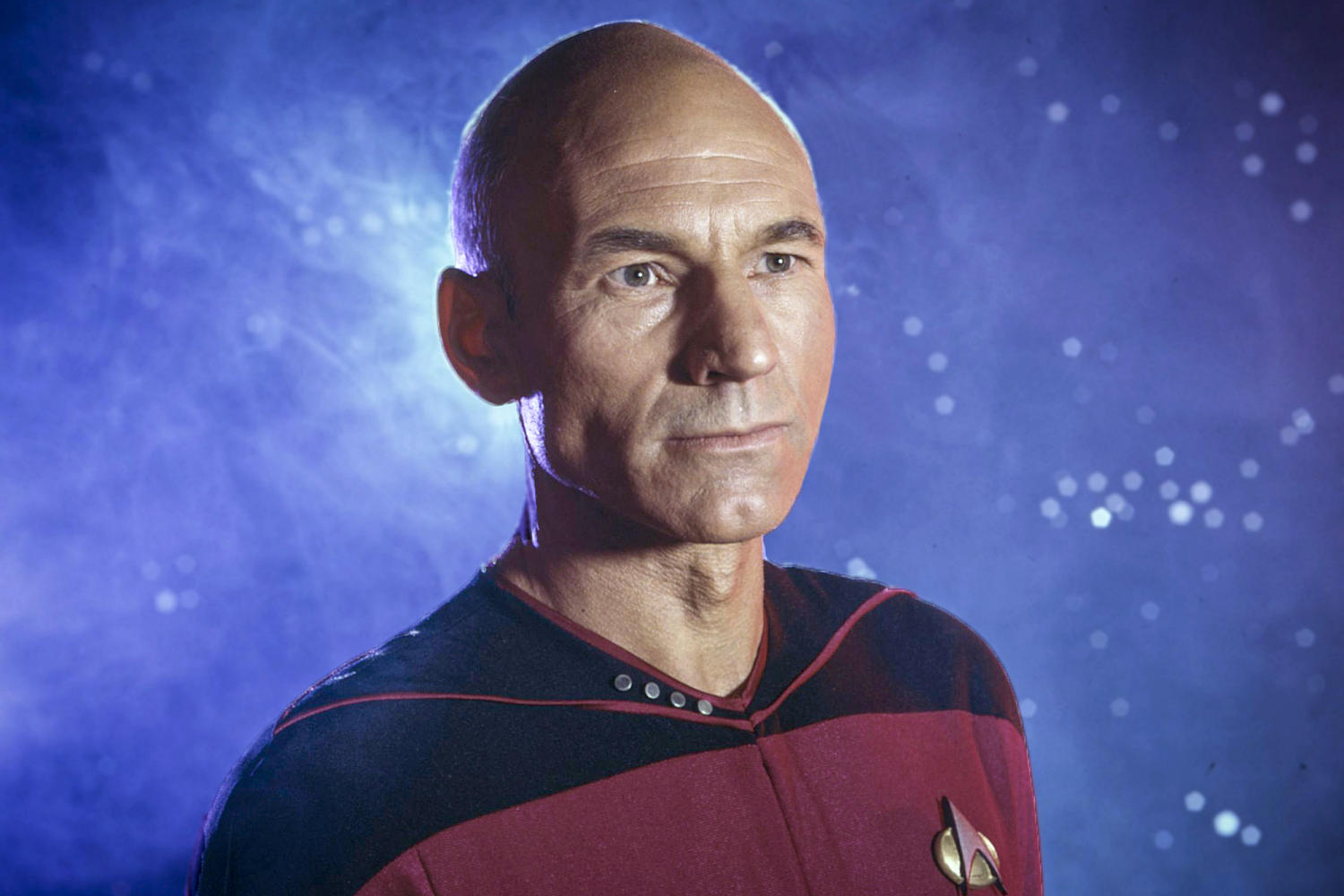
They call it effortless. Every lazy entertainment profile, every breathless retrospective, and every superficial tribute repeats the exact same lie about Sir Patrick Stewart. They paint a picture of a classically trained titan who simply waltzed off the stage at Stratford-upon-Avon, slipped into a spandex jumpsuit on a Paramount soundstage, and casually elevated Saturday night syndication with a flick of his Shakespearean wrist.
That narrative is pure fiction. It insults the man's craft. Worse, it hides the brutal, unglamorous mechanics of how an actor actually survives two completely incompatible mediums without destroying their career in the process. For another perspective, check out: this related article.
Stewart did not glide between the Royal Shakespeare Company and the bridge of the USS Enterprise. He collided with television like a freight train hitting a brick wall. The friction nearly broke him, nearly got him fired, and forced him to completely dismantle and rebuild his entire approach to acting. Calling that transition effortless is like watching a surgeon perform an eight-hour heart transplant and complimenting them on how relaxed they looked.
The Myth of the Classical Cheat Code
Entertainment journalists love a tidy binary. High art versus low art. The Globe versus the soundstage. In their minds, Shakespeare is the heavyweight championship of acting, and everything else is just sparring. Therefore, if you can survive King Lear, a sci-fi television show should feel like a paid vacation. Similar analysis on this trend has been provided by Rolling Stone.
Anyone who has actually worked in a rehearsal room or stood under hot studio lights knows that is completely backwards.
Classical stage acting and single-camera or multi-camera television acting operate on opposite physical and psychological laws. When Stewart joined the Royal Shakespeare Company in 1966, he entered a world built on vocal projection, physical scale, and communal endurance. On the stage of the Royal Shakespeare Theatre, you are speaking to the back row of the balcony, eighty feet away, without a microphone. You use your entire body to punctuate a thought. You build emotional momentum over three uninterrupted hours, riding the wave of iambic pentameter alongside twenty other actors in real time.
Then came 1987. Paramount Pictures cast a forty-seven-year-old, bald, relatively unknown British stage veteran as Captain Jean-Luc Picard in Star Trek: The Next Generation.
Suddenly, the rules inverted. A camera lens sitting three feet from your face does not reward vocal projection; it punishes it. On film, raising your eyebrow half an inch reads like a shout. Delivering a monologue with the rhythmic, muscular cadence required for Macbeth makes you look like a lunatic chewing the scenery. Furthermore, television shoots out of sequence, in forty-five-second fragments, surrounded by fifty bored technicians holding boom poles and eating bagels. There is no three-hour arc. There is no live audience feeding you energy. There is only the red light on the camera and a script written by committee forty-eight hours before call time.
I have watched dozens of brilliant theater actors flame out on television sets because they refused to unlearn their stage habits. They walk onto a soundstage expecting the crew to treat the script like sacred text, and they project to the rafters while a boom operator winces through their headphones.
Stewart was no exception. During the first season of The Next Generation, he was miserable, rigid, and out of his depth. He treated the Enterprise bridge like Elsinore Castle, lecturing his castmates about professionalism because they dared to laugh between takes. He didn't even unpack his suitcase for the first six weeks in Los Angeles because he was convinced the show would be canceled and he would be back in London before Christmas.
There was nothing graceful about it. It was culture shock of the highest order.
Why Stewart Almost Failed on the Bridge
If you want proof that Stewart struggled to bridge the gap, stop reading puff pieces and go watch the first season of The Next Generation.
Look at his performance in episodes like "Encounter at Farpoint" or "Code of Honor." Picard isn't the warm, measured, philosophically grounded diplomat that audiences later fell in love with. Early Picard is stiff, barking, pompous, and weirdly theatrical. Stewart was relying on his stage armor—the resonant baritone, the rigid posture, the clipped diction—because he didn't yet trust the camera to capture subtlety.
At the same time, the show's creator, Gene Roddenberry, originally wanted a French actor with a thick accent and a swashbuckling demeanor, someone closer to William Shatner's Captain Kirk. Stewart was the exact opposite: an austere Yorkshireman with a voice like gravel and velvet. The studio executives at Paramount didn't even want him. They thought a bald middle-aged Englishman would tank the ratings.
So Stewart arrived on set with zero institutional backing, a body trained for the wrong medium, and a cast of young American television actors—Jonathan Frakes, Marina Sirtis, Brent Spiner, LeVar Burton—who understood the relaxed, naturalistic rhythm of Hollywood television far better than he did.
The turning point wasn't some mystical moment where Shakespearean genius magically conquered Hollywood. It was a humbling, unglamorous surrender.
During that notorious first season, the cast finally staged a quiet intervention. They sat Stewart down and told him to lighten up, stop treating the set like a solemn cathedral, and start having fun. As Stewart himself has recounted many times in interviews and in his memoir Making It So, he was initially furious. His British theatrical pride was bruised. Then he went back to his trailer, thought about it, and realized they were right.
He had to strip away decades of theatrical conditioning. He had to learn how to let the camera come to him rather than chasing the lens. He had to learn that in television, the deadpan reaction shot is often more powerful than the five-minute soliloquy.
The Mechanics of the Pivot
To understand what Stewart actually achieved, you have to look at the specific technical adjustments he made between 1987 and 1990:
- Vocal Compression: On stage with the RSC, under directors like Peter Brook and John Barton, Stewart learned to use the full resonance of his chest and diaphragm to fill massive auditoriums. For Picard, he had to compress that dynamic range, keeping the authority of the voice while dropping the volume to an intimate, conversational register.
- Micro-Expression Control: In A Midsummer Night's Dream (where Stewart famously played Snout in Peter Brook's legendary 1970 white-box production), physicality was expansive and acrobatic. On the bridge of the Enterprise, Stewart reduced his physical vocabulary to micro-movements—a slight tightening of the jaw, a slow blink, the tug of his uniform tunic.
- Embracing Absurdity: In classical theater, even the most fantastical plots—ghosts, witches, fairies—are anchored in four hundred years of literary prestige. In syndicated sci-fi, you are delivering deadly serious speeches about "tachyon emissions" and "subspace anomalies" while standing next to a guy in a rubber forehead. Stewart realized that if he played the technobabble with the exact same intellectual rigor he applied to Henry IV, the audience would buy the illusion.
That last point is where the lazy consensus gets closest to the truth, yet still misses the mark. Stewart didn't elevate Star Trek by acting "Shakespearean." He elevated it by treating pulp fiction with the psychological seriousness of classical drama while executing it with the restraint of film acting. Those are two completely different skills.
The Reverse Trap: Going Back to the Stage
Here is the part of the equation that celebrity profiles completely ignore: the damage that seven years of television does to a stage actor's instrument.
If moving from theater to television is like switching from a broadsword to a scalpel, moving back from television to theater is like trying to swing that broadsword after your muscles have atrophied.
When Star Trek: The Next Generation wrapped in 1994, Stewart was fifty-four years old, globally famous, wealthy, and structurally out of shape for live theater. Seven years of hitting marks on a soundstage, doing three or four takes of a two-page scene, and letting boom mics do the heavy lifting will ruin a stage actor's stamina and vocal power if they aren't careful.
Furthermore, celebrity creates a massive barrier in the theater. Audiences who buy tickets to see "Captain Picard" play Othello or Prospero aren't watching a character; they are watching a pop-culture icon for the first twenty minutes of the play. Every gesture is scrutinized through the lens of their television memories.
Stewart didn't get a free pass back into the theatrical elite. He had to earn his way back through grueling, unglamorous work that stripped away his sci-fi persona.
Look at his 1997 performance in Othello at the Shakespeare Theatre Company in Washington, D.C. Director Jude Kelly staged a controversial "photo-negative" production: Stewart played a white Othello surrounded by an entirely Black cast. It was a high-wire act with zero safety net. If Stewart had brought a shred of Jean-Luc Picard's smug moral certainty to the stage, the production would have collapsed into self-parody. Instead, he played Othello as an isolated, deeply insecure outsider whose psychological unraveling felt raw and dangerously unhinged.
Look at his 2008 Macbeth, directed by Rupert Goold, which transferred from Chichester to the West End and Broadway. Goold set the play in a grim, Soviet-style underground bunker. Stewart played Macbeth not as a booming medieval warlord, but as a cold, paranoid, modern dictator—making sandwiches in a fluorescent-lit kitchen while plotting murder.
Notice the pattern. Stewart didn't return to Shakespeare to prove he could still do the old tricks. He used the minimalist, camera-ready stillness he had mastered on television to reinvent how Shakespeare could be played in small, claustrophobic theatrical spaces.
He cross-pollinated the two mediums. That wasn't effortless. That was deliberate, exhausting artistic evolution.
What People Actually Get Wrong About Classical vs. Screen Acting
When audiences and critics talk about actors like Stewart, Ian McKellen, Judi Dench, or Anthony Hopkins, they fall into a predictable set of misconceptions. Let's dismantle the three most common ones.
Does classical training automatically make someone a better film actor?
No. In fact, it often makes them worse—at least initially.
Classical training teaches you how to build a performance from the outside in: text analysis, scansion, vocal placement, physical posture. Film and television acting, particularly in the American tradition rooted in Stanislavski, Strasberg, and Meisner, builds a performance from the inside out, prioritizing raw behavioral truth over linguistic precision.
When a purely classical actor steps in front of a camera without adapting, the result feels manicured, self-conscious, and artificial. You can see the wheels turning. You hear the actor admiring their own vowels. Stewart succeeded on screen precisely because he recognized that his RSC toolkit was incomplete for television and humbled himself enough to learn from American screen actors who had never touched a folio in their lives.
Did Patrick Stewart "slum it" by taking Star Trek?
This is the most condescending myth of all. In 1987, Stewart was not a household name. He was a respected journeyman stage actor who had played supporting roles in films like Excalibur and Dune and prestige BBC miniseries like I, Claudius. He had spent twenty years doing grueling repertory theater for modest pay.
Star Trek didn't lower Stewart's status; it saved him from comfortable obscurity. More importantly, television gave him something the Royal Shakespeare Company never could: the freedom to fail in front of twenty million people every week until he found his range.
In theater, you rehearse for six weeks, open the show, and lock the performance in place. In network television, you shoot twenty-six episodes a year. You play a romantic lead one week, a comedy farce the next, a psychological torture victim the week after that. Look at the Season 5 episode "The Inner Light," where Picard lives an entire lifetime as an alien ironweaver in the span of twenty-five minutes, or Season 6's "Chain of Command," where he is stripped naked and tortured by a Cardassian interrogator.
You cannot get that kind of rapid-fire, high-stakes emotional reps on a theater stage. Star Trek was Stewart's acting gym. Without those 178 episodes, his later stage performances in Waiting for Godot, No Man's Land, and Macbeth would not have possessed half the emotional vulnerability they did.
Why don't more actors successfully pull off the theater-to-franchise crossover today?
Because modern franchise filmmaking actively punishes the exact qualities that make stage actors great.
When Stewart joined The Next Generation in the late 1980s, television was still a writer's medium. Even in sci-fi, episodes were built around twenty-page scenes of dialogue, ethical debates, and moral dilemmas. Stewart's training in rhetoric and argumentation had room to breathe.
Today, if a classically trained theater actor gets cast in a massive cinematic universe, they aren't given three-page philosophical monologues. They are put in front of a green screen, handed a script rewritten on the day of shooting, and asked to react to a tennis ball on a stick while twelve different producers argue over the CGI budget in post-production. There is no text to analyze. There is no ensemble to play off. Stewart caught the last wave of narrative television where theatrical rhetoric still had currency on a soundstage.
The Hidden Cost of Mastery
We love stories where talent looks like magic because magic requires nothing from us. If Patrick Stewart simply glided between Shakespeare and Star Trek on pure, effortless genius, then the rest of us are off the hook. We don't have to confront the terrifying reality of what it actually takes to master two completely different crafts at the highest level.
Stewart paid a massive personal price for that dual career. In his own words, his single-minded obsession with work—flying across the Atlantic between seasons, chasing stage roles during every hiatus, prioritizing the rehearsal room over everything else—contributed directly to the collapse of his first marriage and strained his relationship with his children for decades. He wasn't floating above the fray. He was grinding himself down to the bone to prove he belonged in both worlds.
Even the iconic partnership with Sir Ian McKellen—which the public views as a charming, effortless buddy comedy of two British knights trading quips on Broadway—was forged in intense mutual scrutiny and decades of theatrical rivalry before they ever shared a stage in Waiting for Godot in 2009. Two masters pushing each other at seventy years old so neither one gets lazy.
Stop Worshipping "Effortless"
The next time you watch Patrick Stewart deliver a devastating quiet line on screen, or watch archival footage of him tearing up the stage at Stratford, do not insult him by calling it effortless.
Look at the mechanics instead. Watch how he uses silence on camera—a skill he had to learn from scratch after forty because theater trained him to fill the air with sound. Watch how he anchors a ridiculous sci-fi premise by refusing to wink at the audience, applying the exact analytical rigor of John Barton's Shakespeare workshops to a script about space time-loops. Watch how he took the intimate, micro-detailed restraint of the television lens and carried it back onto the Broadway stage to strip away theatrical bombast.
Greatness across mediums isn't a smooth, frictionless bridge. It is a violent collision of opposing disciplines, survived only by the rare artist willing to break their own habits, swallow their ego, and start over as a beginner in front of the entire world.