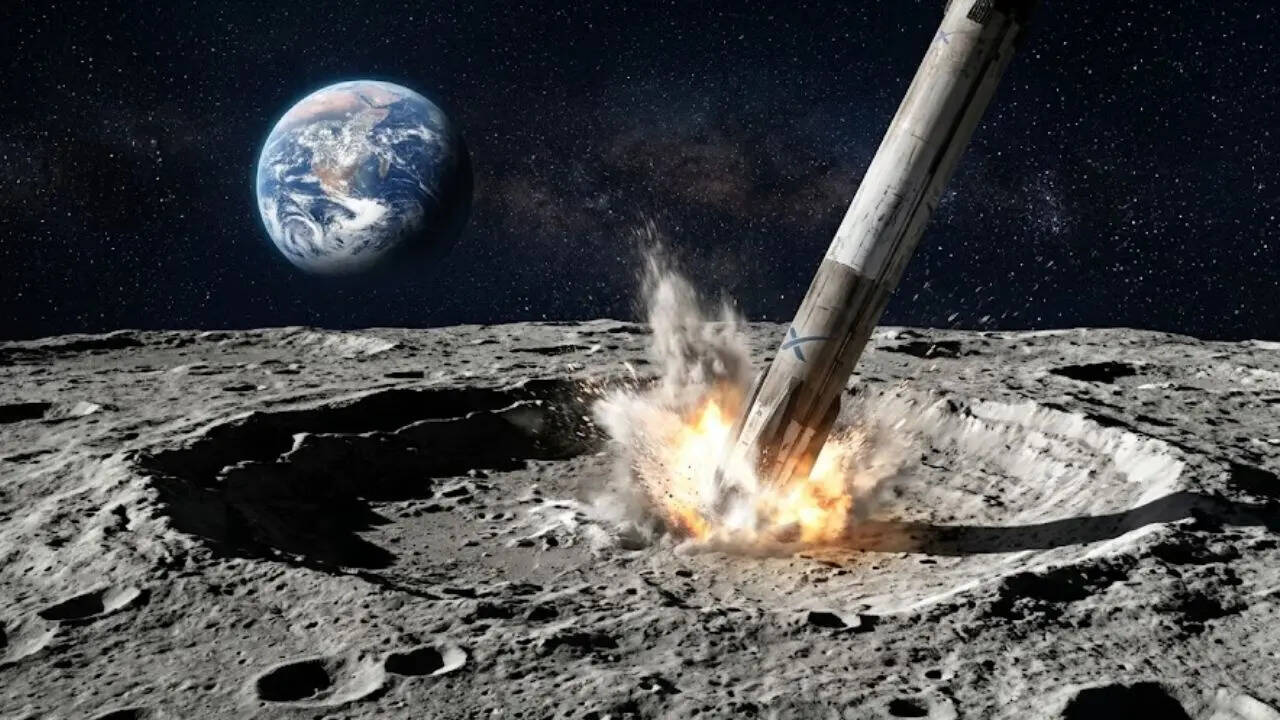
The uncontrolled impact of a SpaceX Falcon 9 second stage on the lunar surface represents a rare intersection of orbital mechanics, deep-space debris persistence, and high-velocity kinetic energy transfer. While headlines focus on the visual spectacle of a "rocket hitting the Moon," the event provides a critical case study in the long-term behavior of discarded hardware in chaotic three-body gravitational systems. This specific event—the impact of booster 2015-007B—is not a failure of mission architecture but a mathematical certainty born from the energy requirements of high-Earth orbit (HEO) missions.
The Mechanics of Orbital Abandonment
To understand why a rocket stage would strike the Moon seven years after its primary mission, one must first isolate the energy states of the Falcon 9 upper stage during the Deep Space Climate Observatory (DSCOVR) launch. Unlike low-Earth orbit (LEO) missions where atmospheric drag ensures a predictable re-entry within decades, or geostationary missions where satellites are boosted into "graveyard orbits," the DSCOVR mission required a transfer to the Sun-Earth L1 Lagrange point. If you found value in this article, you might want to read: this related article.
This trajectory placed the second stage in a highly elliptical Earth orbit with an apogee extending past the Moon’s orbital path. At these distances, the Earth's gravitational dominance weakens, allowing solar radiation pressure and the Moon’s gravity to exert significant perturbative forces. The resulting path is not a stable ellipse but a chaotic trajectory. Over years, these "gravity assists" from the Moon iteratively shifted the booster's orbit until the probability of intersection reached 100%.
Kinetic Energy and Impact Ballistics
The physics of the impact are governed by the relationship between mass and velocity at the point of contact. The Falcon 9 second stage, weighing approximately 4 metric tons (empty), is projected to strike at roughly 2.58 kilometers per second (5,700 miles per hour). For another angle on this story, see the latest update from The Verge.
The energy release is calculated using the standard kinetic energy formula:
$$E_k = \frac{1}{2}mv^2$$
Substituting the known variables:
- Mass ($m$): $4,000\text{ kg}$
- Velocity ($v$): $2,580\text{ m/s}$
- Energy ($E_k$): $\approx 1.33 \times 10^{10} \text{ Joules}$
To put this in perspective, this energy release is equivalent to several tons of TNT. However, the qualitative nature of the impact differs from a chemical explosion. Because the rocket is essentially a hollow aluminum tube, it will not penetrate the lunar surface like a solid tungsten rod. Instead, it will undergo catastrophic structural failure—crumpling like an accordion—while simultaneously excavating a crater.
The Crater Formation Process
The impact process occurs in three distinct phases:
- Contact and Compression: The initial shockwave travels through both the booster and the lunar regolith. Given the booster’s low density compared to the lunar basalt, the vehicle will be pulverized almost instantly.
- Excavation: The shockwave accelerates the lunar soil (regolith) outward, forming a transient cavity. Scientists estimate the resulting crater will span approximately 10 to 20 meters in diameter.
- Modification: The crater walls settle under the Moon's 1/6th gravity, leaving a permanent scar that exposes "fresh," non-weathered material from beneath the surface.
Why This Impact Differs from Natural Meteoroids
The Moon is struck by space rocks daily, yet the Falcon 9 impact is scientifically distinct due to the predictability of the projectile's composition.
Natural impactors vary in density (iron vs. stony) and entry angle, making it difficult to calibrate post-impact observations. The Falcon 9 stage is a known quantity: a specific alloy of aluminum-lithium, a known mass, and a known geometry. By observing the crater formed by a known object, planetary scientists can "ground-truth" their models of lunar regolith depth and density. If the crater is shallower than expected, it suggests the sub-surface layer is harder or more consolidated than current maps indicate.
The Three-Body Problem and Predictive Limits
Tracking the booster was a task of managing the "Three-Body Problem"—the complex gravitational interplay between the Earth, Moon, and Sun. In a two-body system (Earth and a satellite), orbits are predictable for centuries. In a three-body system, small uncertainties in the object's initial position or the effects of "outgassing" (leftover fuel leaking from valves) create exponential divergence in the predicted path.
This specific impact was identified by independent orbital analysts rather than government agencies, highlighting a significant gap in Space Situational Awareness (SSA) for the cislunar region (the space between Earth and the Moon). While we track thousands of objects in LEO, our "radar fence" is effectively blind to objects in high-entropy orbits once they pass a certain distance.
Environmental and Legal Implications for Lunar Operations
The impact brings the "Kessler Syndrome"—the theory of cascading space debris—into a lunar context. While a single impact on the Moon is harmless, it raises questions about the "Lunar Environment."
- Biological Contamination: While the heat of impact will likely sterilize the aluminum, the transfer of Earth-origin materials to the Moon is a concern for "Planetary Protection" protocols.
- The Exosphere: The Moon has a vanishingly thin atmosphere. An impact of this magnitude releases a plume of dust and vaporized metal that can temporarily contaminate the local exosphere, potentially interfering with sensitive lunar telescopes or future ice-mining operations at the poles.
The Strategic Shift Toward Active Debris Removal
The Falcon 9's collision serves as an operational proof of concept for why future deep-space missions must incorporate "disposal burns." Modern mission profiles now increasingly require that upper stages either:
- Re-enter Earth's atmosphere immediately after deployment to burn up.
- Achieve a heliocentric "graveyard" orbit, where they are ejected into orbit around the Sun, effectively removing them from the Earth-Moon system forever.
The cost of these maneuvers is measured in fuel, which translates directly to a reduction in the primary payload's mass. This "Payload-Sustainability Trade-off" is the new reality for launch providers. As lunar traffic increases with the Artemis program and commercial mining interests, the "discard and forget" model of 2015 is no longer viable.
Forecasting Cislunar Traffic Management
The 2022 impact was a harbinger of a crowded cislunar corridor. Within the next decade, the number of spent stages in high-Earth orbits is expected to triple. To mitigate the risk of unplanned impacts on future lunar bases or orbiting stations like the Lunar Gateway, three structural changes are necessary:
- Deep-Space Tracking Networks: Extending the Space Surveillance Network (SSN) to include high-sensitivity optical sensors capable of tracking non-cooperative objects at 400,000 kilometers.
- Standardized End-of-Life (EOL) Protocols: International treaties must mandate that any hardware passing through lunar space must have a deterministic disposal plan.
- Kinetic Mapping: Using these accidental impacts to build a comprehensive map of the Moon’s crustal density, which will inform where future heavy infrastructure can be safely built.
The Falcon 9's final act is not merely a crash, but a free high-energy physics experiment. It exposes the limitations of our current tracking capabilities and the necessity of managing the "orbital ecology" of the Moon as if it were as vital as our own atmosphere. The data gathered from the impact site by the Lunar Reconnaissance Orbiter (LRO) will provide the definitive calibration for lunar impact physics for the next generation of planetary science.
Launch providers must now treat the cislunar volume not as a vast void for disposal, but as a bounded resource. The transition from "mission-centric" to "system-centric" design is the only way to prevent the lunar surface from becoming a graveyard of high-velocity terrestrial junk, which would eventually jeopardize the very lunar missions these rockets were designed to facilitate.