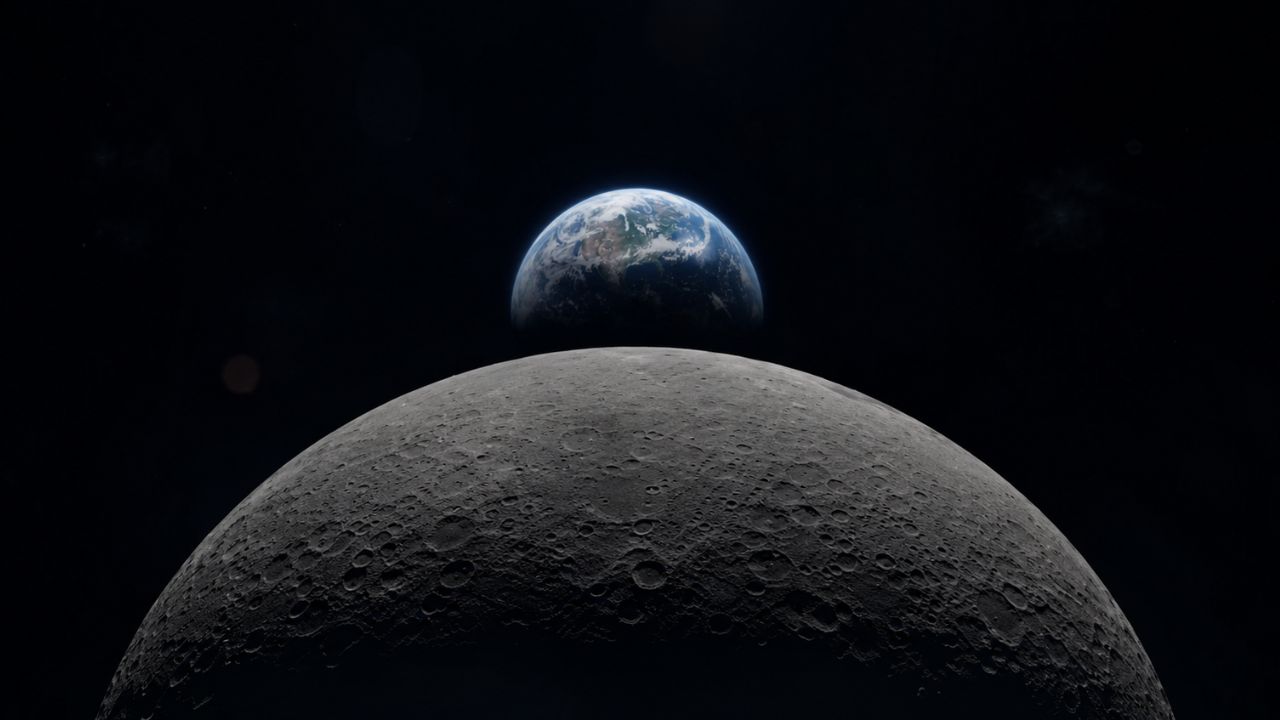
The financial viability of cis-lunar commercialization depends fundamentally on the physics of the Tsiolkovsky rocket equation. Because mass must be expelled to change velocity, every kilogram of fuel required for orbital insertion compounding the total lift-off mass exponentially. Traditional lunar trajectories, such as the high-energy Hohmann transfer or standard direct injection paths, optimize for transit time at the severe expense of propulsive efficiency. Minimizing the cost of cis-lunar transport requires moving away from brute-force propulsive maneuvers and toward the exploitation of multi-body orbital mechanics within the Sun-Earth-Moon gravitational system.
Recent computational breakthroughs using the Theory of Functional Connections have mapped an ultra-efficient class of Low Energy Transfers (LETs) within the Interplanetary Transport Network. By running more than 30 million orbital simulations, researchers have identified non-trivial entry vectors into Earth-Moon invariant manifolds that reduce the required velocity change ($\Delta v$) by exactly $58.80 \text{ m/s}$ compared to the most efficient previously known ballistic lunar transfers. While seemingly marginal, this optimization represents a significant reduction in the dry-mass-to-propellant ratio of deep-space stages. Crucially, this specific geometric path solves a persistent operational bottleneck: it preserves a direct line of sight with Earth ground stations, completely eliminating the communication blackouts that complicate traditional far-side or polar lunar insertions.
The Mechanics of Multi-Body Gravitational Manifolds
To quantify the efficiency of this newly mapped trajectory, the mission profile must be parsed through the Planar Circular Restricted Three-Body Problem (PCR3BP) rather than standard two-body Keplerian approximations. Traditional transfers rely almost exclusively on the gravitational dominance of the Earth during transit, treating the Moon's gravity as a localized perturbation to be overcome via a high-$\Delta v$ lunar orbit insertion (LOI) burn. This approach forces spacecraft to execute a severe braking maneuver to transition from a hyperbolic approach velocity to a closed lunar orbit.
Conversely, Low Energy Transfers leverage the interaction between the Sun-Earth and Earth-Moon Lagrange points ($L_1$ and $L_2$). Surrounding these unstable equilibrium points are periodic orbits, such as Lyapunov and halo orbits. These orbits possess invariant manifolds—tubular pathways in phase space that act as topological channels for transport.
- Stable Manifolds: The set of initial states that asymptoticly approach the periodic orbit over time. Spacetime trajectories inside these tubes naturally transit from regions outside the Moon's orbital radius directly into the lunar capture zone without active propulsion.
- Unstable Manifolds: The set of states that diverge away from the equilibrium region, which can be utilized for outward departures toward deep space.
The optimization discovered by the research team turns conventional orbital insertion design on its head. Historically, mission planners targeted the entry point of the Earth-Moon stable manifold at its closest perigee to Earth, assuming that minimizing initial distance would reduce transit complexity. The 30-million-simulation dataset reveals that entering the manifold from the opposite side—effectively looping around the Lagrange equilibrium neck via a counterintuitive exterior vector—yields a lower absolute energy state relative to the Moon. By approaching the Weak Stability Boundary (WSB) from this non-trivial direction, the spacecraft utilizes solar gravitational perturbations to shape its approach geometry perfectly, allowing the Moon's gravity to capture the vehicle naturally.
The Cost Function of Lunar Insertion Architecture
Evaluating the financial and logistical superiority of this trajectory requires a formal comparison of the core metrics governing cis-lunar transit. The table below contrasts the baseline parameters of a standard direct Hohmann transfer, a baseline Ballistic Lunar Transfer (BLT), and the optimized exterior manifold transfer.
| Performance Metric | Direct Hohmann Transfer | Baseline Ballistic Lunar Transfer | Optimized Exterior Manifold Transfer |
|---|---|---|---|
| Transit Duration | 3 to 5 Days | 80 to 120 Days | 90 to 130 Days |
| Typical Lunar Insertion $\Delta v$ | $\sim 800 \text{ to } 1000 \text{ m/s}$ | $\sim 0 \text{ to } 50 \text{ m/s}$ (Ballistic Capture) | $0 \text{ m/s}$ (Pure Ballistic Capture) |
| Net Orbit Adjustments | High (Critical Time Windows) | Low (Mid-course Corrections) | Minimal ($\Delta v$ reduction of $58.80 \text{ m/s}$) |
| Earth Communication Status | Intermittent (Far-side Blackouts) | Variable (Geometry Dependent) | 100% Continuous Line of Sight |
| Payload Mass Fraction | Lowest (High Fuel Mass Burden) | High | Highest Optimized Yield |
The primary trade-off of the optimized manifold transfer is time. For crewed operations where life-support consumables scale linearly with mission duration, the 100-plus-day transit window remains a disqualifying constraint. For uncrewed logistics, asset positioning, fuel-depot replenishment, and heavy scientific infrastructure, however, transit duration is a secondary variable. The primary objective function is the minimization of $\Delta v$, which directly dictates the payload mass fraction.
The Exponential Value of $58.80 \text{ m/s}$
Dismissing a $\Delta v$ reduction of $58.80 \text{ m/s}$ as trivial overlooks the mathematical structure of the rocket equation:
$$ \Delta v = v_e \ln \left( \frac{m_0}{m_f} \right) $$
where $v_e$ represents the effective exhaust velocity of the propulsion system, $m_0$ is the initial total mass, and $m_f$ is the final dry mass.
Because the mass ratio $m_0 / m_f = e^{\Delta v / v_e}$ is exponential, any linear reduction in required $\Delta v$ translates into a compounding reduction in the required launch propellant. For a heavy-lift upper stage or a long-duration lunar lander utilizing storable hypergolic or cryogenic propellants, saving nearly $60 \text{ m/s}$ yields dozens to hundreds of kilograms of additional payload capacity. In commercial space operations, where launch costs range from thousands to tens of thousands of dollars per kilogram depending on the orbit, this propulsive delta translates directly into multi-million-dollar efficiency gains per launch vehicle.
Resolving the Communication Line-of-Sight Bottleneck
Beyond the mathematical reduction in propulsive energy, this optimized trajectory resolves a severe physical limitation of traditional lunar insertions: RF communication blackouts.
When a spacecraft executes a high-energy insertion burn or enters orbit via standard equatorial or polar vectors, its trajectory frequently carries it behind the lunar disk relative to Earth tracking stations. During the Artemis 2 flight test profiles, for instance, occultation by the Moon creates predictable but highly risky periods of zero communication. During these windows, ground control cannot monitor telemetry, command emergency aborts, or assist in mid-course corrections.
The geometry of the newly discovered exterior manifold trajectory completely bypasses the lunar occultation zone. Because the vehicle approaches the Earth-Moon $L_2$ region from a highly specific, sun-perturbed exterior vector, its orbital plane and approach angle are tilted relative to the Earth-Moon line of nodes. The spacecraft orbits along a wide, three-dimensional halo-like path that prevents the Moon from ever passing directly between the spacecraft’s transponder and Earth-based receivers.
This continuous line of sight offers two distinct operational advantages:
- Elimination of Onboard Autonomy Redundancy: Spacecraft navigating through communication blackouts must rely entirely on flight computers to execute critical orbit-shaping tasks. Continuous communication allows for real-time ground-based delta-differential one-way ranging (Delta-DOR) and immediate command validation.
- Mitigation of Insertion Risk: Because the trajectory terminates in a pure ballistic capture—where the spacecraft slows down naturally relative to the Moon due to the three-body gravitational gradients—there is no single, time-critical "make-or-break" orbit insertion burn. If a minor subsystem fails during transit, ground teams have days, rather than seconds, to push corrective software patches and command low-thrust ion engines or chemical thrusters.
Operational Constraints and Strategic Implementations
While highly optimized, this trajectory does not represent a universal solution for all cis-lunar architectures. Its deployment is bounded by rigid physical and orbital constraints.
The first limitation is the sensitivity to initial conditions. Because these pathways exist near the boundaries of chaotic multi-body systems, a minute deviation in injection velocity or vector angle at the start of the transfer will cause the spacecraft to miss the stable manifold tube entirely. This divergence would send the vehicle into an unrecoverable heliocentric orbit or an uncontrolled ballistic reentry. Executing this transfer demands high-precision navigation assets and automated guidance systems capable of micro-meter-per-second burn fidelity.
The second bottleneck is launch window frequency. Unlike direct Hohmann transfers, which can be executed almost daily as the Moon cycles through its orbit, invariant manifold paths that leverage solar perturbations require precise alignment between the Sun, Earth, and Moon. The specific exterior vector identified in the 30-million-simulation dataset opens up less frequently than standard ballistic lunar transfers, requiring rigid, synchronized launch cadences from orbital fuel depots or launch pads.
For logistics operators building out the infrastructure of the cis-lunar economy, the strategic play is clear: bifurcate the supply chain based on transit priority. Time-sensitive assets, human crews, and emergency replacement parts must continue to utilize high-energy, direct injection trajectories despite their steep $\Delta v$ penalties. Conversely, bulk materiel—including water ice harvested from the lunar poles, structural metals, solar array infrastructure, and propellant reserves—should be routed exclusively through these optimized exterior manifold channels. By integrating these high-efficiency pathways into automated, long-term launch schedules, space agencies and commercial consortia can maximize payload throughput while minimizing the total energy required to sustain a permanent presence beyond low Earth orbit.