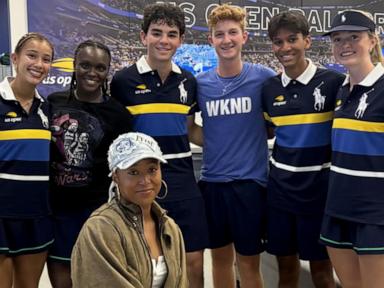
Behind every high-tempo professional tennis match lies a hyper-optimized logistical apparatus designed to eliminate friction, reduce dead time, and maintain a strict kinetic rhythm. While spectators focus on racket head speed and tactical variations, the underlying operational efficiency of a Grand Slam tournament depends heavily on the human infrastructure situated at the perimeter of the court. The US Open Ball Crew represents a masterclass in high-throughput human resource management, physical performance standards, and real-time spatial coordination. Analyzing this workforce reveals the rigorous mechanics required to support elite athletic output under extreme environmental and psychological pressure.
The selection pipeline operates as a severe administrative and physiological filter. Out of thousands of annual applicants, only a fraction advance to the physical evaluation phase, and approximately three hundred individuals ultimately secure a roster spot. This high rejection rate functions as a risk-mitigation strategy for the United States Tennis Association. The tournament cannot afford operational bottlenecks caused by poor spatial awareness, slow sprint recovery times, or an inability to process visual cues under fatigue. Tryouts are structured around hard metrics: timed shuttle runs, baseline-to-net ball retrieval drills, throwing accuracy assessments, and written rules examinations. Candidates must demonstrate not just general athleticism, but specific anaerobic endurance and hand-eye coordination adapted to the geometry of a tennis court.
Once selected, the workforce is governed by a strict division of labor and spatial geometry. A standard court crew consists of six to eight individuals distributed strategically: two at the net posts, two at the back corners, and additional floaters or runners depending on the court tier and broadcast requirements. Each position carries a specialized cost function. Net personnel must excel at crouching low, retrieving short balls cleanly, and executing underhand or overhand rolls to baseline colleagues with minimal aerodynamic drift or bounce variation. Baseline personnel manage the critical pre-serve workflow, supplying players with tennis balls while tracking the precise count, player preferences, and service-line timing rules.
The primary operational constraint in this environment is time management. Professional tennis is bound by strict shot-clock regulations between points, typically mandating a twenty-five-second window at Grand Slam events. The ball crew directly influences compliance with this clock. A sluggish retrieval or an inaccurate ball toss forces a player to reset their physical routine, breaks their concentration, and ultimately degrades the broadcast pacing. Consequently, the crew operates as an asynchronous communication network. Non-verbal signals dictate when a ball is withheld, when towels are deployed, and how fluidly the crew rotates off-court during mandated rest intervals.
Fatigue management is another core variable that dictates crew structuring. Flushing Meadows matches often occur during peak afternoon heat and humidity, testing the physiological limits of crew members who range in age from teenagers to seasoned adult veterans. Shifts are managed through rotating schedules that balance high-profile stadium courts against outer courts where the ball-in-play frequency and spectator density differ. Crew supervisors monitor hydration, physical exhaustion, and cognitive lapses, pulling fatigued members before error rates rise. The margin for error is razor-thin; a stray ball left on the court during a live point can result in a let, a safety hazard, or a rule violation that impacts the integrity of the match.
Beyond the physical mechanics, the role requires absolute psychological neutrality. Crew members operate within inches of elite athletes experiencing intense competitive stress. They must remain functionally invisible, suppressing natural reactions to controversial line calls, player outbursts, or dramatic momentum shifts. This emotional detachment is enforced through rigorous on-court protocol training before the tournament begins. The system treats human personnel with the same reliability standards applied to automated line-calling technology or electronic scoreboards.
Evaluating the tournament through this operational lens shifts the perspective from entertainment consumption to systems engineering. Every sprint, roll, and station rotation is a calculated input designed to maximize throughput and minimize variance. To maintain this standard as player power and match speeds continue to increase, recruitment algorithms and physical screening criteria must evolve in parallel, ensuring the human baseline matches the relentless velocity of the modern game.