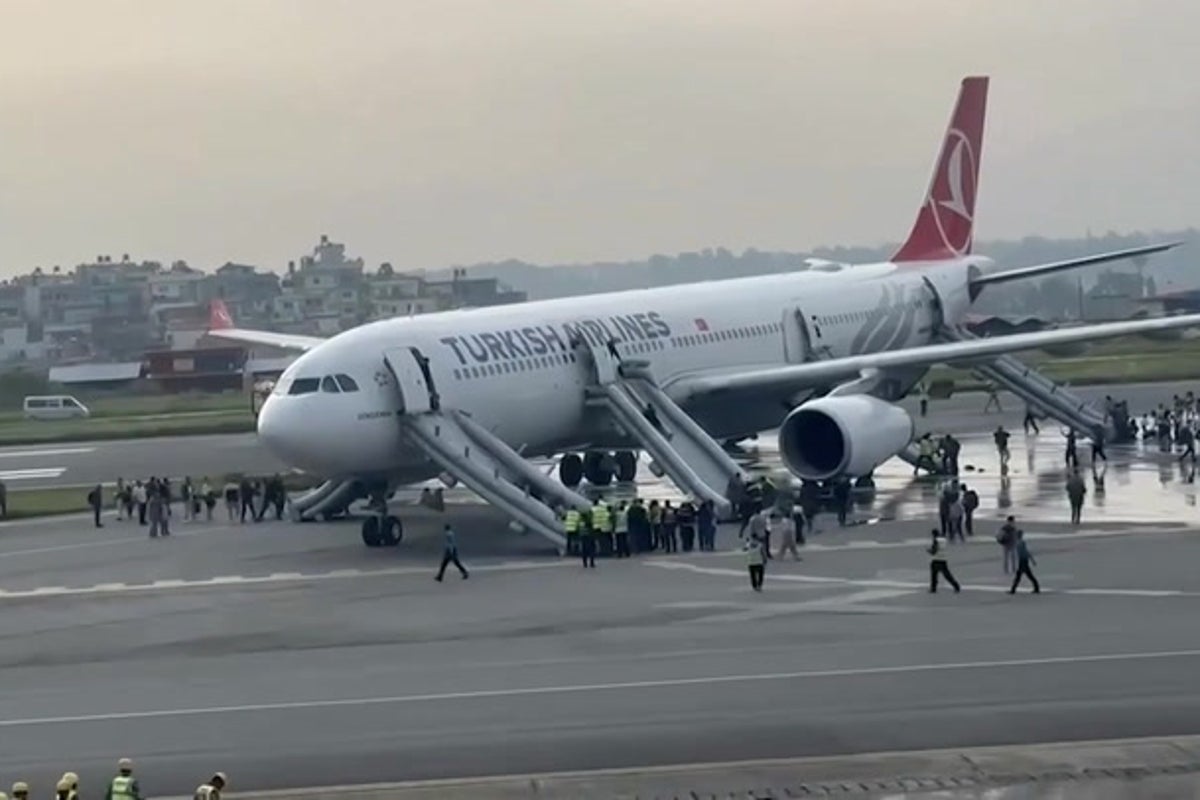
The efficiency of a commercial aviation evacuation is not measured by the speed of the passengers, but by the integrity of the pressure vessel and the thermal resistance of the airframe materials. When Turkish Airlines Flight 5427 experienced a landing gear fire upon arrival at Hatay Airport, the event triggered a sequence of deterministic safety protocols designed to beat the "90-second rule"—the FAA and EASA certification standard requiring a full aircraft evacuation in under a minute and a half with half the exits blocked. This incident provides a raw dataset for analyzing the intersection of thermal dynamics, human psychology in confined spaces, and the failure modes of landing gear assemblies.
The Mechanics of Kinetic Energy Conversion Failures
The genesis of an aircraft fire during landing typically resides in the braking system or the wheel well assembly. Aircraft brakes are designed to absorb massive amounts of kinetic energy, converting it into heat through friction.
Thermal Runaway in Braking Systems
In a standard landing, the carbon brake disks can reach temperatures exceeding 500°C. If a hydraulic leak occurs or if the anti-skid system malfunctions, the temperature can spike beyond the flashpoint of hydraulic fluid or the ignition temperature of the magnesium alloys often found in wheel hubs.
The primary variables in this thermal equation include:
- Maximum Energy Absorption (MEA): The limit at which the brakes can no longer dissipate heat without structural failure.
- Hydraulic Fluid Volatility: The fire point of Skydrol (the common hydraulic fluid) is approximately 175°C; if a line ruptures near a hot brake, ignition is instantaneous.
- Tire Integrity: Over-pressurization due to heat usually triggers fuse plugs—small threaded pins that melt at a specific temperature to deflate the tire safely. If these fail, a tire explosion can sever nearby fuel or hydraulic lines, escalating a localized fire into an airframe-threatening event.
The Three Pillars of Emergency Egress Optimization
Once the cockpit crew confirms an external fire through visual cues or fire detection loops, the transition from a controlled arrival to an emergency evacuation is governed by three distinct structural pillars.
1. The Decision-Making Latency
The gap between the first indication of fire and the "Evacuate" command is the most critical bottleneck. In the Turkish Airlines incident, the crew had to verify the fire's location to ensure passengers were not directed into the flames.
The internal logic follows a strict "Observe-Orient-Decide-Act" (OODA) loop:
- Observation: Sensors detect heat in the wheel well.
- Orientation: The crew determines if the fire is contained or spreading toward the fuel tanks in the wings.
- Decision: Selecting which exits to arm. If the fire is on the right side (Starboard), only the left (Port) doors are utilized.
- Action: Deployment of the inflatable slides.
2. Slide Deployment Dynamics
Evacuation slides are complex pneumatic systems. They must deploy and inflate within six to ten seconds using high-pressure carbon dioxide or nitrogen tanks mixed with ambient air via aspirators.
Failure modes for these systems include:
- Wind Vectors: High crosswinds can displace the slide, making it unusable or causing it to fold back against the fuselage.
- Aspirator Blockage: Debris or ice can prevent the slide from reaching the required rigidity to support the weight of multiple descending passengers.
- Thermal Damage: If the fire is directly beneath an exit, the radiant heat can melt the nylon or polyester slide material before it fully deploys.
3. Flow Rate and Human Impedance
The physical movement of passengers through the cabin is a fluid dynamics problem. An Airbus A320 or Boeing 737 cabin acts as a pipe with specific friction points: the aisles and the door sills.
The "impedance" in this system is almost always human behavior. Despite explicit instructions, passengers frequently attempt to retrieve carry-on luggage. This creates a "clogging" effect at the overhead bins, reducing the flow rate (passengers per second) by as much as 40%. In the Hatay incident, the urgency was compounded by the visible smoke outside, which serves as a powerful but dangerous psychological catalyst, often leading to "competitive behavior" rather than "cooperative flow."
Structural Vulnerabilities of the A321 Airframe in Thermal Events
The A321, often utilized in these regional routes, features a stretched fuselage which increases the distance passengers must travel to reach the nearest exit compared to the standard A320.
Fuselage Burn-Through Resistance
The aluminum skin of a narrow-body aircraft provides a limited window of protection against external fuel fires. Tests indicate that "burn-through"—the point where an external fire penetrates the cabin—can occur in as little as 60 to 180 seconds. This creates a hard ceiling on the evacuation window.
The thermal barrier consists of:
- Aluminum Skin: Reflects radiant heat but loses structural integrity at 200°C.
- Insulation Blankets: Modern aircraft use burn-through resistant materials like Orcon or Johns Manville blankets designed to add extra minutes to the survival clock.
- Cabin Liners: The interior plastics are treated with flame retardants, but once ignited, they release toxic gases (Hydrogen Cyanide and Carbon Monoxide) which are often more lethal than the heat itself.
Quantifying the Survival Envelope
To analyze the success of the Turkish Airlines evacuation, we must look at the survival envelope, which is the intersection of the Available Safe Egress Time (ASET) and the Required Safe Egress Time (RSET).
The goal of the flight crew is to ensure that $RSET < ASET$.
Variables affecting ASET:
- Fuel Volume: The amount of fuel remaining in the wings at landing.
- Fire Suppression Response: The time it takes for airport Fire and Rescue Services (RFFS) to apply foam.
- Atmospheric Conditions: Oxygen availability and wind direction.
Variables affecting RSET:
- Crew Proficiency: The speed of door operation.
- Passenger Density: The number of occupied seats.
- Cabin Visibility: The presence of smoke reduces walking speed exponentially.
In the case of Flight 5427, the RSET was minimized by the rapid deployment of slides on the non-affected side of the aircraft, while the ASET was likely extended by the rapid response of the Hatay ground crews who applied foam to the landing gear before the fire could reach the wing root.
Tactical Deficiencies in Current Passenger Safety Protocols
The Turkish Airlines incident highlights a persistent failure in passenger education. During the evacuation, footage often shows passengers pausing at the top of the slide—a hesitation known as the "hesitation penalty."
Each second of hesitation at the door reduces the total throughput of the exit. If an exit has a theoretical capacity of 60 people per minute, a two-second hesitation by every third passenger reduces the capacity to approximately 40 people per minute. This 33% loss in efficiency can be the difference between total evacuation and smoke inhalation fatalities.
Furthermore, the "luggage factor" remains an unsolved risk. In high-stress environments, the primitive brain reverts to "resource guarding." Passengers grab bags not out of greed, but as a subconscious reaction to a loss of control. Regulatory bodies have considered remote-locking overhead bins, but the mechanical complexity and weight penalties have so far prevented implementation.
The Strategy of the Post-Landing Fire Response
The resolution of the fire on the Turkish Airlines aircraft was not a matter of luck, but a result of rigid adherence to the "Sterile Cockpit" and "Emergency Command" hierarchies.
The Ground-to-Cockpit Communication Loop
The moment the fire was identified, the Tower (ATC) became the eyes of the pilots. Pilots have limited visibility of their own landing gear. The "External Observation" provided by ATC allows the Captain to decide whether to stop on the runway—blocking all other traffic—or taxi to a taxiway. In this instance, stopping on the runway was the only logical choice to prevent the airflow from fanning the flames and to allow immediate access for fire tenders.
The Final Strategic Play: Fleet-Wide Mitigation
For operators like Turkish Airlines, the data from this incident must be fed back into two specific channels:
- Maintenance Reliability Engineering: Analyzing the wear patterns on the brake assemblies of the specific aircraft to determine if the "Turn Around Time" (TAT) at previous airports allowed for sufficient brake cooling.
- Safety Management Systems (SMS): Reviewing the cabin crew's performance to see if the "verbal commands" used were effective in stopping passengers from retrieving luggage.
Aviation safety is a cumulative discipline. The success of the Flight 5427 evacuation reinforces the necessity of the 90-second certification standard but also warns of the fragility of that window when human factors—like luggage retrieval—interfere with the physics of fluid exit flow. The strategic priority for airlines now shifts from fire suppression to fire prevention through real-time brake temperature monitoring and more aggressive passenger compliance strategies during the pre-flight briefing.