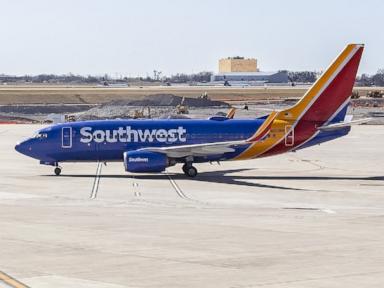
The recent incident involving two Southwest Airlines aircraft at Nashville International Airport—where a Boeing 737 was cleared for takeoff while another was simultaneously cleared to cross the same runway—represents a failure of the Swiss Cheese Model of Systemic Risk. In high-reliability organizations (HROs), safety is not the absence of accidents but the presence of active defenses. When a "close call" occurs, it indicates that multiple independent layers of protection—Air Traffic Control (ATC) sequencing, flight deck situational awareness, and Ground Proximity Warning Systems—failed in a specific, temporal alignment. The Federal Aviation Administration (FAA) investigation must move beyond individual culpability to address the systemic bottleneck of terminal airspace saturation and the latency of ground-based detection technologies.
The Kinematic Conflict Hierarchy
To understand the severity of this incursion, one must categorize the risk based on the kinematic states of the aircraft involved. Aviation safety analysts utilize a three-tiered hierarchy to evaluate "near-miss" severity:
- Spatial Buffers: The minimum required separation between aircraft.
- Temporal Conflict: The window of time before a collision becomes mathematically certain if no intervention occurs.
- Kinematic Energy State: The velocity of the taking-off aircraft relative to the stationary or slow-moving aircraft crossing the runway.
In the Southwest incident, the taking-off aircraft was in a "high-energy state," meaning its ability to maneuver or stop was rapidly diminishing as it approached V1 (takeoff decision speed). The crossing aircraft represented a static obstacle. This creates an asymmetric risk profile: the taking-off crew has seconds to abort, while the crossing crew may be entirely unaware of the closing hazard due to cockpit geometry and line-of-sight obstructions.
The Cognitive Load Bottleneck in ATC Operations
The FAA investigation will likely center on the Controller Communication Loop. Modern terminal environments operate on a "push" system where throughput is prioritized to maintain hub integrity. This creates a cognitive "bandwidth cap" for controllers.
- Instructional Overlap: If a controller issues a takeoff clearance while distracted by a complex ground movement, the mental model of the runway's state becomes decoupled from reality.
- Expectancy Bias: Controllers and pilots often hear what they expect to hear. If a runway is typically clear at a specific interval, the brain may "fill in" the clearance even if the visual confirmation is missing.
- Hearback Errors: These occur when a pilot reads back an incorrect or dangerous instruction, and the controller fails to catch the mistake because they have already pivoted to the next task.
The Nashville event highlights a failure in the Common Operating Picture (COP). When the tower controller and the ground controller are not synchronized, or when a single controller manages multiple high-frequency flows, the probability of a "runway incursion" increases exponentially with each additional aircraft in the movement area.
Technical Limitations of ASDE-X and ASSC
While major airports utilize Airport Surface Detection Equipment, Model X (ASDE-X) or Airport Surface Surveillance Capability (ASSC), these systems are reactive rather than predictive. They rely on multilateration and radar to track transponders.
The technical failure point in "close calls" often involves Alerting Latency. If an aircraft enters a runway without clearance, the system must detect the movement, process the trajectory, and trigger a visual/auditory alert for the controller. In high-speed takeoff scenarios, the delta between "safe" and "catastrophic" can be less than five seconds. If the system's processing cycle and the controller's reaction time exceed this window, the technology becomes a post-incident recording tool rather than a prevention mechanism.
Current infrastructure lacks Automated Runway Status Lights (RWSL) at many secondary hubs. RWSL provides a direct-to-pilot signal—red lights embedded in the pavement—that indicates a runway is unsafe, bypassing the need for a controller to voice the warning. The absence of this hardware creates a single point of failure: the voice radio link.
The Human-Machine Interface on the Flight Deck
For the Southwest crews, the incident tests the Cockpit Resource Management (CRM) protocols. The pilot not flying (PNF) is tasked with exterior scanning, yet the physics of a Boeing 737 cockpit limit visibility during certain phases of taxi and takeoff.
The "Stop Bar" logic is a critical variable. When a crew receives a clearance that contradicts their visual data—or when they see an aircraft where one shouldn't be—there is often a "social pressure" delay. Pilots are trained to follow ATC instructions. Questioning a clearance takes several seconds of cognitive processing, a phenomenon known as Normalization of Deviance. If crews frequently encounter "tight" separations that turn out fine, their internal threshold for aborting a takeoff increases, making them more vulnerable to the one instance where the separation is actually zero.
Structural Pressure and the Southwest Hub-and-Spoke Model
Southwest Airlines operates a unique point-to-point and "rolling hub" model that requires high aircraft utilization. This places immense pressure on "turn times."
- Turn Time Optimization: Every minute an aircraft sits on the ground is a lost revenue opportunity.
- Sequential Departure Pressure: To maintain the schedule, departures are often stacked with minimal intervals.
This operational intensity trickles down to the flight deck. While Southwest maintains a rigorous safety culture, the structural reality of their business model demands high-frequency interactions with ATC. When you increase the number of operations per hour, you statistically increase the exposure to low-probability, high-consequence events.
Quantifying the "Near Miss" via the Loss of Separation Gradient
Safety analysts use a "Loss of Separation" gradient to determine how close the system came to total failure. This is not just about feet or inches; it is about the Available Kinetic Buffer.
If the taking-off aircraft had reached V1, the pilots would have been legally and physically committed to flight. Had the crossing aircraft been 50 feet further onto the runway, an abort would have resulted in an overrun or a collision. The FAA's data-driven approach will use flight data recorder (FDR) information to plot the exact "miss distance" and then run simulations to see how minor variables—a three-second delay in braking, a slightly heavier fuel load, or a wet runway—would have changed the outcome.
The Data Gap in Voluntary Reporting
One of the most significant hurdles in preventing these incidents is the "Shadow Data" problem. The FAA relies on the Aviation Safety Action Program (ASAP), where pilots and controllers voluntarily report errors. However, there is a known bias where individuals only report incidents they believe were "caught" by radar or flight data monitoring.
The Nashville incident was caught because it reached a critical threshold of visibility. We must assume that for every "headline" close call, there are dozens of "micro-incursions" where separation was lost but corrected by luck rather than design. The current analytical framework is "event-based," meaning we study the failures. To truly elevate safety, the industry must transition to "process-based" analysis, using AI to scan thousands of hours of normal operations to find the subtle patterns of "drift" that precede a near-collision.
Redesigning the Safety Buffer
The immediate strategic requirement for the FAA and Southwest is a recalibration of the Safety Margin vs. Throughput trade-off.
- Mandatory Ground-Logic Integration: Integration of ADS-B Out data directly into a cockpit-based runway awareness system (RAAS) that provides "Runway Occupied" aural alerts to pilots, independent of ATC.
- Controller Workload Caps: Implementing dynamic workload monitoring that triggers automatic "ground stops" or increased separation buffers when a controller’s "active track count" exceeds a specific complexity score.
- Sterile Movement Area Protocols: Extending the "Sterile Cockpit" rule to include specific "High-Risk Taxi Phases" where all non-essential communication is banned, and both pilots must have "heads up" visual confirmation before crossing any hold-short line, regardless of ATC clearance.
The Nashville incident confirms that the current reliance on human-to-human radio communication is the weakest link in the National Airspace System. As traffic volumes return to and exceed pre-pandemic levels, the buffer for human error is evaporating. The move from "voice-primary" to "data-primary" taxi and takeoff clearances is no longer a technological luxury; it is a requirement for maintaining the current safety record.
Aviation authorities must now prioritize the deployment of Runway Status Lights (RWSL) at all Class B and C airports, treating them not as an "upgrade" but as essential infrastructure. Simultaneously, Southwest must audit its internal "on-time performance" incentives to ensure that the drive for efficiency is not inadvertently eroding the "Stop-and-Confirm" mentality required in the cockpit. The strategy must shift from investigating why a person failed to investigating why the system allowed the person to be the final point of failure.

:strip_icc()/pic2513216.jpg)