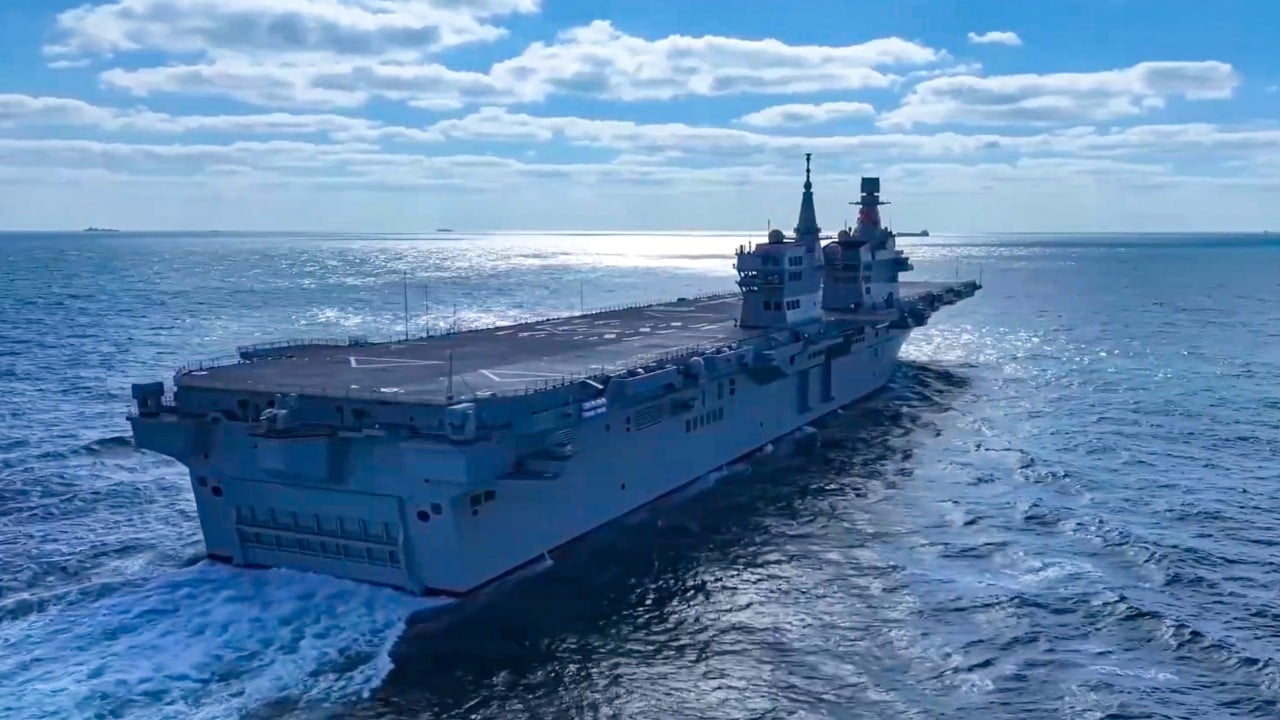
The Type 076 landing helicopter dock (LHD) represents a fundamental pivot in naval architecture, moving away from the traditional role of amphibious assault toward a specialized platform for sustained unmanned aerial operations. While its predecessor, the Type 075, focused on the vertical envelopment of a coastline through rotorcraft and hovercraft, the Type 076 integrates electromagnetic catapult systems (EMALS) into a hull form typically reserved for littoral operations. This integration creates a unique hybrid: a high-capacity drone carrier designed to saturate contested airspaces without the massive displacement or procurement cost of a supercarrier.
The Triad of Technical Disruption
The strategic value of the Type 076 is defined by three specific engineering shifts that differentiate it from existing amphibious vessels.
1. The Electromagnetic Launch Constraint
The inclusion of EMALS on a medium-tonnage vessel (estimated at 40,000 to 50,000 tons) solves a critical launch-weight problem. Conventional LHDs are limited to Short Take-Off and Vertical Landing (STOVL) aircraft, such as the F-35B or the AV-8B Harrier. These aircraft require complex propulsion systems that eat into fuel and payload capacity. By utilizing a catapult, the Type 076 can launch fixed-wing Unmanned Combat Aerial Vehicles (UCAVs) with higher wing loading and greater endurance.
This mechanism allows for the deployment of heavy-payload drones like the GJ-11 Sharp Sword, which features a flying-wing design optimized for stealth rather than short-field performance. The catapult removes the aerodynamic compromise inherent in vertical takeoff, enabling the vessel to project "silent" strike capabilities that can operate within the internal weapon bays of a stealth airframe.
2. Arrested Recovery and Sortie Generation
Unlike the "lightning carriers" or small carriers used by other navies that rely on vertical landings, the Type 076 is expected to utilize arresting gear. This creates a circular logic of efficiency:
- Mass Efficiency: Aircraft do not need to carry the heavy vertical-lift fans or pivoting nozzles required for vertical landings.
- Turnaround Velocity: Fixed-wing recovery via arresting wires allows for a more standardized flight deck flow, potentially increasing the number of sorties per 24-hour cycle compared to the slow, heat-intensive process of vertical recovery on a non-catapult deck.
- Payload Retention: Drones can return to the ship with unspent ordnance, a task that is often weight-restricted during vertical landings in high-temperature environments.
3. The Displacement-to-Cost Ratio
The Type 076 fills a structural gap in the "high-low" mix of a modern fleet. A Type 003 carrier is a billion-dollar asset that requires a massive screen of destroyers and frigates. The Type 076, utilizing a more commercialized LHD hull form, offers a more expendable yet highly lethal alternative. It decentralizes air power. If a fleet relies on one or two supercarriers, the loss of one deck destroys 50% of the fleet's air capability. Spreading fixed-wing drone capacity across several Type 076 vessels creates a distributed lethality that is harder to neutralize.
Strategic Logic of Unmanned Saturation in the South China Sea
The deployment of the Type 076 for training drills in the South China Sea is not merely a show of force; it is a live-environment test of "Unmanned Swarm Logic." The geography of the South China Sea—characterized by dispersed island outposts and shallow waters—favors a vessel that can act as a mobile hive.
The Sensor-to-Shooter Bottleneck
Traditional naval operations are limited by the radar horizon. A ship can only see as far as its masts allow, usually around 30 kilometers for surface targets. By operating a fleet of high-endurance drones from a Type 076, the "eyes" of the fleet are elevated to 40,000 feet, extending the sensor range to hundreds of kilometers.
The Type 076 functions as a localized Command and Control (C2) node. The drones launched from its deck do not just carry bombs; they carry electronic intelligence (ELINT) suites and active electronically scanned array (AESA) radars. This data is fed back to the carrier and then distributed to long-range missile platforms, such as the Type 055 destroyer or land-based DF-21D batteries. The Type 076 turns the entire theater into a transparent battlespace where the enemy has nowhere to hide.
Denial of Access through Attrition
In a high-intensity conflict, the primary goal is to deplete the enemy's expensive interceptor missiles with cheap, autonomous targets. The Type 076 is the primary delivery vehicle for this attrition strategy.
- Launch: The carrier releases waves of low-cost UCAVs.
- Engagement: The adversary is forced to use $2 million interceptor missiles to down $500,000 drones.
- Depletion: Once the adversary’s magazine depth is exhausted, the Type 076 launches its "silver bullets"—the stealthy, high-end UCAVs—to strike high-value targets.
Architectural Limitations and Vulnerabilities
It is an analytical error to view the Type 076 as a "carrier killer" or a direct substitute for a supercarrier. It operates under significant physical and operational constraints that dictate its usage.
The Single-Catapult Bottleneck
Current satellite imagery and deck plans suggest a limited number of catapults—likely one or two. This creates a fundamental limit on "Alpha Strikes" (launching the entire air wing at once). While a supercarrier can launch four aircraft in rapid succession, the Type 076 will have a slower launch cadence. This makes it less effective for overwhelming a sophisticated carrier strike group in a direct duel, but perfectly suited for the steady-state patrol and "drip-feed" aerial presence required in the South China Sea.
Defensive Deficits
An LHD hull is not built to the same survivability standards as a dedicated aircraft carrier. It lacks the extensive compartmentalization and armor of a capital ship. The Type 076 relies entirely on its escorting destroyers for anti-submarine and anti-ballistic missile defense. If caught isolated, its ability to withstand a modern anti-ship cruise missile (ASCM) hit is significantly lower than that of a 100,000-ton vessel.
The Propulsion Trade-off
To keep costs down, these vessels often use diesel or gas turbine propulsion rather than nuclear power. This limits their top speed and, more importantly, their electrical power generation. Running an EMALS system requires massive bursts of energy, typically stored in flywheels or capacitors. The engineering challenge for the Type 076 is maintaining enough sustained power to cycle the catapult while simultaneously running high-powered sensors and propulsion. This likely means the launch rate will be tied directly to the ship's fuel consumption and mechanical fatigue.
Tactical Integration with the Type 075
The most likely operational configuration for the Type 076 is as part of an Amphibious Task Group (ATG) alongside the Type 075. In this "Dual-LHD" model, the roles are strictly bifurcated:
- Type 075 (The Hammer): Carries the Z-8 and Z-20 helicopters, transporting marines and heavy equipment to the beach. It handles the "dirty" work of physical occupation.
- Type 076 (The Shield and Eye): Remains offshore, launching drones to provide a continuous Combat Air Patrol (CAP) over the landing zone. It suppresses enemy air defenses (SEAD) and provides real-time targeting data to the troops on the ground.
This division of labor prevents the "bottlenecking" of the flight deck. By moving the fixed-wing drone requirements to the Type 076, the Type 075 can maximize its deck space for rapid helicopter rotations.
The Shift in Maritime Hegemony
The existence of the Type 076 signals that the era of the "all-purpose" ship is ending. Naval power is moving toward modularity. The Type 076 is essentially a modular airbase that can be customized for the specific mission.
If the mission is counter-insurgency or littoral patrol, the hangar is filled with surveillance drones. If the mission is high-end sea denial, the hangar is filled with stealthy strike UCAVs and electronic warfare birds. This flexibility allows a navy to scale its presence without the political and financial baggage of deploying a full carrier strike group.
The South China Sea drills are the calibration phase for this new doctrine. Analysts should focus not on the ship's movement, but on the communication links between the ship and its unmanned assets. The true "weapon" of the Type 076 is the software architecture that allows a single ship to coordinate twenty or thirty autonomous aircraft in a synchronized attack.
Strategic Forecast
Expect the Type 076 to become the standard "workhorse" of regional power projection. While the Type 003 and 004 carriers will be reserved for prestige and "blue water" operations in the Indian or Pacific Oceans, the Type 076 will be the primary tool for enforcing territorial claims in the First Island Chain.
The move to integrate EMALS on an LHD-sized hull will likely trigger a reactive design cycle in other navies, particularly those currently operating F-35B-capable ships. The "Drone Carrier" is no longer a conceptual experiment; it is a realized logistical framework that prioritizes mass, persistence, and unmanned attrition over the traditional metrics of tonnage and manned pilot proficiency. The final evolution of this platform will be the full automation of the flight deck, where AI-driven "deck hands" manage the movement and fueling of drones, further reducing the crew requirements and increasing the operational tempo beyond human limits.
Military planners must now account for a reality where "air superiority" is not won by the best pilot, but by the navy that can maintain the highest number of autonomous sensors in the air for the longest period. The Type 076 is the first vessel designed specifically to win that war of persistence.