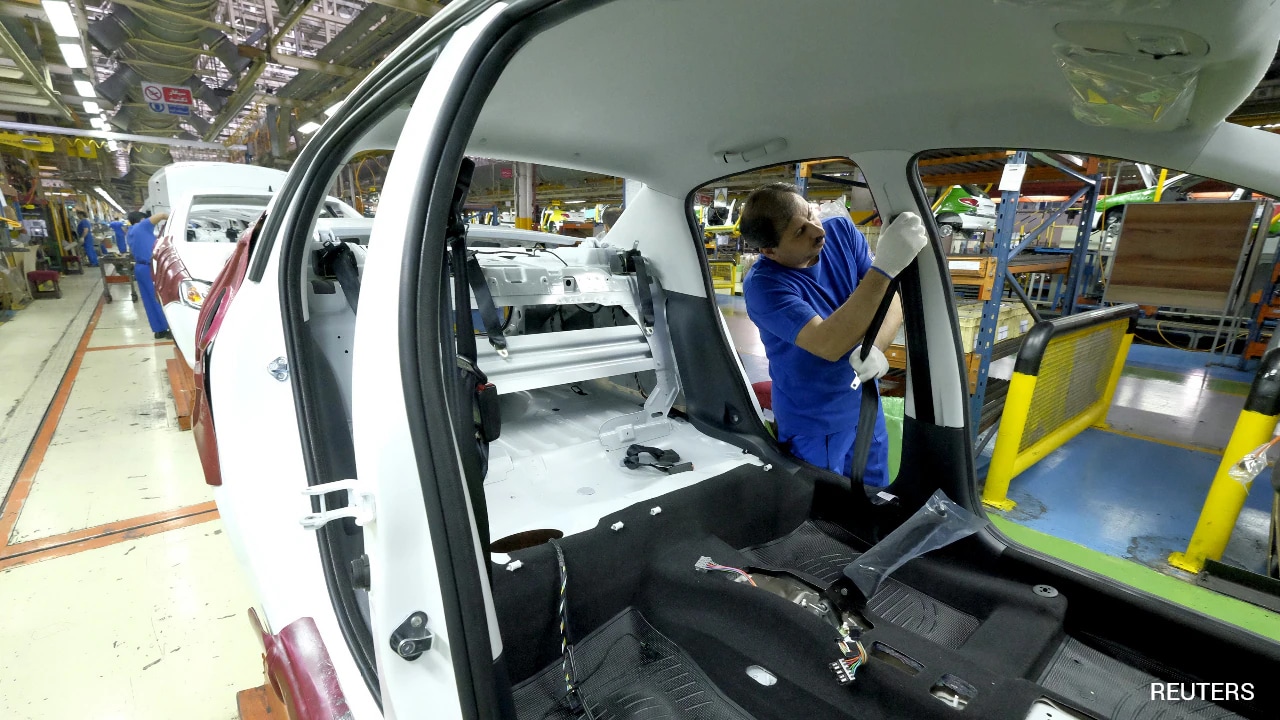
The United States Treasury Department has officially broadened its economic crosshairs, moving beyond traditional maritime choke points and oil pipelines to dismantle Iran’s terrestrial logistics. Under the banner of Operation Economic Outcast, Washington's latest sectoral determinations target the spine of Iran's domestic manufacturing and internal supply chain: its automotive and railway networks. For decades, economic warfare against Tehran relied on naval blockades and financial isolation of the energy sector. But as maritime routes tightened, the Iranian regime adapted, rerouting illicit cargo, chemicals, and industrial revenue streams across overland tracks and state-backed manufacturing fronts.
This is not a routine administrative penalty. It represents a fundamental shift in strategy, acknowledging that to truly squeeze an insulated economy, every back door must be welded shut.
The Anatomy of a Captive Market
To understand why the White House targeted Iran Khodro (IKCO) and SAIPA—the nation's twin automotive monoliths—one must look past the low-quality badge engineering. For years, Western analysts misread these companies as bloated, inefficient domestic carmakers struggling under the weight of ordinary commercial mismanagement. In reality, they function as financial laundering machines and industrial incubators for the Islamic Revolutionary Guard Corps (IRGC).
These two entities control over ninety percent of Iran's domestic auto production. They generate steady internal cash flow, employ tens of thousands of workers, and crucially, maintain dual-use manufacturing capabilities that directly support the regime's defense industrial base. When an automotive plant produces military transport chassis or sources dual-use electronics under civilian commercial cover, the line between state commerce and state security vanishes.
By designating IKCO, SAIPA, and key subsidiaries like Iran Khodro Diesel and Pars Khodro under Executive Order 13902, the Treasury has stripped away the corporate veil. Any international supplier, whether located in the United Arab Emirates, Turkey, or Indonesia, that continues to feed components, steel, or assembly tech into these networks now faces catastrophic secondary sanctions exposure. The administrative grace period is over. Compliance departments across emerging markets are discovering that traditional due diligence checklists are no longer sufficient to protect them from the long arm of U.S. enforcement.
Steel Tracks and Shadow Networks
While the automotive sector absorbs the domestic industrial shock, Iran's railway network forms the external vascular system of its sanction-evasion architecture. As maritime surveillance tightened around the Strait of Hormuz, Tehran increasingly pivoted toward overland corridors, moving fertilizer, precursor chemicals, and petroleum products by rail and heavy truck freight.
Railways offer a high-volume, difficult-to-monitor alternative to container ships. Freight cars cross borders into neighboring jurisdictions with minimal customs friction, mixing licit agricultural goods with illicit industrial cargo. By bringing the state railway operators and associated logistics infrastructure under the sanctions regime, Washington is attempting to choke this terrestrial bypass.
Yet, enforcement on land is exponentially more complex than enforcement at sea. A container ship has a transponder, a flag state, and a designated port of call. A freight train crossing an inland border crossing involves localized politics, regional trading partners who depend on cross-border commerce, and complex freight forwarder chains. For Operation Economic Outcast to succeed on land, the United States must exert immense diplomatic and financial pressure on transit hubs that have historically turned a blind eye to dual-use cargo transfers.
The Compliance Quagmire for Multinationals
For international corporations, the widening of sectoral sanctions creates an acute operational headache. It is entirely insufficient to simply stop shipping finished goods to Iranian ports. Global supply chains are porous, and sub-tier suppliers often source raw materials or components that trace back to sanctioned Iranian entities, particularly within the metals, mining, and manufacturing sectors.
Consider a hypothetical tier-three manufacturing supplier in Southeast Asia that exports specialized alloy castings. If even a fractional percentage of their raw material procurement intersects with designated Iranian industrial fronts, their access to U.S. dollar clearing accounts can be severed overnight. Financial institutions are responding by deploying hyper-conservative risk parameters. They are cutting ties with any freight forwarder, inland port operator, or logistics firm that cannot definitively prove its cargo manifests are entirely free of Iranian nexus.
This creates a chilling effect across regional trade. Companies are forced to choose between a minor, distant commercial relationship with Iranian intermediaries or maintaining unobstructed access to the global financial system. Predictably, most choose self-preservation.
The Domestic Gamble inside Iran
The architects of this maximum pressure strategy are betting on a severe internal tipping point. By striking at the automotive and rail sectors, the pressure moves from abstract macroeconomic indicators down to the daily friction experienced by the broader population. Iran's domestic manufacturing ecosystem supports hundreds of thousands of livelihoods. When major assembly lines stutter due to a lack of imported sub-components, and when internal transport costs skyrocket because the railway infrastructure is starved of maintenance capital, the economic contraction hits the working class directly.
Tehran’s political strategy relies on shifting the blame entirely outward, painting foreign pressure as the sole source of domestic hardship. Regime officials frequently project confidence, predicting that shifting political cycles in Washington will eventually soften the enforcement posture.
However, the structural reality of Operation Economic Outcast is designed to be self-sustaining. By mapping the shadow banking networks, front companies in Hong Kong and the Caribbean, and third-party procurement hubs that keep these industrial sectors afloat, the U.S. Treasury has built an evidentiary web that transcends short-term political shifts.
The maritime routes are heavily restricted, the skies are increasingly monitored, and now the asphalt roads and steel tracks are under direct financial assault. The regime’s options for generating illicit revenue are narrowing to a suffocating degree, leaving the domestic economy cornered by its own structural dependencies.