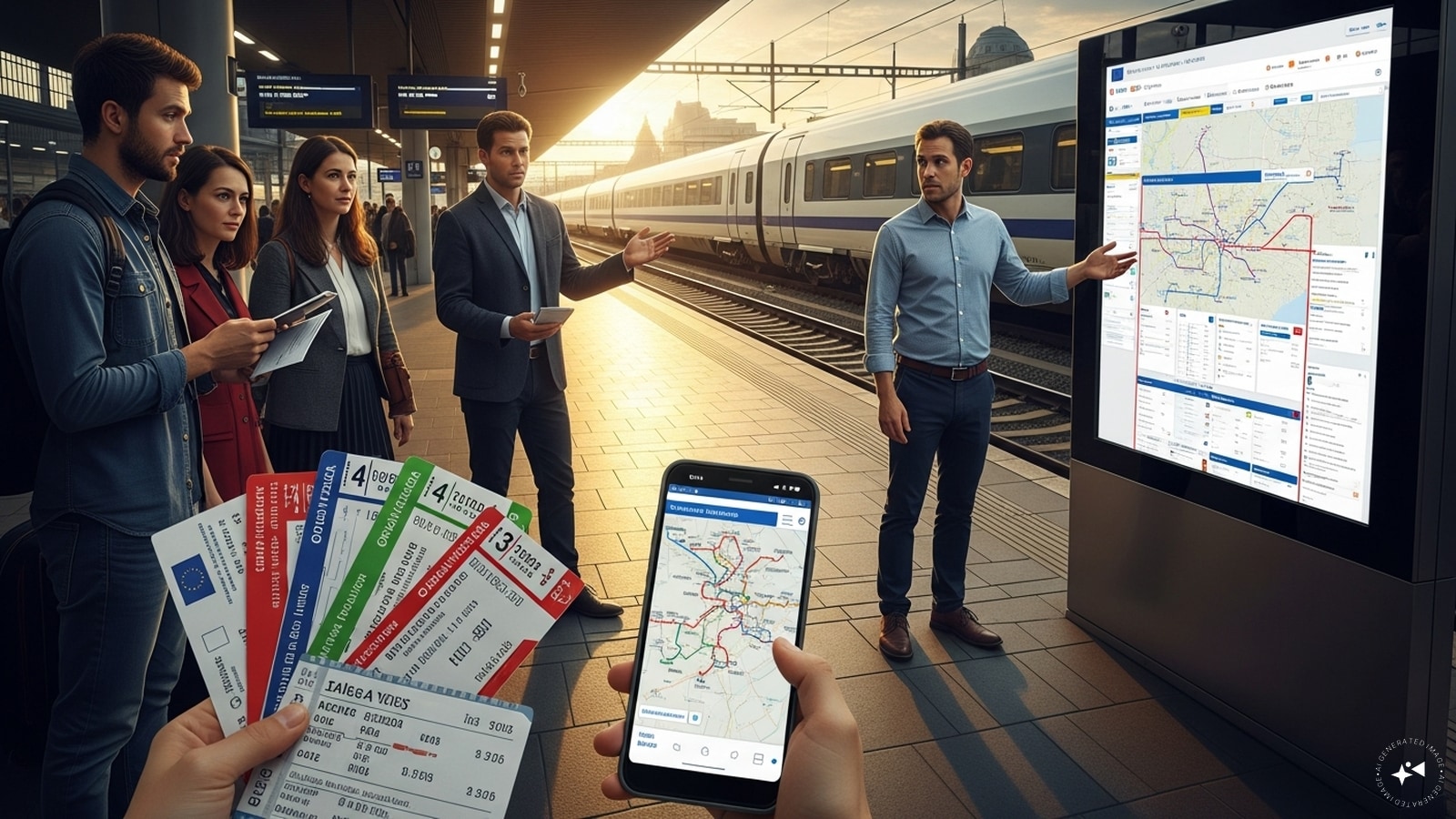
Brussels is selling a daydream. The European Commission is currently patting itself on the back for its latest push toward "multimodal digital mobility services." To the average vacationer, it sounds like a miracle: a single ticket that lets you glide from a French TGV to a German ICE and onto a Polish regional train, all with the click of one button and the legal protection of a single contract.
It is a bureaucratic mirage.
The promise of a unified European rail ticket isn't just difficult to implement; it is fundamentally at odds with how modern transportation economics work. By trying to force rival rail companies to play nice, the EU is about to break the only thing currently making European rail travel affordable: competition. If you think the "one-ticket" dream is going to lower prices or make your life easier, you haven't been paying attention to how monopolies actually function.
The Myth of the "Seamless" Journey
The logic of the EU’s plan is simple on the surface. If you book a flight from London to Tokyo with a layover in Dubai, and the first leg is late, the airline is on the hook. You get rebooked. You get a hotel. You get fed. The EU wants to transplant this "passenger rights" model onto rail.
Here is the problem: Airlines operate in a hub-and-spoke system where code-sharing agreements are baked into the business model. Rail is a fragmented, infrastructure-heavy monster.
When a Deutsche Bahn (DB) train is delayed by twenty minutes—which, let’s be honest, is practically a guarantee these days—and you miss your connecting Trenitalia service in Milan, who pays? Under the proposed rules, the first carrier or the ticket seller takes the hit. This sounds great for the traveler until you realize that DB and Trenitalia aren't partners; they are fierce competitors on lucrative cross-border routes.
Forcing a Spanish operator to underwrite the reliability of a crumbling German rail network is a recipe for an accounting nightmare. I’ve consulted for logistics firms that struggle to sync three warehouses in the same zip code. Trying to sync thirty state-backed rail giants and dozen-plus private startups across twenty-seven jurisdictions is a fool’s errand.
The Death of the Discount
The "one-ticket" mandate will kill the budget traveler’s greatest weapon: the split-ticket price war.
Right now, savvy travelers use platforms like Trainline or Omio to hunt for deals. You might buy a cheap Ouigo segment in France and pair it with a separate discounted Sparpreis ticket in Germany. You take the risk of the connection, but you save €150.
Once the EU mandates "through-ticketing" with full liability, the "convenience" tax will be astronomical. Operators will bake the cost of potential delays and re-accommodation into the base price of every ticket. They have to. If I am an operator and I am legally forced to guarantee your arrival on a different company’s train, I am going to charge you a massive premium for that insurance policy.
We are moving toward a "Boutique Rail" model where only the wealthy can afford the protected "Euro-Ticket," while everyone else is left scrounging for leftovers. The EU isn't democratizing travel; they are creating a premium tier of transit that looks remarkably like the bloated, overpriced national monopolies we spent the last twenty years trying to dismantle.
Why Infrastructure, Not Apps, is the Real Bottleneck
The obsession with the digital interface—the "one app to rule them all"—is a classic distraction technique. It allows politicians to look busy without actually pouring concrete.
The reason you can’t get from Lyon to Munich easily isn’t because you have to use two different apps. It’s because the physical tracks don’t support the volume. We have different signaling systems (ETCS is still a fragmented mess), different track gauges in the Iberian Peninsula, and different voltages in overhead lines.
- Fact Check: There are currently over 20 different signaling and speed control systems across the EU rail network.
- The Reality: A train driver moving from Paris to Frankfurt often has to be certified in multiple languages and technical systems, or the locomotive itself has to be swapped at the border.
The EU’s push for a single ticket is like trying to build a world-class website for a store that has no inventory and a collapsing roof. It addresses the "booking friction" while ignoring the "operational friction" that actually makes cross-border rail a headache.
Imagine a scenario where the EU spends the same political capital on harmonizing the power grids and track maintenance schedules of its member states. That would actually speed up travel. Instead, they are arguing over who gets to host the API for a ticket that most people won't be able to afford.
The Data Grab You Aren't Seeing
There is a darker side to the "Single Digital Market" for rail: the death of the independent reseller.
The EU proposal often hints at forcing national operators (like SNCF or DB) to share their real-time data with third-party platforms. On the surface, this is pro-consumer. In practice, the state-owned giants hate this. They want you on their own apps, where they can upsell you on hotels and car rentals.
By mandating a "single ticket" framework, the EU is inadvertently giving the giants a reason to tighten their grip. If they are legally responsible for the "journey," they will demand total control over the data. This will squeeze out the small, innovative startups that actually made rail booking easier over the last decade. We are watching the "platformization" of rail, where the winner isn't the company with the fastest trains, but the company with the most aggressive data-sharing lawyers.
Stop Fixing the Ticket, Fix the Train
If we want people to stop flying from Rome to Berlin, the solution isn't a prettier PDF in their inbox. The solution is a competitive, high-frequency rail network where "connections" aren't a high-stakes gamble.
The obsession with through-ticketing assumes that rail travel should function like the airline industry. It shouldn't. Rail is at its best when it is high-frequency and "turn-up-and-go."
The Swiss have already figured this out with the Taktfahrplan (integrated fixed-interval timetable). You don't need a "protected" ticket if the next train leaves in fifteen minutes. You just get on the next one. The "protection" is built into the frequency of the service, not a legal contract.
The EU's move is a confession of failure. It is an admission that they cannot make the trains run on time, so they are going to spend the next ten years litigating who pays the passenger when they are late.
The Actionable Truth for Travelers
If you want to travel Europe by rail in 2026, ignore the hype about "unified ticketing." It’s a trap that will lead to higher fares and less flexibility.
- Embrace the Split-Ticket: Buy your legs separately. Use a buffer of two hours at major hubs like Basel or Brussels. Go get a coffee. Read a book. You will save 40% compared to any "integrated" fare the EU manages to churn out.
- Trust the Privateers: Whenever possible, book with private operators like Italo in Italy or Westbahn in Austria. They are leaner, hungrier, and usually have better tech than the state-owned behemoths.
- Assume the Delay: Never book a rail connection that requires a "guarantee" to be viable. If the connection is that tight, the infrastructure will fail you, regardless of what the law says.
The EU’s plan is a bureaucratic solution to a physical problem. It’s an attempt to legislate "smoothness" into a system that is fundamentally jagged. Until the tracks are unified, the tickets shouldn't be.
Stop waiting for a single app to save European travel. The chaos is where the value is.