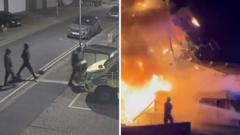
The grainiest video you’ve ever seen just dropped, and the internet is doing its favorite thing: playing detective while accomplishing absolutely nothing.
The recent footage from Golders Green showing suspects involved in an ambulance attack is being treated like a breakthrough. It isn't. It’s a post-mortem. By the time the public sees these pixelated silhouettes, the trauma is already etched into the victims, the vehicle is out of commission, and the "security" we pay for has already failed its only meaningful test.
We are addicted to the theater of surveillance. We mistake the ability to watch a crime for the ability to prevent one. If we want to actually protect emergency workers and the public, we have to stop worshiping the "Ring doorbell" culture and start dismantling the logic that says a camera on a pole is a substitute for a functioning society.
The Surveillance Trap: High Cost, Low Yield
For decades, the UK has been the most watched nation on earth. We have more cameras per capita than almost any other Western country. And yet, here we are, squinting at a screen trying to identify a person in a hoodie from fifty yards away.
The "lazy consensus" among local councils and police departments is that more eyes equals less crime. The data suggests otherwise. A massive meta-analysis by the College of Policing found that while CCTV can reduce certain types of property crime—specifically in parking lots—it has a negligible effect on violent crime or public disorder.
Why? Because a person brazen enough to attack an ambulance in broad daylight or under the cover of night in a high-traffic area like Golders Green isn't checking for lens flare. They aren't deterred by the "possibility" of being caught on a hard drive that might be overwritten in 48 hours.
Surveillance is a reactive technology masquerading as a proactive solution. It provides a sense of "closure" for the evening news, but it does nothing to harden the target. We are spending millions on the digital equivalent of a "Keep Off the Grass" sign while the grass is being set on fire.
The Ambulance as a Soft Target
The Golders Green incident highlights a terrifying reality: our most vital infrastructure is incredibly vulnerable. We’ve turned ambulances into high-tech mobile hospitals, but we’ve left the security protocols in the 1970s.
Critics will say, "We can't turn ambulances into tanks." They’re right. But we can stop pretending that a camera on a nearby shopfront is "protection."
I have spent years analyzing urban security bottlenecks. When you see an ambulance attacked, you aren't seeing a failure of the police to "be everywhere at once." You are seeing a failure of systemic design. We prioritize the visibility of the crime over the resiliency of the service.
If we took half the budget currently funneled into expansive, redundant CCTV networks and redirected it into real-time, integrated panic systems for EMS workers—systems that trigger immediate, localized intervention rather than just a recording for a courtroom six months later—we might actually save lives.
The Myth of the "Public Eye"
"People Also Ask" usually involves some variation of: How can I help the police identify suspects?
The brutal honesty? You probably can't.
Most CCTV footage released to the public is of such low quality that "identification" is more a matter of luck than science. Worse, it leads to "vigilante misidentification." We saw this during the Boston Marathon bombing. We see it on every local Facebook group. A blurry image of a person in a North Face jacket is enough to ruin the life of a random delivery driver who happened to be in the wrong zip code.
The reliance on public appeals for CCTV identification is an admission of defeat by the state. It says: "We let this happen, we didn't catch them, and now we need you to do our job with zero training and terrible tools."
Beyond the Lens: The Real Solution
If we want to stop attacks in neighborhoods like Golders Green, we have to stop looking at the screen and start looking at the street.
- Contextual Policing over Digital Archiving: A camera doesn't have intuition. It doesn't notice the tension in a crowd or the erratic behavior of a loiterer. We have traded "beat" officers for "monitor" officers. One stops a fight; the other watches it.
- Hardening the Assets: Ambulances need more than just GPS. They need active-deterrence tech. This isn't science fiction; it’s basic logic. If a vehicle is a target, it needs to be able to signal for help in a way that creates an immediate physical or auditory barrier.
- The Golders Green Paradox: This is an area with a high sense of community but a high reliance on external security. When the "state" fails to protect an ambulance, the community feels it twice as hard. But more cameras won't restore that trust. Only the presence of physical security and faster response times will.
The Dark Side of Your Security Obsession
Here is the part nobody likes to admit: our demand for more CCTV is actually making it easier for criminals to operate.
How? Through Predictable Surveillance. Professional criminals know exactly where the "blind spots" are. They know which cameras are decoys and which ones haven't been serviced since 2018. By creating a "safe" zone of cameras, we create a roadmap for anyone smart enough to look up.
We’ve built a system that rewards the "appearance" of safety. It makes politicians look good in a press release. It makes tech companies rich. But for the paramedic being harassed or the ambulance being vandalized, it provides exactly zero protection.
Imagine a scenario where we stopped buying new cameras for six months. Imagine if that money—those millions—was spent on staffing and training. The crime rate wouldn't spike; the capture rate would. Because a camera can't make an arrest, and a pixel can't testify in court without a massive amount of corroborating evidence that we are currently too understaffed to collect.
Stop Watching and Start Acting
The next time you see a "Watch This" headline featuring grainy footage of a crime, don't feel safer because "the police are on it." Feel outraged that they’re asking you to do the work they failed to do.
The Golders Green footage isn't a success story. It’s a testament to a broken philosophy that thinks we can record our way to a safer society. We can't.
Tear down the cameras. Put people back on the corners. Give the paramedics more than a "Good Luck" and a dashcam.
The truth is uncomfortable: The camera isn't protecting you. It’s just filming your downfall for the six o’clock news.
Get off the screen and back into the real world.