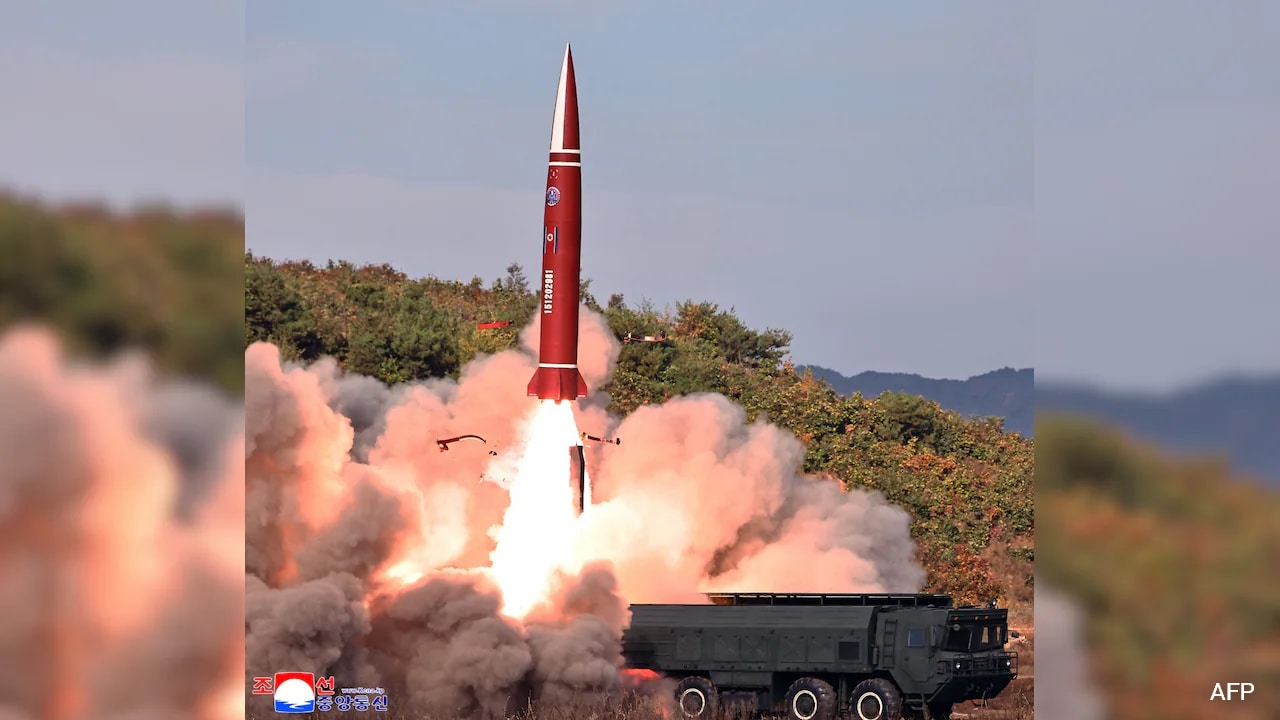
North Korea’s latest test of a new air-defence missile system signals a deliberate shift in Pyongyang’s military strategy from pure offensive nuclear deterrence to active survivability. Supervised by state media and military leadership, the launch evaluated a next-generation surface-to-air interceptor designed to engage incoming aerial threats, including cruise missiles, reconnaissance drones, and tactical ballistic warheads. While headlines routinely fixate on Pyongyang’s massive intercontinental ballistic missiles, this defensive test reveals a far more urgent reality on the Korean Peninsula. The regime recognizes that its offensive arsenal is useless if it cannot survive the first forty-eight hours of a modern air campaign.
For decades, North Korean air defense was a museum piece. The Korean People’s Army Air and Anti-Air Force relied heavily on aging Soviet-era hardware like the S-75 Dvina and S-125 Neva, systems designed to shoot down high-altitude bombers from the Vietnam era. Against fifth-generation stealth aircraft like the F-35 Lightning II, now operated by both the United States and South Korea, those legacy batteries are effectively blind. They lack the radar resolution to track low-observable airframes and the computing speed to calculate intercepts against maneuvering munitions.
That vulnerability kept generals in Pyongyang awake at night. If a conflict erupted, allied air power would dismantle North Korea’s command-and-control nodes, radar sites, and mobile missile launchers before a fraction of its nuclear force could leave its underground bunkers.
The Anatomy of an Asymmetric Shield
Building a credible air-defence missile system requires solving one of the hardest engineering problems in modern warfare. You are trying to hit a bullet with another bullet, often at closing speeds exceeding several kilometers per second.
To close this technological gap, North Korea has spent the last decade developing indigenous surface-to-air platforms, most notably the Pongae-5 and Pongae-6 series—designated by Western intelligence as the KN-06 and a newer, unnamed variant often compared to Russia’s S-300 and S-400 systems. The recent test represents the evolutionary peak of this program.
State media releases from these trials typically highlight two specific technological upgrades that defense analysts scrutinize frame by frame.
- Twin-rudder control systems and double-impulse flight engines. In plain terms, a double-impulse motor allows the interceptor to ignite a second stage of solid fuel just before impact. This gives the missile a sudden burst of kinetic energy in the terminal phase of flight, enabling it to pull extreme G-forces to match the evasive maneuvers of an incoming cruise missile or fighter jet.
- Phased-array radar integration. Traditional radars sweep a mechanical dish across the sky, creating a delay between updates. Phased-array radars steer beams electronically, tracking dozens of targets simultaneously while guiding multiple interceptors toward them.
When North Korea claims a new anti-aircraft missile can destroy "various aerial targets," they are specifically talking about countering South Korea’s Kill Chain doctrine. Kill Chain is Seoul’s preemptive strike strategy, designed to detect imminent nuclear launch preparations and obliterate them on the ground using precision-guided munitions and tactical ballistic missiles like the Hyunmoo series. By fielding a functional terminal defense shield, Pyongyang hopes to blunt that initial decapitation strike, buying enough time to disperse and launch its own nuclear payloads.
The Moscow Connection and Battlefield Telemetry
You cannot analyze North Korean air defense in a vacuum anymore. The geopolitical tectonic plates shifted permanently when Pyongyang began shipping millions of artillery shells and ballistic missiles to Russia for use in Ukraine.
Military technology transfer is rarely a one-way street. While intelligence agencies have stopped short of confirming complete blueprints changing hands, the sudden acceleration in North Korean air-defense reliability tracks closely with deepening Russo-Korean defense cooperation. Russia operates some of the most battle-tested surface-to-air networks on earth, having spent years defending against Western-supplied HIMARS rockets, Storm Shadow cruise missiles, and commercial drone swarms.
Consider a hypothetical scenario in which North Korean engineers gain access to Russian radar signal-processing algorithms or electronic warfare countermeasures. Even minor software refinements—such as filtering out ground clutter or resisting radar jamming—could shave years off Pyongyang’s domestic research and development timeline.
Furthermore, North Korea’s own KN-23 and KN-24 ballistic missiles are currently being fired in combat in Eastern Europe. Every launch generates telemetry data on how modern Western air-defense batteries, like the Patriot PAC-3, detect and intercept North Korean flight profiles. That real-world combat feedback flows straight back to the Academy of Defense Science in Pyongyang. They are learning how to defeat Western shields while simultaneously building better shields of their own.
The Drone Problem Nobody Talks About
High-altitude stealth fighters get the press, yet low-altitude unmanned aerial vehicles represent a much more immediate headache for North Korean air-defense commanders.
In late 2022, five small North Korean drones crossed the Demilitarized Zone, with one penetrating the no-fly zone around the South Korean presidential office in Seoul. The incident exposed a massive blind spot in South Korea’s air defense network, which was tuned to catch fast-moving jets and ballistic missiles, not slow, tiny, composite-frame drones flying close to the terrain.
Pyongyang knows that the exact same vulnerability works in reverse. South Korea has since established a dedicated Drone Operations Command, investing heavily in long-endurance surveillance UAVs and loitering munitions.
Intercepting a small drone with a massive, multi-million-dollar surface-to-air missile is economically ruinous and technically difficult. Small drones have minuscule radar cross-sections and low thermal signatures. A new air-defence missile system must therefore operate as part of a layered network—combining long-range area interceptors with short-range point-defense guns, optical tracking sensors, and electronic jamming systems. Without that lower tier, an adversary can simply exhaust North Korea’s expensive missile inventory using cheap, expendable decoys.
Reading Between the Lines of State Propaganda
Whenever Korean Central News Agency releases photographs of a missile test, analysts look at what is missing just as closely as what is shown.
Notice the environment. Tests are almost always conducted over the East Sea under pristine weather conditions, against predictable target drones flying steady trajectories. Real warfare is messy. In an actual conflict on the Korean Peninsula, North Korean radar operators would be operating under severe electronic warfare attack. Specialized aircraft like the EA-18G Growler would flood the electromagnetic spectrum with noise, blinding receivers and feeding false target coordinates into fire-control computers.
There is also the acute problem of logistics and production scale. Testing a prototype battery on a coastal range is vastly different from manufacturing hundreds of solid-fuel interceptors under the crushing weight of international sanctions.
Solid-fuel propellant requires precise chemical precursors and specialized mixing equipment. High-end seeker heads demand microelectronics, inertial measurement units, and radio-frequency components that North Korea cannot legally import. While Pyongyang has proven remarkably adept at skirting sanctions through shell companies and illicit maritime transfers, mass-producing complex air-defense missiles remains a severe industrial bottleneck. A single sophisticated surface-to-air battery can fire off its entire ready-to-launch loadout in under two minutes during a saturation attack. If the factories behind the lines cannot replace those tubes rapidly, the shield collapses after the first wave.
The Strategic Calculation in Northeast Asia
Why announce this test now? Timing in Pyongyang is never accidental.
Military demonstrations serve three distinct audiences simultaneously. First is the domestic population, who are fed a steady diet of technological triumph to justify chronic economic deprivation and rigid state control. Second is South Korea and the United States, particularly during periods of joint military exercises that Pyongyang views as rehearsals for invasion. Demonstrating an improved anti-air capability raises the projected cost of any future allied air campaign.
The third audience is the global arms market.
North Korea has transformed from an isolated pariah state into a major munitions supplier. By publicly showcasing an indigenous, modern air-defence missile system, Pyongyang is effectively running a live-fire advertisement for sanctioned regimes or non-state actors looking for alternatives to Western hardware. Russian air-defense production lines are currently stretched to their absolute limit just to replace losses and protect domestic infrastructure. Countries that once relied on Moscow for surface-to-air missiles are suddenly facing multi-year backlogs. North Korea is positioning itself to fill that vacuum.
The Reality of Deterrence on the Peninsula
A stronger North Korean air-defense network does not make the Korean Peninsula impenetrable, nor does it neutralize the overwhelming technological superiority of the US-ROK alliance. Stealth aircraft, stand-off cruise missiles launched from outside radar range, and cyber operations targeting command networks still hold decisive advantages.
What it does change is the risk calculation.
Deterrence relies on doubt. As long as North Korean leaders believed their forces would be wiped out instantly in a conventional conflict, their doctrine leaned heavily toward a "use it or lose it" nuclear posture—creating terrifying pressure to escalate early in any crisis. Ironically, by field-testing a more capable defensive shield, Pyongyang is trying to buy itself survival margin. Whether that margin breeds reckless overconfidence or slightly reduces hair-trigger nuclear anxiety depends entirely on how well those missiles actually perform when the radars are jammed and the sky is full of incoming fire.


