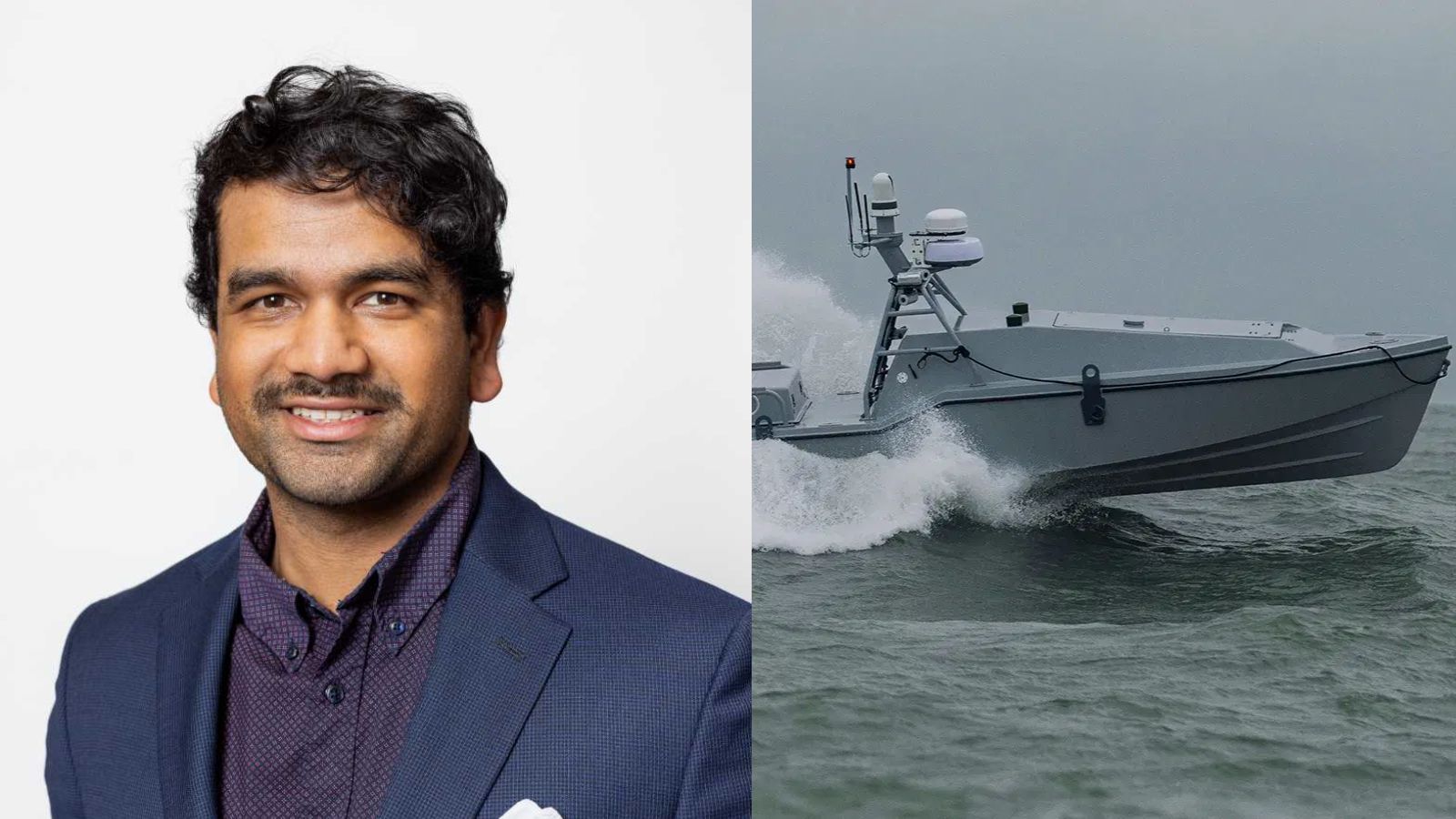
The Atlantic Ocean at three o’clock in the morning does not look like water. It looks like liquid obsidian, heavy and indifferent, moving with a terrifying, rhythmic muscle. If you fall into it from the deck of a United States Navy vessel, the world shrinks instantly. The ship, a floating city of steel and fluorescent light, keeps moving. It has to. Turbines running at full steam cannot simply brake. By the time the watch officer yells "Man overboard," the gap between you and safety is already measured in football fields.
Then comes the dark.
Searching for a human head—roughly the size of a coconut—in a pitch-black, churning ocean is an exercise in statistical despair. Sailors call it looking for a needle in a moving haystack, except the haystack is trying to drown you. Night-vision goggles fog. Searchlights slice through the mist, catching nothing but whitecaps. Every second the water temperature saps warmth from the human core. Panic sets in. The lungs burn.
For decades, this was a grim equation of probability that naval commanders simply had to accept. If someone went over the side at night, the odds favored the ocean.
But a few years ago, the math changed. It changed because a quiet, unassuming engineer looked at a drone and didn't see a weapon or a camera toy. He saw a life raft with wings.
The Weight of the Blank Screen
Vibhav Altekar does not look like a man who wrestles with the fury of the open sea. Based in California, the Indian-American tech mind carries the calm, deliberate cadence of a classic researcher. He speaks in measured sentences, the kind that favor precision over bravado. Yet, his daily work sits at the intersection of life and sudden death.
To understand what Altekar built, you have to understand the sheer limitations of traditional rescue operations. When a sailor goes missing, the protocol is loud, violent, and agonizingly slow. Helicopters must be spun up. Crews must be briefed. Search grids must be calculated on maps that change with every knot of the ocean current.
Altekar looked at this chaos and saw a vacuum.
Imagine a different sequence of events. The cry goes out: Man overboard. Instead of waiting for a multi-million-dollar chopper to clear the flight deck, a sailor runs to the rail and launches a compact, rugged drone directly into the gale. The drone doesn't need a pilot to find its bearings. It doesn't get disoriented by the pitch-black horizon. It flies out, locks its digital eyes onto the thermal signature of a human body shivering in the waves, and drops a life-saving payload right into their hands.
This is the artifact Altekar helped forge: the US Navy’s life-saving drone, a piece of autonomous technology designed not to take lives, but to fiercely protect them.
The engineering hurdle here wasn't just making something fly. It was making something survive. The ocean is a graveyard for electronics. Saltwater corrodes circuitry within minutes. High winds rip standard rotors apart. The flight deck of a destroyer is an electromagnetic nightmare, buzzing with radar and communications arrays that can scramble a standard drone's internal compass.
Altekar’s genius lay in making the machine smarter than the environment trying to kill it. He worked to ensure that the drone could think on its own, navigating through brutal crosswinds and electronic interference without requiring a sailor to manipulate a joystick from a distance. In the middle of a crisis, the crew needs to focus on the rescue, not on piloting a remote-controlled aircraft.
When the Code Meets the Cold
Let us examine what actually happens when abstract software design meets the terrifying reality of a maritime emergency.
Consider a hypothetical sailor. We will call him Specialist Torres. It is a Tuesday night off the coast of a stormy Pacific cape. A rogue wave catches him near the catwalk. In a blink, he is airborne, then submerged in forty-five-degree water.
When Torres surfaces, gasping, his mind enters a state of hyper-arousal. His vision narrows. His fingers go numb within three minutes, losing the fine motor skills required to tie a knot or grab a slick rope.
In the old days, the ship would spin into a massive, sweeping turn called a Williamson Turn, a maneuver that takes valuable time and brings the massive hull back along the original track. Meanwhile, Torres would be drifting, a speck of warmth fading into the black.
With Altekar’s technology, the response is near-instantaneous. The autonomous drone leaves its cradle. It uses specialized sensors that cut through the visual noise of ocean spray and darkness.
But the real problem lies elsewhere. It isn't just about finding Torres; it is about keeping him alive until a rigid-hull inflatable boat can fight its way through the swells to reach him.
The drone solves this by carrying a payload—an inflatable flotation device that activates the moment it hits the water. The drone’s software calculates the wind drift, the speed of the current, and the trajectory of the falling package. It doesn't drop the raft on Torres; it drops it just upwind, allowing the ocean itself to push the survival gear directly into his desperate grasp.
Suddenly, Torres isn't treading water alone, fighting a losing battle against hypothermia. He is insulated. He has a beacon. He has a fighting chance.
The Unseen Architecture of Rescue
We often romanticize innovation as a single, blinding flash of insight. We like to picture the inventor working late in a garage, suddenly shouting "Eureka!" as the pieces fall into place.
The truth is much more exhausting.
Altekar’s journey to perfecting this system was a grueling marathon of trial and error. It meant testing materials against the corrosive bite of simulated sea spray. It meant debugging lines of code that dictated how a drone should behave when it loses its GPS signal over an endless expanse of gray water.
If the drone loses its connection to the ship, does it panic? Does it fly aimlessly until its battery dies?
Altekar and his team had to build a system that possessed a form of mechanical resilience. If the digital link snaps, the drone relies on its internal logic. It remembers where it came from, it calculates where the ship should be based on its last known speed and heading, and it returns home. It is an extraordinary feat of predictive mathematics masquerading as a humble search-and-rescue tool.
What makes this narrative so compelling is the cultural bridge it represents. Altekar represents a vibrant generation of Indian-American innovators who are quietly redefining the landscape of American defense and tech infrastructure. These are minds that don't always seek the spotlight of silicon valley consumer apps. They aren't building platforms to get groceries delivered five minutes faster or algorithms to maximize ad clicks.
They are working on the infrastructure of survival.
The Shift in the Wind
There is an old saying among mariners that the sea finds out everything you did wrong. It tests every weld, every seam, every line of code. If you are lazy, the ocean exposes you.
When Altekar's drone underwent rigorous testing by the US Navy, it wasn't just evaluated in a calm sunny bay. It was subjected to the harsh, unyielding realities of operational deployment. And it stood up to the test.
The adoption of this technology marks a fundamental shift in how the military views autonomous systems. For years, the public narrative around drones has been dominated by surveillance and strike capabilities. We think of them as shadows in the sky, harbingers of distant, clinical warfare.
Altekar’s work turns that paradigm on its head. It reframes the autonomous machine as a guardian angel. It proves that the same technological breakthroughs that allow a machine to track a target can be used to track a soul waiting for rescue.
The true value of this innovation cannot be measured in the dollar amount of the defense contract or the technical specifications listed in an engineering journal. The true value is found in the letters that won't have to be written to parents, spouses, and children. It is found in the quiet relief of a deck crew when they realize they didn't leave a teammate behind in the dark.
The next time a storm rages in the middle of the shipping lanes, and the swell rises to thirty feet, a young sailor will stand watch on a pitching deck. They will look out into the terrifying expanse of the black ocean. But they will do so knowing that if the worst happens, the sky above them holds a quiet, vigilant intelligence, engineered by a mind that refused to let the darkness win.