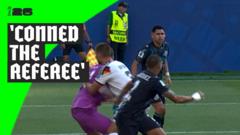
The grass at the Westfalenstadion does not just hold water; it holds noise. On a night drenched in summer rain, eighty thousand voices converged into a singular, vibrating entity. It is a sound that travels from the soles of your feet straight to your chest. When the ball hit the back of the net, that sound exploded.
Schlotterbeck had done it. Or so we thought. You might also find this similar story useful: The Calculated Power of the Wimbledon Royal Box Courtship.
For exactly twelve seconds, the world was perfect. Grown men fell into the arms of strangers. Beer rained down from the upper tiers, catching the floodlights like liquid amber. In that fleeting pocket of time, football was exactly what it was meant to be: raw, chaotic, and beautifully human.
Then came the silence. As extensively documented in latest reports by Sky Sports, the results are notable.
It did not happen all at once. It began as a low ripple of anxiety, a collective intake of breath as eighty thousand pairs of eyes shifted from the pitch to the giant screen hovering in the gloom. A referee, standing frozen in the center circle, pressed a single finger to his earpiece. He was no longer a judge of men; he was an antenna waiting for a signal from a windowless room miles away.
The machine was thinking. And while the machine thought, the soul of the stadium evaporated.
The Dissection of a Joy
What followed was not a refereeing decision. It was an autopsy.
Video Assistant Referee technology—VAR—was sold to the footballing world as a savior. We were promised an end to injustice. We were told that blatant errors would be wiped away, leaving behind a pristine, fair game. But fairness is a cold word. It belongs in a laboratory, not a colosseum.
Consider what happens when a goal is scored under the modern regime. The linesmen, once the immediate arbiters of joy or heartbreak, now keep their flags down by decree. They let the play run. They allow the emotion to build, fully aware that the entire sequence might be an illusion. It is a cruel psychological trick. The sport now asks its fans to celebrate with an asterisk, to hold back a piece of their hearts until a group of technicians in a broadcast center have checked the telemetry.
On this particular night, Germany’s opening goal was erased not because of a glaring foul or an obvious, blatant offside that the human eye could easily catch. It was disassembled.
Imagine a master painting being rejected because a microscope revealed a single fiber of the canvas was misaligned by a millimeter. That is what football has become. The referee pointed to the spot, signaled the disallowed goal, and just like that, the frantic energy of the match was replaced by a clinical, sterile frustration.
The opposition breathed a sigh of relief they hadn't earned. The hosts looked at each other, deflated, their momentum stolen by a digital ghost.
The Illusion of Absolute Truth
We have fallen into a dangerous trap. We believe that because a camera can slow life down to a thousand frames per second, it can provide absolute truth.
But football is a game of contact, of momentum, and of intent. When you freeze a moment in time, you strip it of its context. A gentle touch looks like a violent shove when viewed in super-slow motion over twenty consecutive replays. A defender’s natural stride becomes a calculated block. The technology does not remove human error; it merely shifts the burden of that error from the man on the pitch to the man behind the screen.
The irony is palpable. In our obsessive quest to eliminate controversy, we have created an entirely new species of it.
Before VAR, a bad call was a tragedy. It was a flash of human fallibility. You cursed the referee, you blamed bad luck, and you moved on, accepting it as part of the sport’s unpredictable fabric. Now, a bad call feels like a bureaucratic failure. It feels like being audited by a machine that doesn't understand the poetry of the game it is analyzing.
The debate is no longer about the skill of the striker or the tactics of the manager. It is about pixels. It is about lines drawn on a screen by a technician trying to determine if a forward's sleeve was a fraction of an inch ahead of a defender's boot.
The High Cost of Perfection
Sports thrive on the edge of imperfection. The greatest moments in football history are defined by their flaws, their chaotic scrambles, and the immediate, undeniable realization of victory or defeat.
When Diego Maradona scored with his hand in 1986, it became folklore. If VAR existed then, the goal would have been wiped away in ninety seconds. The world would have been fairer, yes. But it would have been infinitely duller. We are trading the legendary for the mathematically precise.
But the real problem lies elsewhere. It is not just about the correctness of the decisions; it is about the theft of time.
A football match used to be a continuous narrative, a ninety-minute symphony of shifting tides and escalating pressure. Now, it is a fragmented experience. The game stops. The players stand around, their muscles tightening in the chill air, losing the rhythm they spent weeks training to find. The fans sit in bewildered silence, checking their phones for updates from television broadcasts because the people inside the stadium are often the last to know what is actually happening.
We are turning a theatrical masterpiece into a boardroom meeting.
The whistle blew eventually, signaling the restart of play. The match continued, the ball rolled on, and the players ran until their lungs burned. But the atmosphere had fundamentally altered. The spontaneous magic of the night had been replaced by a lingering paranoia. Every attack was weighed down by the knowledge that even if the ball crossed the line, the final word belonged to the code.
The rain continued to fall on the Westfalenstadion, washing away the chalk lines on the pitch, but it could not wash away the feeling that something fundamental had been broken. We looked at the scoreboard, saw the numbers change back, and realized that in our relentless pursuit of a perfect game, we are dangerously close to destroying the one we love.