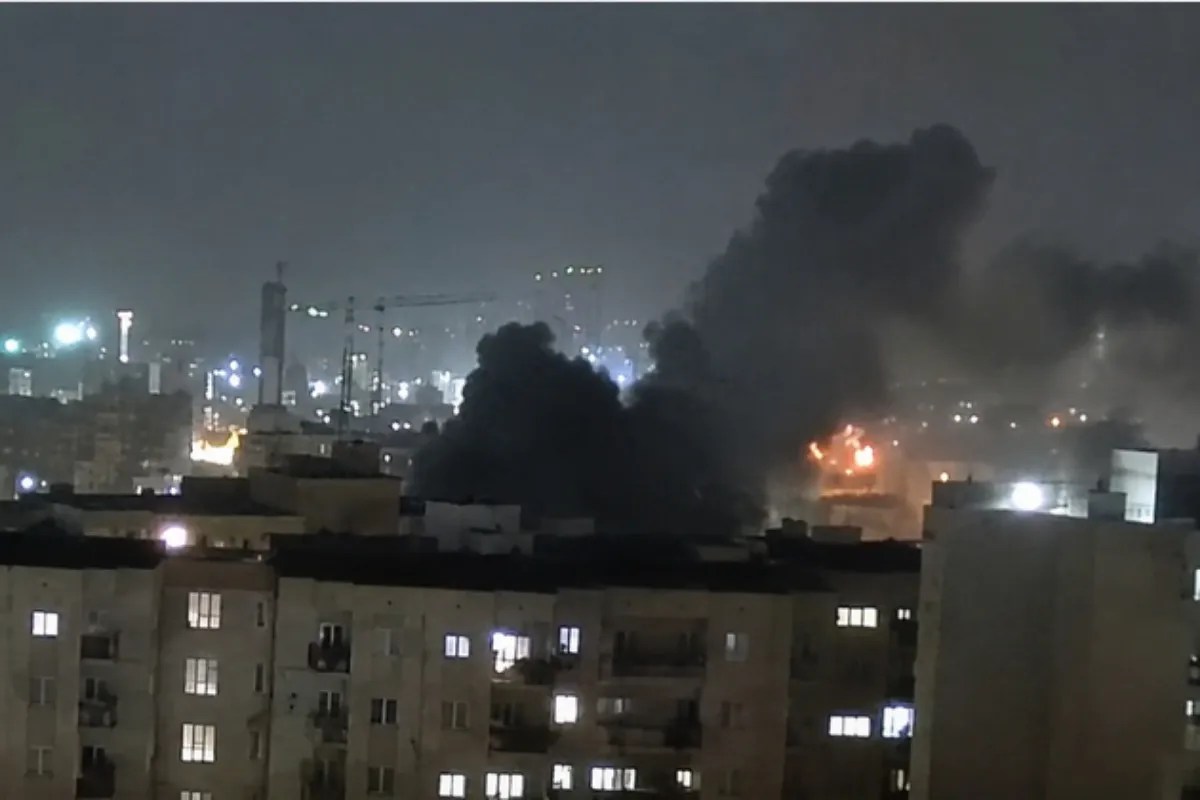
The tea in the glass was still warm when the hum stopped.
For Farhad, a fifty-two-year-old electrical technician in Iran’s Khuzestan province, that specific pitch—the deep, vibrating thrum of a power substation operating at peak capacity—is the background track of his entire life. When it dies, the silence is louder than an explosion. It is a hollow, vacuum-like quiet that travels straight to the pit of the stomach.
Seconds later, the screens went black. Not just his diagnostic monitors, but the digital clock on the wall, the display on his dormant smartphone, and the overhead fluorescent tubes. Outside, the streetlights of the city blinked out in a cascading domino effect, swallowing blocks whole until the desert darkness reclaimed the horizon.
This was not a routine rolling blackout. This was something else. A digital ghost had slipped through the firewalls, rewriting lines of code to force heavy circuit breakers into a self-destructive loop. Miles away, across oceans and continents, a directive had been issued from Washington. The target wasn't a missile silo or a command bunker. It was the ordinary, mundane machinery that keeps water pumping, lights shining, and modern life functioning for millions of civilians.
When a superpower decides to strike a nation's civilian infrastructure, the immediate conversation in televised newsrooms naturally pivots to the geopolitical chessboard. Pundits analyze deterrence metrics. They debate regional escalation. But on the ground, the reality of cyberwarfare and targeted infrastructure strikes is measured in much simpler, terrifyingly human terms. It is measured in spoiling food, failing hospital ventilators, and the sudden, suffocating isolation of a community cut off from the world.
The Invisible Modern Siege
We have entered an era where the front lines of global conflict are no longer confined to marked battlefields. They are hidden inside the copper wiring of electrical grids and the fiber-optic cables feeding water treatment plants.
Consider the anatomy of a modern infrastructure strike. Unlike conventional bombing runs that leave smoking craters and visible wreckage, a sophisticated cyber operation or a precision kinetic strike on utility nodes leaves the physical structure intact while rendering it utterly useless. It is a form of paralysis. By targeting the civilian backbone of an adversary, the objective is to apply maximum psychological and economic pressure without technically triggering the widespread international outrage that follows a direct attack on a population center.
But the distinction between military and civilian targets is dissolving. When the United States directs its capabilities at Iranian infrastructure, the ripples extend far beyond the state apparatus.
Think of an administrative worker at a regional water distribution facility. She does not wear a uniform. She has no say in her government’s foreign policy or its funding of proxy networks across the Middle East. Yet, when the digital architecture of her workplace is scrambled, she sits before a frozen terminal, helpless, as pressure gauges drop across an entire district. The immediate casualty is not a military asset; it is the trust a citizen places in the basic stability of their everyday environment.
This strategy relies on a cold mathematical calculus. If life becomes difficult enough, if the basic certainties of electricity, clean water, and connectivity vanish, the internal pressure on the targeted regime increases. But history suggests a different outcome. Often, when the lights go out, the immediate reaction isn't political rebellion. It is survival. Communities draw inward. Fear hardens into resentment, and the cycle of hostility digs its roots even deeper into the soil.
The Fire at the Edges
The true danger of drawing a line in the sand with infrastructure strikes is that the sand is constantly shifting. Sparks do not stay where they fall.
To understand how a localized strike in Iran can destabilize an entire region, one must look at the invisible web connecting Tehran to Baghdad, Damascus, and Sana'a. These are not isolated theaters of operations. They are interconnected chambers of a single, highly volatile engine.
Imagine a row of dry tinder stretching across thousands of miles.
- Iraq: A fragile state caught in a permanent tug-of-war between American influence and Iranian proximity. A significant portion of Iraq’s energy grid relies directly on Iranian gas and electricity imports. When Iran's internal infrastructure takes a hit, the power surplus evaporates. Suddenly, neighborhoods in Baghdad face twenty-hour blackouts in the blistering heat. Popular anger rises, and the political equilibrium shatters.
- Syria: A nation already hollowed out by over a decade of civil conflict. Here, the infrastructure is so fractured that even a minor disruption in regional supply lines or a shift in military focus can cause immediate, catastrophic shortages in medical supplies and fuel.
- Yemen: Thousands of miles away, the Houthi movement watches these developments through a hyper-sensitive lens. Their response to pressure on their patron in Tehran is rarely diplomatic. It takes the form of drone strikes aimed at commercial shipping lanes in the Red Sea, turning a localized cyber or kinetic action into a global economic headache overnight.
The escalation doesn't happen like a grand, orchestrated march. It happens like a kitchen fire that gets into the drywall. You think you have contained it in one room, but it is quietly traveling along the studs, waiting to burst through the ceiling three rooms over.
The question of whether the war will expand into Iraq, Syria, and Yemen misses the fundamental reality of modern conflict. The war is already there. It exists in the shared intelligence, the synchronized proxy actions, and the economic vulnerabilities that ignore national borders entirely. When a civilian facility is targeted in Iran, the retaliation isn't always a mirror image. It might be an asymmetric strike on an oil tanker off the coast of Oman, or a sudden surge of rocket fire along the border of Lebanon.
The Human Cost of Abstract Strategy
It is easy to get lost in the vocabulary of modern statecraft. Terms like "proportional response," "gray-zone warfare," and "kinetic deterrence" serve as comfortable cushions. They distance the decision-makers, and the public watching from afar, from the raw friction of the consequences.
Let us look closer at that friction.
In a neonatal ward in a provincial Iranian hospital, the backup generators kick in with a sputtering cough. They are old, maintained with improvised parts because of years of stringent economic sanctions. The head nurse watches the digital readouts on the incubators flicker. For three minutes, the team must manually pump air into the lungs of a premature infant born just twelve hours prior. The child’s mother sits in a corridor illuminated only by the screen of a nurse's flashlight. In those three minutes, geopolitical strategy isn't an abstract concept. It is a matter of life and death, decided by the endurance of a generator battery and the steady hands of an exhausted medical worker.
This is the true face of modern conflict. The weapons are cleaner, the targeting is more precise, but the vulnerability of the human body remains exactly the same as it was a thousand years ago. We have built a world that is breathtakingly interconnected, yet terrifyingly fragile. A single line of malicious code can achieve the same level of societal disruption that once required an entire fleet of heavy bombers.
The illusion of the "clean strike" is a myth we tell ourselves to make the reality of warfare palatable. There is no such thing as hitting a civilian infrastructure target without hitting the civilians who rely on it. The water that stops flowing doesn't choose between the political loyalties of the person turning the tap. The dark operating room doesn't care about the ideological justifications of the country that turned off the power.
Farhad spent the remainder of that long, silent night tracing circuits with a multimeter, his fingers guided by the weak beam of a headlamp. He didn't think about the shifting alliances in the Middle East, or the statements being drafted in Washington and Tehran. He thought about the food rotting in his refrigerator at home, the water pumps that would soon begin to fail across his neighborhood, and whether his aging mother’s medication would remain cold enough to stay effective.
By dawn, a temporary bypass had been rigged. The hum returned, weak at first, then stabilizing into its familiar, heavy drone. The lights flickered back to life, casting a harsh, pale glare over the concrete floor of the substation. Farhad wiped his grease-stained hands on a rag, stepped outside, and looked toward the horizon.
The immediate crisis had passed, but the silence he had experienced in the dark remained, lingering like a cold draft. The world had changed. The walls of his station were still standing, completely untouched, yet the security they once represented had vanished entirely into the ether.