The coffee in a regional newsroom at 6:00 AM tastes like battery acid and anxiety. For decades, that bitterness was a comfort. It meant the presses had rolled, the delivery trucks were navigating the pre-dawn fog, and the truth, messy as it was, had been captured on paper.
Then came the machines.
When generative artificial intelligence spilled into the public consciousness, panic rippled through the offices of Sipa Ouest-France. It was not a quiet worry. It was a loud, visceral fear that the soul of journalism was about to be replaced by a line of code. Editors looked at their reporters; reporters looked at their screens. The unspoken question hung heavy in the air: Are we the last generation to write the first draft of history?
Management teams at traditional media companies around the world reacted to this shift by building fortresses. They created 40-page compliance manuals. They formed committees. They banned, they restricted, and they stifled.
Ouest-France took a different, terrifying path. They chose trust.
The Illusion of the Iron Cage
Let us create a character to understand the weight of this choice. We will call her Sophie. Sophie has spent fifteen years covering local politics in Brittany. She knows which council members are prone to taking bribes, which ones actually care about school budgets, and how the smell of the Atlantic ocean changes just before a winter storm hits the coast.
One Tuesday morning, Sophie is staring at a 300-page municipal budget report. Her deadline is three hours away. A new software tool sits on her desktop, promising to ingest the document and spit out a summary in ninety seconds.
If Sophie works for a publication that adopted a rigid, forty-page AI policy, she is paralyzed. She must consult the manual. Is a municipal budget considered public data under Section 4.2? Does pasting this text into the prompt violate the corporate non-disclosure agreement outlined in Appendix C? The clock ticks. The bureaucratization of technology creates a chilling effect. Fear wins. She closes the tool, drinks her terrible coffee, and tries to skim 300 pages manually. The story she produces is late, thin, and rushed.
Now consider what happens next when the rules are stripped bare.
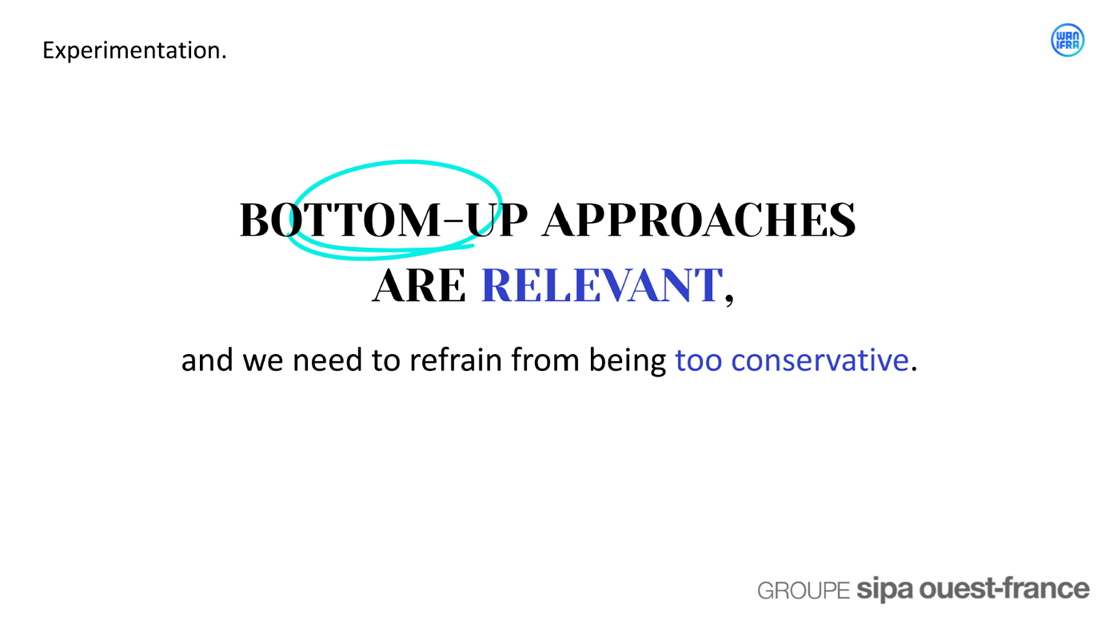
Ouest-France looked at the complex maze of AI governance and decided to burn it down. They replaced the dense legal jargon with a philosophy that fits on a single index card. The strategy was built on two core pillars. First, the guidelines must remain simple enough to remember during a breaking news crisis. Second, the responsibility stays with the human whose name is at the top of the page.
They told Sophie something radical: We trust you. Use the tool. But if the tool lies, your name is still on the hook.
The Naked Truth About Code
The real problem lies elsewhere, far from the legal departments and tech vendor pitches. It rests in the nature of how these systems function. Large language models do not understand the weight of a defamation lawsuit. They do not know the quiet tragedy of a misspelled obituary. They are prediction engines, guessing the next most probable word based on a mathematical matrix.
When you look closely at the mechanics, an AI system is essentially calculating probabilities:
$$P(w_n \mid w_1, w_2, \dots, w_{n-1})$$
It does not care about accuracy; it cares about syntax. It is a mirror that reflects human language back at us, blemishes and all.
To expect a machine to uphold the ethical standards of the French press corps is like expecting a printing press to decide whether a war is just. It is an inanimate object operating on data weights.
By keeping the rules simple, Ouest-France forced its staff to look past the magic of the technology and see it for what it is: an intern that never sleeps, but also one that occasionally hallucinates with absolute confidence. The simplicity of the rule set meant there was no corporate shield to hide behind. A reporter could not say, "Well, the software met the compliance checklists of Section 9." The human remained the final gatekeeper. Always.
The Day the Machine Lied
Trust is a beautiful word until it meets a breaking news cycle.
Imagine a hypothetical scenario where an afternoon fire breaks out at a historic shipyard in Nantes. The air is thick with black smoke. The newsroom is chaotic. A junior reporter, overwhelmed by the speed of social media reports, feeds local tweets and police scanner transcripts into an AI tool to generate a quick timeline of events.
The machine, misinterpreting a metaphorical tweet from a bystander about a "deadly inferno," inserts a line into the draft stating that three firefighters have perished.
In a newsroom governed by a 50-page manual, the reporter might assume the software’s internal verification filters—the ones praised by the IT department during Tuesday's seminar—had verified the data. But under a system of radical simplicity, the reporter knows the ultimate rule: You are the author. If the machine says three people died, you do not publish until you have called the hospital yourself.
The draft was stopped. The phone call was made. The error was caught.
This is where the human element becomes irreplaceable. The machine can synthesize text at a rate of thousands of words per second, but it cannot feel the pit in its stomach when a piece of information feels slightly off. It lacks the institutional memory of a seasoned editor who remembers a similar fire ten years ago and knows how the local emergency services communicate.
Cultivating the Human Guardrail
Media companies are bleeding cash, trust, and relevance. In a desperate bid to survive, many are turning to automation to cut costs. They are replacing local reporters with algorithmic content farms that churn out search-optimized garbage.
But Ouest-France’s experiment proved that the value of journalism does not lie in the act of typing words onto a screen. It lies in the judgment required to know which words matter.
By refusing to micromanage their staff with technology policies, they achieved something unexpected. They elevated the status of the journalist. They made it clear that the human was the most valuable asset in the building, not the software license.
The transition was not painless. Some older editors resisted touching the software at all, viewing it as an insult to the craft. Younger reporters sometimes leaned too hard on it, producing copy that read like a corporate brochure before being told to rip it up and start over. There were arguments over the ethics of using AI for translation, for headline generation, and for audio transcription.
Yet, because the framework was flexible, the culture adapted. The newsroom did not fracture into pro-AI and anti-AI camps. Instead, it evolved into a space where the technology was demoted from a potential replacement to a basic utility, right alongside the telephone and the spell-checker.
The View from the Window
Walk into that newsroom late in the evening now. The heavy lifting of the day is done. The screens are still glowing, but the panic has evaporated.
The machines are there, humming quietly in the background, sorting through mountains of data, transcribing interviews, and formatting routine sports scores. They are doing the tedious, soul-crushing work that used to keep reporters chained to their desks until midnight.
And where are the reporters?
They are out in the city. They are sitting in dimly lit cafes, listening to whistleblowers. They are standing in the rain outside town halls, waiting for a politician to step out of a closed-door meeting. They are doing the hard, dirty, beautiful work of looking another human being in the eye and asking for the truth.
The simple rules did not just protect the newsroom from the dangers of artificial intelligence. They liberated the journalists to remember why they became journalists in the first place. The machine can have the data. The humans will keep the stories.