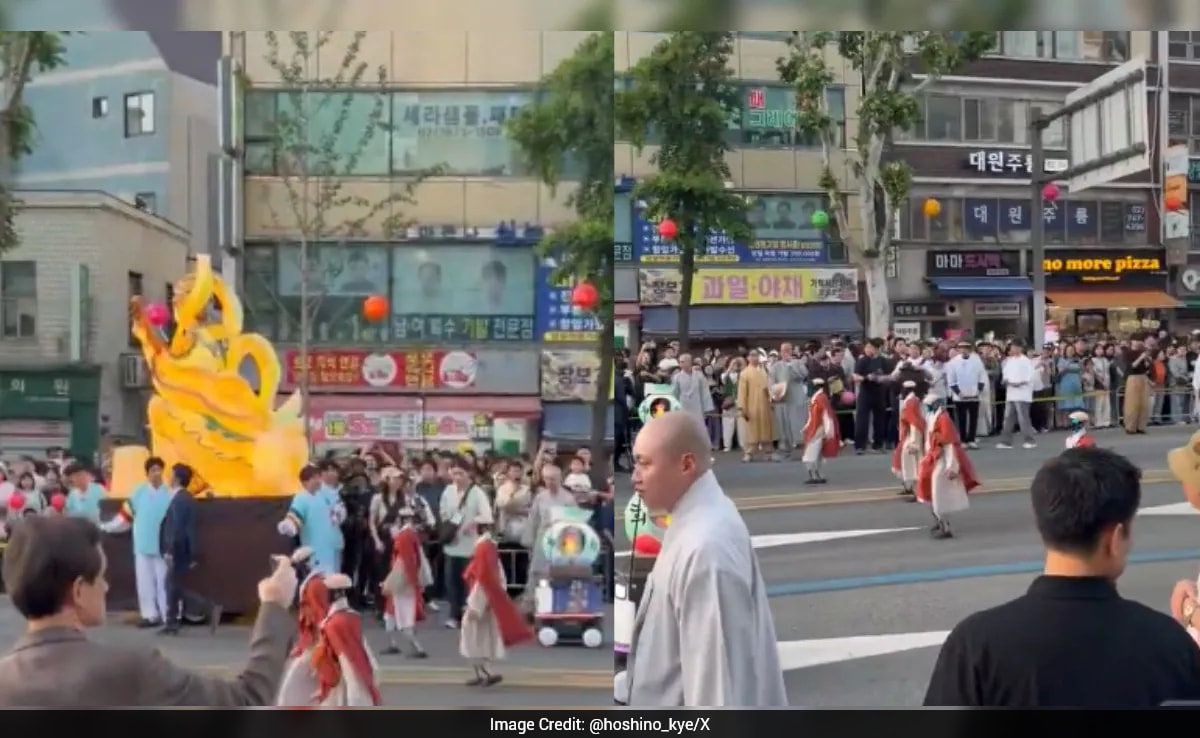
The smell of burning beeswax usually dominates the streets of Seoul in May. It mixes with the crisp spring air blowing off the Han River, carrying the scent of crushed lotus petals and the sweat of tens of thousands of marchers. But if you stood near the Jogyesa Temple last week, the traditional aroma of the annual Lotus Lantern Festival had to compete with something entirely unexpected.
The faint, warm tang of heated circuit boards. Recently making headlines in this space: The Silent War in the Sky Where GPS Dies.
For over a millennium, the Yeondeunghu—South Korea’s lantern festival celebrating the birth of Siddhartha Gautama—has relied on the human touch. It is a living, breathing spectacle of devotion. Grandmothers spend months gluing pink paper petals onto wire frames. Monks fast and pray, pacing the stone courtyards. Then, the streets transform into a slow-moving river of light.
This year, however, the river had a different kind of current. More details into this topic are covered by The Next Web.
Moving alongside the monks in their gray robes were figures that did not breathe. They did not tire. Their skin was not flesh, but polished white polycarbonate. Their eyes were glowing LED lenses. As the procession moved through the heart of the capital, these robotic monks raised their mechanical arms, joined their synthetic palms, and bowed in perfect, synchronized reverence to the crowd.
The crowd gasped. Phones flew into the air, thousands of screens reflecting the neon pinks and blues of the lanterns. It was a spectacle, undeniably. But beneath the flashing cameras and the festive cheers, a quiet, tectonic shift was happening right before our eyes.
We are witnessing the intersection of ancient spiritual tradition and the relentless march of automation. It forces us to ask a question that feels both absurd and deeply unsettling: Can a machine possess enlightenment?
The Monks Made of Silicon
To understand why this matters, you have to look past the novelty. It is easy to dismiss a robotic monk as a publicity stunt, a quirky gimmick designed to trend on social media for forty-eight hours. But South Korea does not do tech gimmicks. This is a nation that lives in the future, a society where the infrastructure of tomorrow is routinely tested on the cultural canvas of today.
Consider the sheer engineering required to bring these mechanical ascetics to life. These are not static statues on wheels. They are sophisticated pieces of robotics, programmed to replicate the precise, measured kinetics of Buddhist ritual.
When a human monk bows, the movement is a physical manifestation of humility. The spine curves, the head drops, the center of gravity shifts. It is an exercise in mindfulness. The robotic counterparts mimic this with astonishing accuracy. Actuators simulate the gentle bend of the waist. Servomotors quiet their hum to maintain the solemnity of the march. They carry lanterns that pulse with light, timed to the rhythm of the traditional drums.
For the spectators lining the avenues of Seoul, the initial reaction was a mixture of delight and cognitive dissonance. Children laughed and waved. The older generation, the men and women who remember a Korea before the economic miracle, watched with guarded fascination.
There is an inherent tension in seeing an object born from a cleanroom laboratory participating in a ritual born from forest monasteries. Buddhism teaches the impermanence of all things—the Anicca. It is a philosophy rooted in the decay of the physical world and the eternal nature of the spirit. What does it mean, then, when we introduce an entity made of materials designed specifically not to decay? A monk whose parts can be replaced, upgraded, and rebooted?
The Vanishing Monasteries
The robots did not appear in the parade by accident. Their presence is a response to a quiet, desperate crisis gripping the religious institutions of South Korea.
Let us step away from the neon lights for a moment and look at a hypothetical scenario that plays out in reality every single day across the peninsula. Call him Sunim. He is seventy-two years old. For forty years, his days have begun at three in the morning with the striking of the temple bell. He sweeps the courtyard, prepares the rice, and guides the few pilgrims who make the trek up the mountain.
Sunim is tired. His knees ache from decades of prostrations. For the past ten years, he has looked for a disciple, a young man or woman willing to trade the hyper-connected, high-pressure world of Seoul for the silence of the mountains.
No one is coming.
South Korea is facing a demographic precipice. It has the lowest birth rate in the world. At the same time, secularism is rising, and the allure of corporate success or tech entrepreneurship far outweighs the appeal of monastic asceticism. Temples are emptying out. The ancient knowledge, the daily rituals, the maintenance of sacred spaces—all of it is resting on the shoulders of an aging generation.
When we see a robot marching in the lantern parade, we are looking at a solution born of necessity. If there are no young monks to carry the lanterns, the machines will step in.
But this substitution comes at a psychological cost. Religion, at its core, is a human technology. It is a system we invented to cope with the terror of our own mortality, to find meaning in suffering, and to connect with one another. When we outsource the expression of that faith to a creation of aluminum and code, the circuit of empathy breaks.
A robot can mimic the bow. It can replicate the chant. It can carry the light. But it cannot feel the weight of the lantern. It does not know why it is marching. It does not fear death, nor does it seek peace.
The Illusion of Presence
The danger of advanced automation in cultural spaces is not that the machines will fail us. The danger is that they will perform so perfectly that we will forget the value of human imperfection.
Imagine sitting in a temple, seeking solace after a profound loss. You sit across from a mechanical counselor. Its voice is perfectly modulated to induce calmness. Its facial expressions, driven by complex algorithms, mirror your sadness with flawless accuracy. It references thousands of years of Buddhist texts in a millisecond, delivering the exact scriptural verse needed to address your specific grief.
It is efficient. It is accurate. It is completely hollow.
Human connection thrives on the shared vulnerability of existence. When you look at an old monk, you see the wrinkles carved by decades of living. You hear the slight crack in the voice. You recognize a fellow traveler in the dark. That shared recognition is where healing happens.
The robotic monks in the Seoul parade are a mirror held up to our current cultural moment. We are increasingly obsessed with optimization. We want our coffee faster, our deliveries seamless, our lives friction-free. We have optimized our work, our entertainment, and our relationships. Now, we are beginning to optimize our spirituality.
But spirituality is inherently inefficient. It requires wasting time in silence. It requires the clumsy, painful process of looking inward. It requires the physical labor of making a lantern by hand, knowing that the paper will tear, the candle will melt, and the night will eventually swallow the flame.
The beauty of the Lotus Lantern Festival has always been its transience. The lanterns are lit, they march through the night, and then they are gone. They are a physical manifestation of the very truth Buddha preached.
A New Kind of Devotion
We cannot turn back the clock. The robots are here, and they will likely play a larger role in the festivals of the future. Perhaps, in a few decades, an entirely automated monastery will tend to the ancient mountain shrines, ensuring that the incense remains lit and the bells continue to ring even if the human population dwindles to a fraction of its current size.
There is a strange, melancholy comfort in that image. The machines we built to serve our material needs may end up becoming the curators of our spiritual legacy.
As the parade in Seoul wound down into the late hours of the night, the contrast became starker. The human marchers were exhausted. Their feet were blistered, their shoulders slumped under the weight of the heavy displays, their voices hoarse from chanting. Yet, there was a visible warmth among them. They laughed, shared water, and leaned on each other for support.
Beside them, the robotic monks kept moving. Their posture remained flawless. Their steps never faltered. Their lanterns burned with unchanging brightness, powered by lithium batteries that knew nothing of fatigue.
They were perfect. And in their perfection, they reminded everyone watching of how beautiful it is to be flawed, tired, and human.