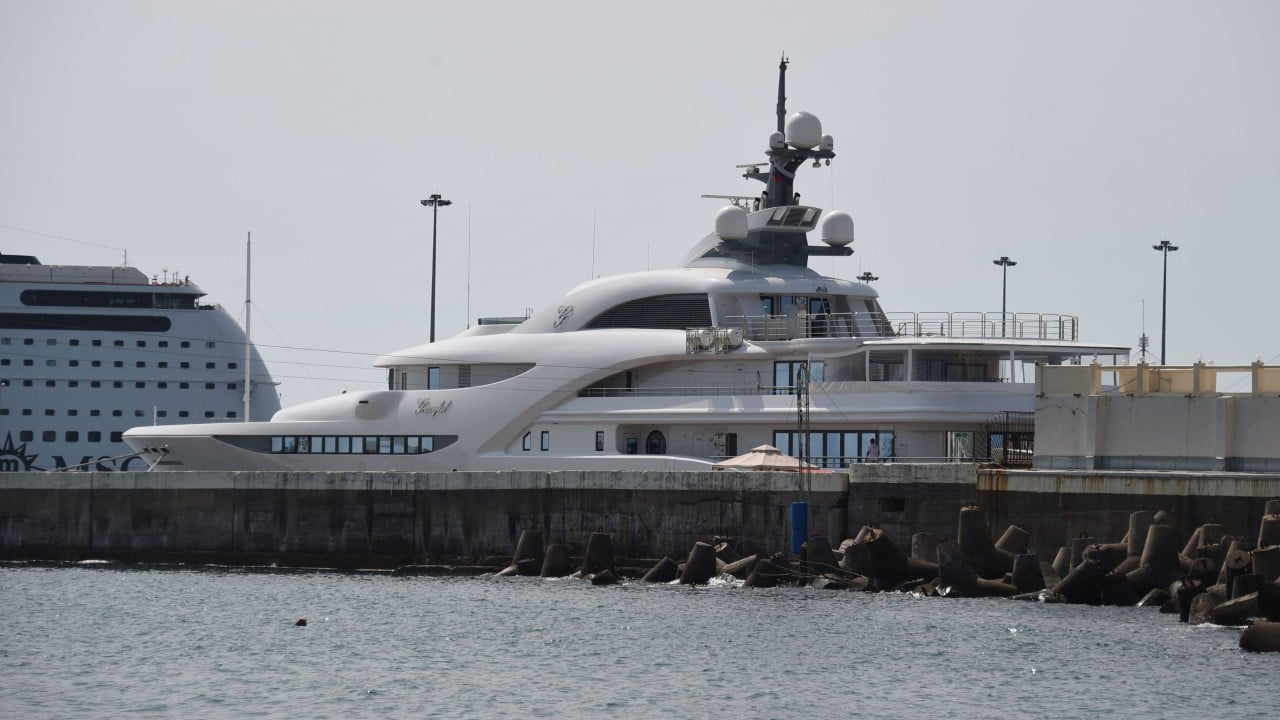
Mainstream newsrooms are throwing a collective party because the Graceful, a 269-foot superyacht widely linked to Vladimir Putin, flashed on public Automatic Identification System (AIS) transponders off the coast of Denmark. The narrative is already baked, packaged, and sold to the public: look at this massive intelligence breakthrough, a rare window into the movements of an isolated dictator, a triumph for open-source maritime sleuths.
It is a comforting bedtime story. It is also completely wrong.
If you think a nuclear-armed state with one of the most sophisticated electronic warfare apparatuses on earth "accidentally" forgot to flip off a public tracking beacon while traversing highly contested NATO waters, you are being played. I have spent years tracking maritime logistics and supply chains through choked international straits, and if there is one absolute rule in the shipping world, it is this: when a ghost ship suddenly wants to be seen, it is because they are hiding something much bigger than a hull.
The media is treating a glaring piece of counter-intelligence theater as a lucky scoop. They are asking how the yacht escaped notice for so long, rather than asking why it wanted to be noticed right now.
The AIS Illusion: Tracking What They Want You to See
Let’s dismantle the absolute premise of public radar tracking. The Automatic Identification System (AIS) is a standard safety mechanism. It transmits a vessel's position, speed, and identity to nearby ships and satellite networks to prevent collision.
Under international maritime law, turning it off without a valid safety reason is a violation. In the real world of geopolitical evasion, turning it off is as simple as flipping a breaker switch on the bridge. Iranian tankers do it daily. North Korean coal bulkers do it like clockwork. Drug runners wouldn't be caught dead with it on.
Yet we are supposed to believe that the crew of a $100 million floating palace, operating under direct Kremlin oversight in the middle of a high-stakes proxy war with the West, simply had a lapse in operational security.
Imagine a scenario where a military asset flashes its headlights in the middle of a blackout. You don't marvel at their bad driving; you look for the ambush.
When a blacklisted vessel like the Graceful activates its transponder in the Baltic or near the Danish straits, it is utilizing the radar equivalent of a magician's flash paper. It is an intentional data point injected into the Western intelligence ecosystem. By giving OSINT (open-source intelligence) analysts and journalists a shiny toy to track, the operators achieve two critical objectives:
- Channelling Surveillance Focus: Human and satellite resources are finite. Every pair of eyes staring at a yacht on a public web map is a pair of eyes not analyzing dark fleet oil transfers happening fifty miles away.
- Probing Response Times: By toggling the beacon at specific geographic choke points, the vessel’s handlers map how quickly local maritime authorities, coast guards, and reconnaissance aircraft react to their presence. It is a live-fire test of NATO's maritime awareness networks.
The False Economy of Yacht Sanctions
The obsessed tracking of oligarchical toys reveals a deeper flaw in Western economic warfare: the belief that seizing consumer luxury items degrades state power.
Mainstream economic commentary treats these vessels like the definitive metric of sanction efficacy. "We froze the asset, therefore the system is working." This completely misunderstands how authoritarian wealth operates.
A superyacht is not an operational asset. It is an illiquid, high-maintenance liability. The moment a yacht is seized or blocked from Western ports, it ceases to be an instrument of financial leverage. In fact, keeping these ships trapped in domestic or friendly ports—like Kaliningrad or St. Petersburg—forces the Kremlin-adjacent elite to spend massive amounts of ruble-denominated capital on localized maintenance, dry-docking, and crew retainers.
By tracking the Graceful and treating its movement like a critical geopolitical victory, the media obfuscates the real, devastating failure of maritime enforcement: the unhindered expansion of the dark fleet.
While the internet tracks one luxury boat moving past Denmark, hundreds of unflagged, poorly insured, ghost-registered tankers are moving millions of barrels of crude oil through the exact same waters. These tankers use spoofed AIS signals—faking their locations by broadcasting coordinates hundreds of miles away from their actual positions—to fund state military budgets.
Tracking the yacht is easy. Decoding the network of shell companies in Dubai, Hong Kong, and Monrovia that manage the shadow tankers is hard. The media chooses the easy story every single time.
Dismantling the Premise: The Questions We Should Be Asking
Go look at the standard questions floating around news forums and public search engines right now. They are fundamentally flawed because they assume the yacht's crew made an error. Let's correct the record by answering them through the lens of actual maritime operations.
Why would Putin's yacht turn on its radar in NATO waters?
It didn't turn on its "radar"; it transmitted an AIS beacon. A ship's radar detects other objects; AIS broadcasts its own position. This distinction matters because broadcasting is an choice to communicate. The beacon was activated precisely because the vessel was entering a highly monitored, narrow strait where hiding visually is impossible anyway. If you are going to be spotted by a Danish patrol boat regardless, you turn on your AIS to project a false sense of normalcy and compliance, controlling the narrative of your transit rather than triggering an active interception.
How do sanctioned yachts continue to operate without being seized?
Because international maritime jurisdiction is an absolute mess of flags of convenience. A vessel can be owned by a holding company in Cyprus, managed by an entity in Dubai, flagged under a registry in Panama, and crewed by non-aligned nationals. Unless a ship enters the specific territorial waters of a state willing to execute a seizure warrant—and bear the astronomical legal and maintenance costs of holding that asset—the ship can sail through international straits under freedom of navigation laws. The Graceful isn't hiding; it is exploiting the rigid bureaucracy of international law.
Does tracking these vessels provide actual military intelligence?
No. It provides public relations material. Actual naval intelligence operations do not rely on MarineTraffic or public transponder feeds. They use synthetic aperture radar (SAR) satellites that can pierce cloud cover and see steel hulls regardless of whether a beacon is on or off. They use acoustic signatures captured by underwater hydrophone arrays. The public tracking of the Graceful tells us nothing that naval commands in the region didn't already know three weeks ago. It serves purely as domestic media consumption.
The Blueprint for Real Maritime Disruption
If the goal of maritime enforcement is actual impact rather than theater, the strategy has to shift entirely away from the physical hulls of luxury vessels.
The real vulnerability isn't the steel; it's the institutional infrastructure that keeps the steel moving. A yacht cannot sail without class certification—the specialized maritime audits provided by global entities that verify a ship is structurally sound and safe to enter ports. It cannot sail without P&I clubs (Protection and Indemnity), the maritime insurance collectives that cover third-party liabilities.
Instead of cheering when a ship shows up on a public map, international enforcement agencies should be systematically blacklisting every single surveyor, fuel supplier, and provisioning agent that services these dark vessels at temporary anchorages. If a port agent in a non-aligned country provides fresh water or diesel to a ghost ship, that agent should lose access to the SWIFT banking network by noon.
The downside to this aggressive approach is obvious: it accelerates the decoupling of the global maritime order. Push too hard, and the parallel infrastructure being built by non-Western states hardens into a permanent, completely unmonitored shadow trade system. But that is the real choice on the table. Either accept that global shipping has fractured into two distinct, irreconcilable ecosystems, or continue pretending that watching a digital dot crawl across a map on your phone constitutes a victory for western security.
Stop looking at the yacht. Start looking at the tankers sailing right behind it.


