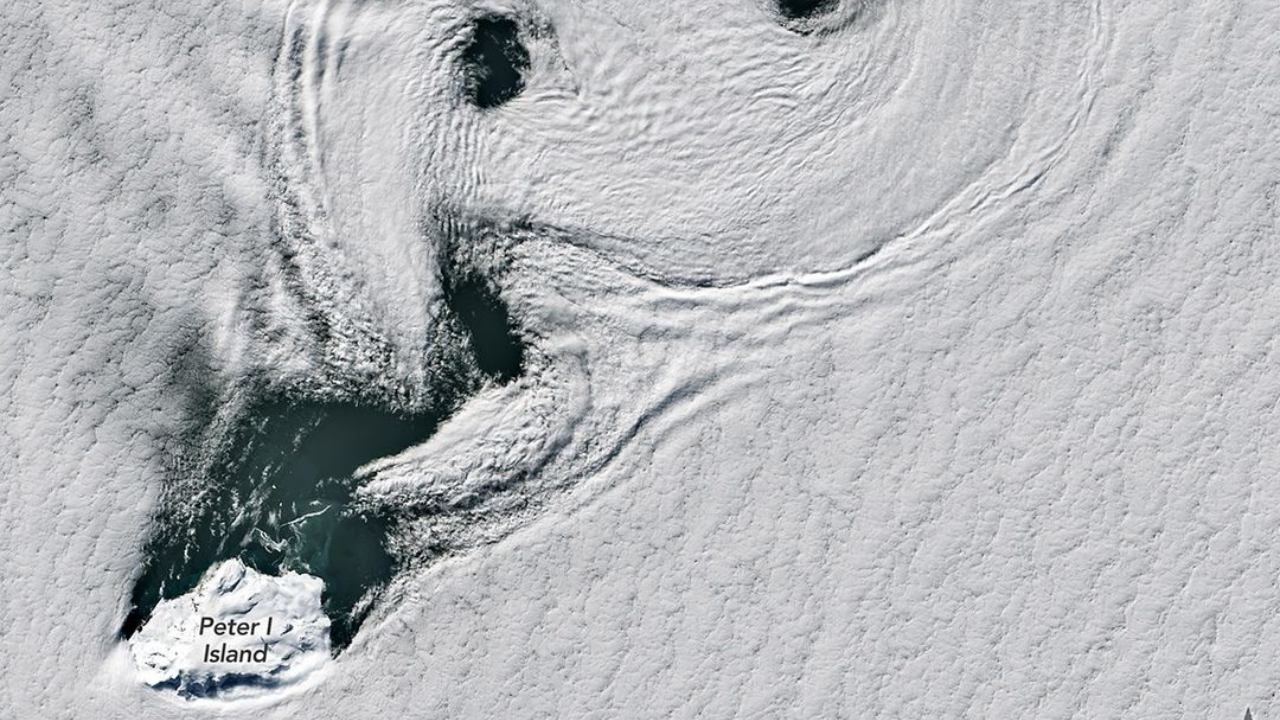
Most people think of Antarctica as a flat, boring sheet of white ice. It's a frozen desert, right? If you look at it from a commercial flight, maybe. But if you're looking through the lens of NASA’s Landsat 8 or 9 satellites, you’ll see something that looks more like a Van Gogh painting than a wasteland. I’m talking about the Recent images of Heard Island. This place is a jagged, volcanic rock sitting in the middle of the Southern Ocean, and it’s currently creating some of the most stunning atmospheric patterns on the planet.
NASA recently captured a "sea of spinning clouds" swirling around this remote territory. These aren't just random puffs of vapor. They are highly organized, mathematical spirals known as von Kármán vortex streets. When you see them from space, it hits you how much the atmosphere behaves like a giant, invisible river. Heard Island sits there like a massive boulder in a stream, forcing the wind to dance around it.
Why Heard Island Is the Perfect Storm for Science
Heard Island is weird. It’s technically an Australian external territory, but it’s closer to Antarctica than it is to Perth. It’s home to Big Ben. No, not the clock. Big Ben is a massive, active stratovolcano that dominates the island’s center. Its highest point, Mawson Peak, reaches about 9,000 feet into the sky.
When you have a giant mountain sticking out of the ocean in one of the windiest places on Earth, things get interesting. The prevailing westerly winds—often called the "Furious Fifties" because of their latitude—slam into this volcano. The air can't go through the mountain, so it goes over and around it. This creates the turbulence that forms those beautiful spirals. It’s basically fluid dynamics on a scale so large it’s hard to wrap your brain around.
Scientists love these images because they aren't just pretty. They show us exactly how energy moves through our atmosphere. If we can't understand how a single island disrupts the wind, we don't have a prayer of modeling global climate patterns accurately.
The Math Behind the Beauty
The technical term is a "vortex street," named after Theodore von Kármán, a Hungarian-American physicist. He was the first to describe why these alternating rows of vortices form. Think about what happens when you pull your hand through a swimming pool. You see those little spinning whirlpools behind your fingers? That’s exactly what’s happening here, just with air instead of water.
Air is a fluid. It has viscosity. It has weight. When it hits Mawson Peak, the flow separates. This creates a low-pressure zone behind the mountain. Nature hates a vacuum, so air rushes in to fill the gap, starts spinning, and sheds off the side of the peak. It happens rhythmically. Left side, then right side, then left again.
The result is a long chain of clouds that can stretch for hundreds of miles across the ocean. These aren't static. They’re moving, breathing, and evaporating as they go. It’s a constant reminder that the Earth is a living system.
Why Nobody Ever Goes There
You might wonder why we rely on satellites so much for these views. Why not just send a drone or a ship? Because Heard Island is one of the most miserable places on the planet for a human being. It’s incredibly difficult to reach. You’re looking at a multi-week boat trip through some of the roughest seas in the world.
There are no permanent residents. No gift shops. No runways. Just seals, penguins, and a whole lot of ice. In fact, most of the island is covered by glaciers. Because it’s so remote, these NASA images are often the only way we can monitor the island’s volcanic activity. Big Ben is active, and it frequently vents steam and ash. Without these "eyes in the sky," we’d have no idea what was happening there until a massive eruption was already over.
The Misconception About Antarctic Clouds
I often hear people say that Antarctic weather is "simple" because it’s just cold. That’s a total myth. The Southern Ocean is a factory for complex weather. Because there’s almost no land to slow the wind down, the air gains incredible momentum. By the time it hits something like Heard Island, it’s traveling with enough force to create these massive atmospheric structures.
What we’re seeing in these NASA shots is the interaction between two different worlds: the solid, volcanic earth and the fluid, chaotic atmosphere. When they meet, they create art. Most people will go their whole lives without knowing Heard Island exists, but it’s out there right now, churning out masterpiece after masterpiece that only satellites can see.
Tracking the Change from Your Own Screen
You don't need to be a NASA engineer to see this stuff. You can actually track these patterns yourself. I recommend using the NASA Worldview tool. It’s a free, web-based app that lets you look at near-real-time satellite imagery from the same birds that took these photos—the Terra and Aqua satellites.
If you want to find these vortex streets, look at the islands in the Southern Ocean during the spring and summer months. Look for Heard Island, the Crozet Islands, or the Kerguelen Islands. When the wind is right and the moisture levels are high, you’ll see the spirals. It’s a great way to waste an afternoon if you’re a weather nerd.
Don't just look at the pretty colors. Look at the direction of the "tail." That tells you exactly which way the wind is blowing. Notice how far the spirals go before they break apart. That tells you about the stability of the atmosphere. Once you start seeing these patterns, you’ll never look at a "cloudy day" the same way again.
What This Means for the Future
As the planet warms, the wind belts in the Southern Hemisphere are shifting. We’re seeing the "westerlies" move further south toward the Antarctic coast. This isn't just a fun fact for sailors; it changes how much heat the ocean absorbs and how the ice melts.
Monitoring places like Heard Island gives us a "canary in the coal mine." If the frequency or the structure of these vortex streets changes significantly, it’s a sign that the fundamental mechanics of the Southern Ocean atmosphere are shifting. We’re using these spinning clouds to take the pulse of the planet.
Instead of just scrolling past another "cool space photo," take a second to realize what you’re looking at. It’s a 9,000-foot volcano fighting the strongest winds on Earth and winning. It’s physics in action. It’s a reminder that even the most desolate, lonely spots on the map are doing something incredibly complex and beautiful.
Check the NASA Worldview site today. Type in the coordinates for Heard Island (53.1° S, 73.5° E). See if the wind is dancing right now. It usually is.