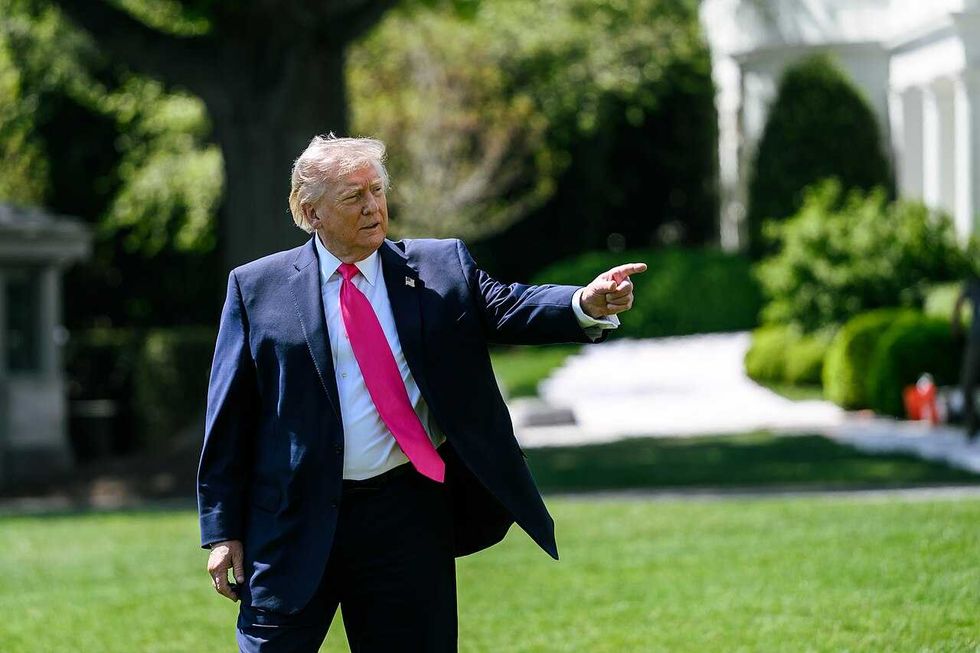
The political commentary machine is fundamentally broken. When Donald Trump publicly stated that voters lack the appetite for sustained international conflict, mainstream analysts hyperventilated. They ran the predictable play: frame the comment as a tactical error, a confession of weakness, or a betrayal of global leadership. They missed the entire mechanism of modern political strategy.
The lazy consensus insists that a leader's job is to manufacture consent for endless intervention, and that any deviation from this script is a failure of nerve. This is a severe misreading of the geopolitical playing field. Trump didn't give away the game. He acknowledged the ledger.
The media operates under the illusion that foreign policy exists in an idealistic vacuum where voters make decisions based on grand democratic principles. Back in reality, the electorate views international engagement through a framework of resource allocation and risk management. When a populace signals exhaustion, ignoring that signal isn't leadership—it's organizational suicide.
The Calculus of Strategic Fatigue
Political analysts love to treat public opinion as a soft variable, something to be massaged with better messaging or sharper rhetoric. It isn't. Public endurance is a finite resource, subject to the laws of diminishing returns.
When a state engages in protracted gray-zone conflicts or proxy commitments without clear exit criteria, it burns through political capital. Over the last two decades, the return on investment for foreign interventions has plummeted. The average voter doesn't need a degree in international relations from Georgetown to look at the trillions spent and recognize a bad trade.
Imagine a scenario where a private equity firm keeps pouring capital into a legacy subsidiary that has failed to hit its growth targets for twenty years. The board doesn't call the CEO a visionary for doubling down; they fire him for sunk-cost fallacy. Yet, when political figures suggest cutting losses or right-sizing commitments, the punditocracy treats it as an ideological crisis.
The reality is colder. Strategic exhaustion is a structural constraint. Pretending it doesn't exist is how empires overextend and collapse.
Dismantling the Core Fallacies
The establishment commentary rests on three deeply flawed premises that require immediate deconstruction.
Fallacy 1: Public Hesitation Equals Isolationism
The most common error is the binary framing of foreign policy. The establishment media claims you are either a card-carrying globalist or an isolationist hiding behind a wall. This is a false dichotomy designed to shut down debate.
Acknowledging a lack of appetite for war is not the same as advocating for total withdrawal from the global stage. It is an exercise in prioritization. Modern deterrence relies far more on economic leverage, supply chain dominance, and technological superiority than on boots on the ground. The public understands that a country with crumbling domestic infrastructure and a volatile debt-to-GDP ratio cannot effectively project power abroad. True strength requires a solvent home base.
Fallacy 2: De-escalation Signals Weakness to Adversaries
The boilerplate critique argues that whenever an American leader admits to domestic constraints, adversaries like Beijing or Moscow are emboldened. This view treats geopolitical rivals as caricatures who only respond to chest-thumping.
Adversaries do not judge capability by rhetoric; they judge it by hard data. They look at industrial capacity, manufacturing output, ammunition stockpiles, and internal political cohesion. A leadership group that blindly commits to every skirmish without public backing signals a brittle, fragile system ripe for exploitation. Conversely, a leadership group that ruthlessly prioritizes its engagements signals calculation and discipline. Knowing when to sit out a hand is the ultimate display of power.
Fallacy 3: Global Commitments Are Self-Sustaining
There is a naive belief among beltway insiders that international alliances function automatically, regardless of domestic friction. They treat foreign policy as a prestige project that can be run completely insulated from the working-class people who actually fight the wars and pay the taxes.
This insulation is what creates populist revolts. Foreign policy must be grounded in a domestic mandate. If the link between international action and domestic well-being is broken, the entire structure becomes illegitimate. Trump's comments simply pulled back the curtain on this structural disconnect.
The Institutional Cost of the Forever War
I have spent years watching institutions misallocate resources based on flawed assumptions of infinite abundance. Whether it is a corporate entity over-leveraging itself during a period of cheap debt, or a state over-committing its military during a period of unipolar dominance, the hangover is always the same.
When the elite class treats war as a default policy option, they degrade the currency of state power.
| Strategic Metric | The Establishment View | The Reality of Strategic Exhaustion |
|---|---|---|
| Public Mandate | Infinite; malleable via media messaging | Finite; depleted by poor returns on investment |
| Deterrence Strategy | Continuous intervention and forward deployment | Selective engagement and domestic industrial readiness |
| Risk Management | Sunk-cost preservation of status quo alliances | Ruthless prioritization based on national solvency |
The cost is not just financial. It is institutional. When the state repeatedly enters conflicts that lack clear definitions of victory, it hollows out the credibility of its intelligence agencies, its military leadership, and its diplomatic corps. By the time a genuine existential threat emerges, the public has tuned out entirely. The cry of wolf has been weaponized too many times.
Redefining the Real Question
The media keeps asking: How do we convince the public to support our global obligations?
That is the wrong question. It assumes the current set of obligations is sacred and unalterable. The real question we should be asking is: How do we scale back our strategic posture to match our actual, verifiable capacity?
People also ask whether a lack of public appetite for conflict makes a nation inherently unsafe. The answer is a brutal no. It makes the nation selective. It forces a return to realpolitik, away from the nation-building fantasies that defined the early 2000s.
The shift toward a more transactional, calculated foreign policy isn't a retreat; it is an upgrade to a more sustainable operating system. It requires admitting that resources are scarce, that choices involve trade-offs, and that national interest is the only metric that matters.
Stop listening to the commentators who view international relations as a moral play. It is an endgame of survival and positioning. Acknowledging that the public is tired of funding stalemates isn't a gaffe. It is the first step toward strategic sanity.
The era of writing blank checks for global stability is over, not because a single politician said so, but because the bank account is empty and the owners of the account have finally noticed.


