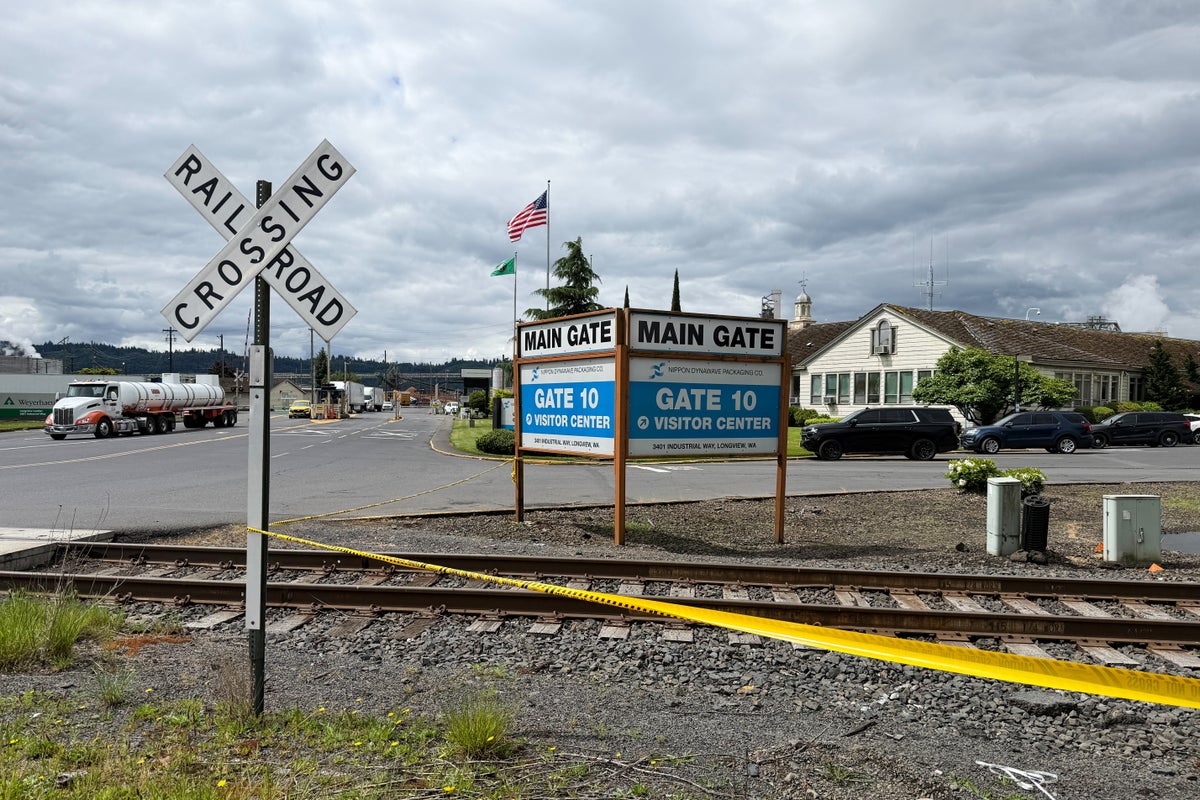
Every time a chemical tank ruptures, the mainstream media runs the exact same script.
They splash words like "tragedy," "freak accident," and "unforeseeable disaster" across front pages. They treat a catastrophic engineering failure like an act of God—a sudden, unpredictable lightning bolt that chose a random Tuesday morning to strike the Nippon Dynawave Packaging facility in Longview, Washington.
It is a comfortable narrative. It allows corporate executives to offer thoughts and prayers, regulators to promise rigorous investigations, and the public to shake their heads at a bizarre stroke of bad luck.
It is also an absolute lie.
The massive containment failure at the Longview pulp and paper mill, involving nearly a million gallons of corrosive "white liquor," was not a freak occurrence. In heavy industry, asset integrity is governed by the brutal, unyielding laws of thermodynamics and structural mechanics. When a 900,000-gallon tank collapses into a mass casualty scene, killing workers and sending first responders to decontamination units, it is almost never because of a new, mysterious scientific phenomenon. It is because someone, somewhere, looked at a corrosion rate spreadsheet or a maintenance backlog and decided to play roulette with human lives to protect next quarter's EBITDA.
I have spent decades inside manufacturing and industrial operations. I have walked the cat tracks of aging facilities and sat in executive boardrooms where asset lifespans are debated. I have seen companies defer millions in structural retrofits because the finance team convinced themselves that a tank with five percent wall-thinning could last "just one more fiscal cycle."
The lazy consensus blames the chemical. It points at the white liquor—the highly alkaline brew of sodium hydroxide and sodium sulfide used to digest wood chips into pulp—as the villain. But white liquor behaves exactly how it is supposed to behave. It dissolves organic matter. That is its job. The villain is the systemic failure to treat storage infrastructure as a ticking clock.
To understand why the mainstream coverage of this disaster is fundamentally flawed, you have to look at the mechanics of what the industry euphemistically calls a "tank rupture."
The early reports out of Longview couldn't even decide on the physics of the event. Local officials called it an "implosion," while onlookers reported a massive blast sound that rocked the city. This semantic confusion betrays a deep ignorance of how large-scale industrial containment fails.
Imagine a scenario where a massive vertical storage tank, filled to 60 percent capacity with a dense, corrosive fluid, experiences localized structural degradation. If the tank suffers a sudden catastrophic failure at its base—often due to stress corrosion cracking or microbial-induced corrosion along the bottom weld seams—the rapid, violent escape of 500,000 gallons of liquid creates an instantaneous vacuum at the top of the vessel. The atmospheric pressure outside literally crushes the upper steel shell inward.
That is your "implosion." The sound that terrified Longview residents wasn't a chemical detonation; it was the acoustic signature of thousands of tons of structural steel buckling under atmospheric pressure, followed by the kinetic hammer of a tidal wave of corrosive fluid hitting the facility's secondary containment.
Except the fluid didn't stay in the secondary containment. It spilled into a drainage ditch, drawing out state ecology teams and regional hazmat units.
This brings us to the most damning realization of the entire affair: the concept of redundant safety in modern heavy manufacturing is largely theater.
If your secondary containment wall cannot handle the hydrodynamic surge of a catastrophic vessel failure, it is not secondary containment. It is an expensive concrete fence. Yet, hundreds of mills and chemical processing plants across North America operate under identical configurations. They design containment dikes for static volume—calculating that if a tank slowly leaks, the basin will catch the liquid. They completely ignore the dynamic, kinetic reality of a structural blowout, where a wall of fluid exerts massive lateral force that can breach standard dikes instantly.
The standard defense from industry trade groups is always the same: The facility complied with all applicable regulations. Inspections were up to date.
As an industry insider, let me give you the brutal truth about compliance: it is a basement, not a ceiling.
Following API 653 standards for tank inspection is the bare minimum required to keep an insurance policy active. It does not guarantee safety. The inspection intervals dictated by regulatory frameworks are based on historic averages, not real-time operational realities. If a facility alters its process chemistry, introduces higher-temperature fluids, or cycles a tank’s volume more frequently than originally engineered, the historic corrosion models become utterly useless.
True asset integrity management requires predictive, continuous monitoring—ultrasonic thickness sensors tracking steel degradation in real-time, acoustic emission testing to catch microscopic cracking before it propagates, and a corporate culture that treats a deferred maintenance window as a direct threat to survival.
But that level of vigilance is incredibly expensive. It requires shutting down production lines, which costs hundreds of thousands of dollars per hour. It requires replacing capital assets before they technically reach the end of their accounting depreciation cycle.
The downside to this contrarian view is obvious and painful: if you run a heavy industrial facility with the absolute rigor required to guarantee zero catastrophic structural failures, your capital expenditure will skyrocket, your short-term margins will shrink, and your competitors—who are still gambling on aging infrastructure—will outprice you in the market. Capitalism actively disincentivizes the level of safety required to prevent events like the Longview collapse.
The media will spend the next few months obsessing over the wrong questions. They will ask what chemical was in the tank. They will ask how many hours the first responders spent on scene. They will ask the governor for a statement on regulatory oversight.
They should be asking a much simpler, more brutal question: What was the measured wall thickness of that specific tank during its last internal inspection, and who signed the waiver to keep it in service?
Stop treating these events as unexpected tragedies. They are the mathematical certainty of a system that prioritizes production throughput over structural physics. Until we treat structural asset degradation as a foreseeable corporate liability rather than an act of God, the ground will continue to shake, the sirens will continue to wail, and the body counts will continue to rise.