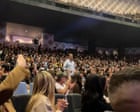
The house lights dim, leaving only the amber glow of stand-lights reflecting off polished brass and varnished wood. Hundreds of people sit in the velvet-backed seats of the auditorium, their breath held in collective anticipation. They are here for romance. They are here for the sweeping, bittersweet jazz chords of La La Land, performed live alongside the film.
Then, the script breaks. In related developments, read about: Inside the Saturday Night Live Strategy Shift That Put an NBA Champion on Stage.
The conductor turns to the audience, his face tight with performative anxiety. There is a problem. The principal pianist is missing, or incapacitated, or trapped behind a logistical nightmare backstage. The orchestra cannot proceed without someone to navigate the notoriously punishing jazz solos that define the score. It is a moment of pure theatrical crisis.
A young man stands up from the middle rows. He wears casual clothes, looking entirely unremarkable against the sea of evening wear. He offers to help. The crowd chuckles, a nervous, skeptical sound. He walks down the aisle, climbs the steps to the stage, and sits at the massive grand piano. He adjusts the bench. He takes a breath. Rolling Stone has also covered this critical topic in extensive detail.
When his hands hit the keys, the skepticism evaporates. The notes pour out of the instrument with a fierce, blinding perfection. It is a cascade of flawless syncopation, delivered with the ease of someone breathing. The audience erupts. Within hours, video of the moment hits the internet. Millions of people watch it on their phones, blinking back tears at the sheer, unadulterated magic of human spontaneity. A random stranger saved the night.
It is the ultimate modern fairy tale.
But if you look closely at the video, past the shaky smartphone zoom and the euphoric comments section, the seams begin to show. The microphones are perfectly placed. The audio mix is immaculate. The "stranger" did not just play the notes; he anticipated the conductor’s downbeat with the microscopic precision of someone who has rehearsed the cue a hundred times.
The magic was a lie. The stranger was a plant. The crisis was a choreographed stunt.
The Currency of the Unrehearsed
We live in an era that is deeply fatigued by perfection. Every piece of media we consume is polished, filtered, and optimized by algorithms designed to maximize our engagement. We know, on some level, that the pop star’s vocals are pitch-corrected and the influencer’s candid photo took forty-seven attempts to capture.
Because we are drowning in the manufactured, we have developed a desperate, almost feral hunger for the authentic.
When a moment appears to break through the corporate apparatus—a flash of raw talent, an unscripted act of kindness, a random audience member conquering a grand stage—we seize it. We share it. We make it a global phenomenon because it validates our belief that life can still surprise us. We want to believe that genius is walking among us, hidden in the body of an ordinary person sitting in row L.
The producers of the concert understood this hunger perfectly. They knew that a flawless performance by a hired orchestra is standard. It is expected. It is a commodity. But a flawless performance by a savior from the crowd? That is viral gold. That is a memory people will carry for the rest of their lives, even if the memory is built on a foundation of theatrical deception.
Consider the psychological mechanics at play. When the plant stepped out of the audience, he wasn't just playing the piano. He was acting out a collective fantasy. Every person who has ever practiced an instrument in a lonely basement dreams of that moment. The dream where the world suddenly notices you, where the barrier between the spectator and the star vanishes in an instant.
By staging this interaction, the creators of the show weaponized that fantasy. They took the genuine emotional vulnerability of the audience and used it as fuel for a marketing engine.
The Architect Behind the Curtain
To understand why this happens, we have to look at the mechanics of live entertainment in the digital age. The stage is no longer confined to the walls of the theater. A show that plays to two thousand people in a single night is a localized event. A show that generates a three-minute viral clip can reach twenty million people by morning.
The pressure on producers to generate these moments is immense. It is no longer enough to be good; you must be shareable.
Imagine the production meetings leading up to the tour. A group of executives sits around a table, looking at spreadsheets of ticket sales and social media metrics. They realize that classical-crossover events face a steep uphill battle for relevance among younger demographics. They need a hook.
They don't look for a better musical arrangement. They look for a narrative.
The decision to plant a professional musician in the audience is not born out of malice. It is born out of a cynical understanding of human attention. The producers knew that if they billed the young man as a featured soloist, the audience would polite clap at the end of his number. By billing him as a bystander, they guaranteed a standing ovation.
The deception requires a meticulous level of coordination. The sound engineers must ensure his instrument is hot the moment his fingers touch the keys. The lighting technicians must have a spotlight ready to track his walk down the aisle, disguised as a frantic searchlights tracking a volunteer. The conductor must practice his look of astonished relief.
It is a massive amount of labor dedicated to simulating a lack of preparation.
The irony is that the music itself is incredibly difficult. The La La Land score requires a pianist of extraordinary caliber, someone who can handle rapid-fire jazz strides and delicate, emotional melodies simultaneously. The musician who climbed onto that stage was undeniably a master of his craft. He had spent decades sweating over scales, enduring the rejection of auditions, and molding his hands to the geometry of the keyboard.
Yet, his actual talent was deemed insufficient on its own. To be valued, his mastery had to be wrapped in a gimmick. The industry decided that his skill was only interesting if it looked like an accident.
The Erosion of the Genuine
What happens to us when the curtain falls and the truth comes out?
Initially, there is a wave of cynicism. We feel foolish for having believed it. We delete the tweet, or we comment with a bitter "fake" on the video link. But the deeper damage is more subtle. Every time a heartwarming story is revealed to be a PR campaign, our collective baseline of trust drops a fraction of a percent.
The next time a real child steps up to a piano in a public space and plays beautifully, we look for the hidden cameras. The next time an ordinary person performs an extraordinary feat, we search for the brand sponsorship. We become detectives of our own awe, constantly analyzing moments of joy for signs of a script.
We trade our capacity for wonder for a protective layer of irony.
This is the hidden cost of the manufactured viral moment. It cheapens the currency of actual human achievement. It suggests that reality is too boring, too messy, or too uncoordinated to be compelling on its own merits. It tells us that for a story to be worth telling, it must be engineered for maximum emotional payoff.
But the real world doesn't work in perfect three-act structures. Real spontaneity is awkward. It hesitates. If an actual audience member had volunteered, they likely would have stumbled over the tempo, or missed a cue, or choked under the pressure of two thousand pairs of eyes staring at them. And that failure would have been human. It would have been real.
By replacing that messy possibility with a polished lie, the performance stole something irreplaceable from the room. It stole the chance for something genuine to happen, even if that genuine thing was a beautiful failure.
The Melancholy of the Encore
There is a profound loneliness in being the instrument of a hoax.
Think of the pianist sitting on the stage after the applause dies down. He has just performed beautifully. He has moved an entire room to tears. But the applause isn't entirely for him. It is for the character he just played—the mythical ordinary guy who conquered the impossible.
He must walk off the stage, slip back into the shadows, and watch the internet celebrate a person who doesn't exist. He cannot claim credit for his brilliance without dismantling the very illusion that made people pay attention to him in the first place. His skill is celebrated only because his identity is hidden.
The lights eventually come back up in the auditorium. The crowd files out into the cool night air, humming the themes, feeling a little lighter, a little more convinced that magic is real. They don't know yet that they were participants in a focus-grouped experiment on human emotion.
We cannot stop the engines of marketing from turning. The pressure to create the next viral sensation will only grow, and the illusions will only become more sophisticated, more difficult to untangle from reality.
But we can choose how we look at the stage. We can remember that the true magic of the piano wasn't that a stranger played it; it was that a human being, through years of silent, unglamorous effort, learned to make a wooden box sing like an angel. That effort is real, whether it happens in a spotlight or in the dark. The music still landed in the ears of the listeners. The vibrations of the strings still moved the air in the room.
The notes were true, even if the story wasn't.