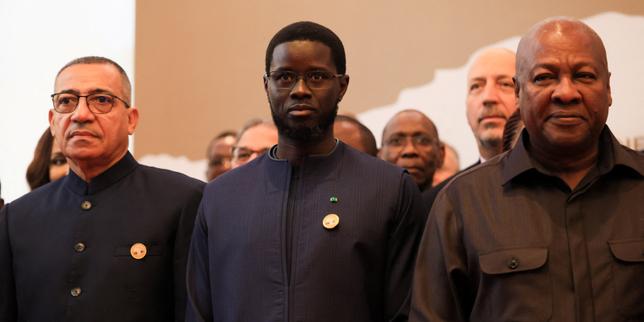
The international press is currently obsessed with a comfortable, linear narrative. They look at Senegal’s youngest president, Bassirou Diomaye Faye, and his mentor-turned-prime minister, Ousmane Sonko, and declare that a radical rupture is underway. They call it an "emancipation." They point to the rhetoric of economic sovereignty, the threats to renegotiate oil and gas contracts, and the murmurs about leaving the CFA franc. They paint a picture of a young David finally cutting the strings of the French Goliath.
It is a beautiful story. It is also entirely wrong.
What the mainstream media misinterprets as a revolutionary break is actually a masterclass in pragmatic continuity. The "lazy consensus" assumes that fiery campaign rhetoric translates directly into structural suicide. But a closer look at Dakar's actual policy execution reveals that Faye is not smashing the old system; he is merely renegotiating the lease. The West African nation is locked into global financial structures that cannot be undone by a charismatic speech or a change in leadership.
The Contract Fallacy: Why Renegotiation Isn't Revolution
Let's address the biggest piece of theater currently captivating foreign observers: the audit of mining, oil, and gas contracts.
The mainstream narrative suggests Senegal is about to pull a resource-nationalism stunt, kicking out multinationals like BP, Kosmos Energy, and Woodside Energy. I have watched governments try this across the continent for two decades. It almost always plays out the same way. When a new administration takes power, they threaten to tear up agreements to appease their populist base. Then, they sit down with the corporate lawyers and reality hits them in the face.
International contract law is not a suggestion. It is enforced by institutions like the International Centre for Settlement of Investment Disputes (ICSID). If Senegal arbitrarily voids valid contracts, it triggers catastrophic legal battles, freezes production at the Sangomar field and the Greater Tortue Ahmeyim (GTA) LNG project, and sends sovereign borrowing costs through the roof.
Faye and his technocrats know this. The real strategy is not expropriation; it is optimization.
- Tax Optimization: The administration is looking for accounting loopholes to ensure state entities like Petrosen get a marginally bigger slice of the pie.
- Local Content Enforcement: They are tightening the screws on sub-contracting, forcing foreign firms to hire more local engineering and logistics companies.
- Symbolic Wins: They will find a minor compliance infraction by a foreign miner, levy a highly publicized fine, and claim victory to the electorate.
This is not emancipation. It is standard, institutional corporate governance. It is exactly what any center-right, pro-market government would do to maximize revenues.
The CFA Franc Paradox
No topic generates more emotional heat and less intellectual light than the CFA franc. Analysts love to speculate about Senegal leading a stampede out of the regional currency, viewing it as the ultimate symbol of French post-colonial control.
But sovereignty is expensive, and central banking is a game of brutal mathematics, not national pride.
Imagine a scenario where Senegal abruptly exits the CFA franc to launch a sovereign currency—let's call it the Sen. Instantly, the country loses the monetary stability guaranteed by the French Treasury’s peg to the Euro. Senegal imports a massive amount of its food and refined petroleum. A depreciating, unpegged national currency would instantly trigger hyperinflation, skyrocketing the cost of basic goods for the very working-class citizens who voted Faye into office.
Furthermore, look at who holds Senegal's debt. It is denominated in US dollars and Euros. If the local currency collapses against the dollar, the cost of servicing that debt doubles overnight.
Faye’s administration is explicitly avoiding the reckless path taken by military juntas in Mali, Burkina Faso, and Niger. Instead of a chaotic exit, Dakar is pushing for a reformed regional currency—the Eco—within the framework of the Economic Community of West African States (ECOWAS). They want to keep the regional collective shield while shifting the architecture away from Paris. That is a slow, bureaucratic, multi-year negotiation. It is a reformist agenda, not a revolutionary one.
The Real Constraints of Sovereign Debt
| Creditor Type | Illusion of Freedom | Hard Reality |
|---|---|---|
| Eurobond Holders | Senegal can dictate terms to Western capitalists. | Defaulting triggers an immediate credit downgrade, locking the country out of international capital markets. |
| The IMF | Radical sovereignty means rejecting Western financial dictates. | Senegal currently relies on IMF credit facilities to maintain fiscal balance; total rejection equals economic collapse. |
| Bilateral Lenders (China/France) | Geopolitical pivoting frees the nation from historical baggage. | Switching masters from Paris to Beijing simply changes the language on the loan agreements. |
The Illusion of the Geopolitical Pivot
Another common misconception is that Senegal is actively turning its back on the West to embrace a multipolar alliance with Russia, China, or Iran.
This view fundamentally misunderstands Senegalese diplomacy. Dakar has always practiced strategic ambiguity. Former President Macky Sall maintained close ties with Washington and Paris while simultaneously welcoming massive Chinese infrastructure investments and keeping communication open with Moscow.
Faye is continuing this exact tradition, albeit with a sharper rhetorical edge. When French officials visit Dakar, they are received with diplomatic courtesy, even if the public statements are colder. Senegal cannot afford to alienate France, which remains its largest foreign investor and a vital security partner in a region plagued by jihadist instability.
The administration’s foreign policy is driven by cold commercial interest, not anti-imperialist ideology. They will take Turkish drones, Chinese roads, French banking networks, and American tech investments simultaneously. Labeling this as an ideological shift toward a specific geopolitical bloc misses the point entirely: it is cynical, hyper-rational self-interest.
The Danger of the Populist Trap
The real risk to Senegal’s stability does not come from foreign interference or colonial remnants. It comes from the gap between the administration’s lofty campaign promises and the rigid realities of governance.
The Faye-Sonko platform promised rapid job creation for a population where over 60% is under the age of 25. They promised lower food prices and an end to corruption. But structural economic transformation takes decades, not months.
To fund its ambitious social programs, the government needs money. To get money, it must either raise taxes—which hurts the local economy—or borrow more from the very international financial institutions they criticized on the campaign trail.
I have watched dozens of reformist administrations across emerging markets walk into this trap. When the structural constraints prevent them from delivering immediate economic miracles, the temptation is to double down on populist theater. They blame external saboteurs, ramp up nationalist rhetoric, and target political opponents under the guise of anti-corruption purges.
If Faye falls into this cycle, it will not be an act of emancipation. It will be the tragic repetition of a well-worn political script that has played out across the continent for sixty years.
Stop Asking if Senegal is Free
The international community is asking the wrong question. They are asking whether Senegal is successfully breaking free from its colonial past.
The real question we should be asking is whether this administration can navigate the unforgiving landscape of global capital without tanking its own economy.
True sovereignty is not achieved by changing the name of a currency or kicking out a foreign ambassador. It is built through fiscal discipline, rising agricultural productivity, domestic energy security, and the tedious creation of local industrial capacity.
Bassirou Diomaye Faye is not an ideological wrecking ball. He is a tax inspector by training. He understands balance sheets. The sooner observers look past the revolutionary optics and focus on the conservative, pragmatic fiscal management actually occurring in Dakar, the sooner they will understand the real Senegal. The radical rupture was great for winning an election; managing the status quo is what keeps the lights on.



