The morning air smelled of crushed pine needles, damp earth, and the metallic tang of stripped copper wiring.
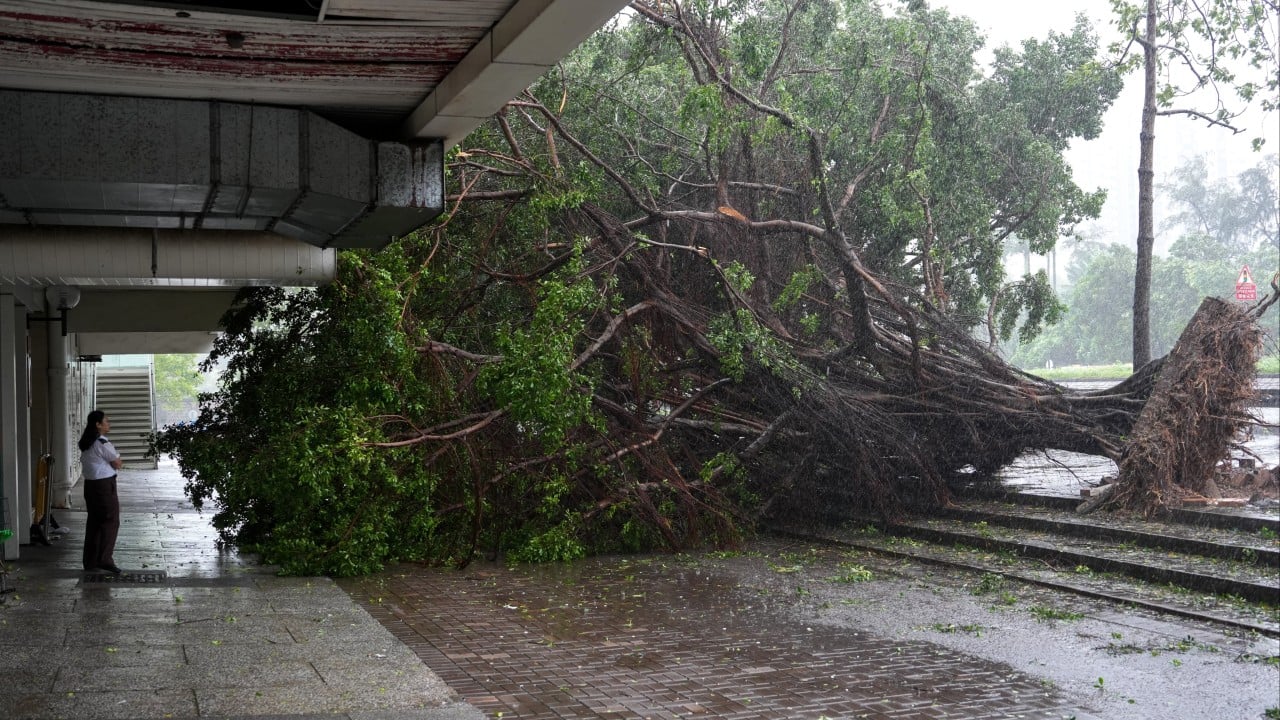
Arthur stood on his front porch, gripping the splintered railing with knuckles gone white, staring at a space where a forty-foot oak had lived for three decades. The tree was gone. In its place lay a tangled mass of gray roots, pointing toward the bruised morning sky like broken fingers.
Around him, the suburban estate looked less like a neighborhood and more like the aftermath of an artillery strike. Driveways were choked with splintered timber. Fences were pancaked. Roof tiles lay shattered across manicured lawns like spilled salt.
And then came the murmur. It started down the block, carried on the damp wind.
Why?
It was the question on every resident's lips as they stepped out of their battered homes following the departure of Typhoon Noul. Why did the storm carve such a violent path through this specific pocket of suburbia? Why did the grand, mature canopies—trees that had weathered lesser squalls for generations—snap like dry twigs while younger saplings down the lane stood trembling but intact?
To understand the tragedy of that morning, we have to look beneath the surface. Literally.
The False Promise of Permanence
When families move into master-planned developments, they buy a dream packaged in greenery. Developers know this. Lush, mature trees add twenty percent to property values overnight. They offer shade, privacy, and an immediate sense of belonging in a brand-new concrete grid.
So, saplings are rushed into the ground. Not by nature, but by heavy machinery.
(Note: In the following exploration of urban forestry practices, hypothetical composite residents like Arthur are used to illustrate real, documented failures in post-storm arboricultural investigations.)
Consider how a tree is born in the wild. A tiny seed drops into the leaf litter. It meets resistance. Its taproot plunges deep into the earth, anchoring it against the subterranean pressures of shifting soil, searching for water tables far below. It builds a sprawling, subterranean empire that mirrors its crown above.
Now, consider the life of a commercial nursery tree destined for a modern housing estate.
It spends its formative years in a smooth plastic container. Its roots hit the slick interior wall, turn inward, and circle themselves in a tight, frantic spiral. They do not know depth. They only know the perimeter of their cage.
When the landscape crew arrives with a backhoe, they dig a shallow, wide hole, drop the root-bound cylinder into the clay, and kick the topsoil back over it. To the homeowner standing on the porch with a cup of coffee, it looks magnificent. It has leaves. It has stature.
It is a skyscraper built on sand.
The Anatomy of a Collapse
When Typhoon Noul made landfall, it brought sustained winds that pushed past terrifying thresholds. Weather stations recorded gusts that screamed through the narrow corridors between two-story homes like air forced through a jet nozzle.
Physics does not negotiate.
A tree caught in a hurricane experiences a dual assault. The crown acts as a massive sail, catching the kinetic energy of the wind and translating it into rotational torque at the base. A healthy, deeply rooted tree distributes that torque down into the earth, flexing and swaying in a delicate, ancient dance of survival.
The estate trees could not dance.
Because their roots were trapped in a restrictive basket shape—a condition arborists call circling or girdling roots—they could not spread outward to grip the surrounding earth. When Noul hit them from the side, the root ball simply rotated inside the clay like a peg in a loose hole.
Snap.
Arthur walked the perimeter of his uprooted oak, crouching down to inspect the failure point. The root mass was bizarrely flat, resembling a dinner plate rather than a wedge. There was no central anchor. There was only a dense, tangled mat of hair roots that had choked themselves to death long before the storm ever formed over the warm western Pacific.
The residents were asking about the wind speed. They were asking about municipal zoning laws, or whether the drainage ditches had been cleared. Those were valid questions, administrative questions, the kinds of things lawyers and insurance adjusters love to argue over coffee.
But the real problem lay much deeper. In the dirt.
The Hidden Architecture of Safety
We live in a culture of instant gratification. We want our houses built in six months, our lawns sodded in a weekend, and our shade trees full-grown by the time the first summer barbecue rolls around.
Nature rejects this timeline.
In the aftermath of Noul, neighborhood association meetings turned into shouting matches. Fingers pointed at the developers who cut corners to save profit margins. Fingers pointed at the landscape architects who prioritized immediate aesthetic over long-term structural integrity.
And they were right to point.
Yet, there was a quieter realization dawning on the people holding the rakes and clearing the debris. The vulnerability of their homes was a mirror of their own relationship with the environment. They had traded resilience for convenience. They had accepted a facade of strength because it looked good in the real estate brochure.
Consider what happens next: the cleanup crews will haul away the timber. New trees will be planted. Insurance payouts will fix the dented gutters and patched roofs.
The temptation will be to repeat the past. To buy the biggest, fastest-growing shade trees available, drop them into quick-dug holes, and hope that Noul was a once-in-a-century anomaly.
Meteorologists will tell you that typhoons like Noul are becoming more frequent, fueled by warming ocean currents and shifting atmospheric rivers. The storms are getting smarter, stronger, and more unpredictable.
Our urban planning needs to catch up.
The Long Road Back
By late afternoon, the roar of chainsaws filled the valley. Sparks flew as utility workers spliced copper lines back together, restoring the invisible veins of power to the silent houses.
Arthur sat on his back step, wiping sweat and sawdust from his brow. The yard looked naked without the oak. The afternoon sun beat down unmercifully on his patio, unshielded by the canopy that had protected it for decades.
He looked at the empty patch of earth. He realized that whatever he planted next would not provide shade for him, nor perhaps even for his children. It was an investment in an invisible future. It required patience, humility, and a willingness to let roots dig deep into the dark, difficult earth where no one could see them.
The wind had died down to a gentle whisper, stirring the debris of a broken morning, carrying the promise of a long, quiet rebuild.