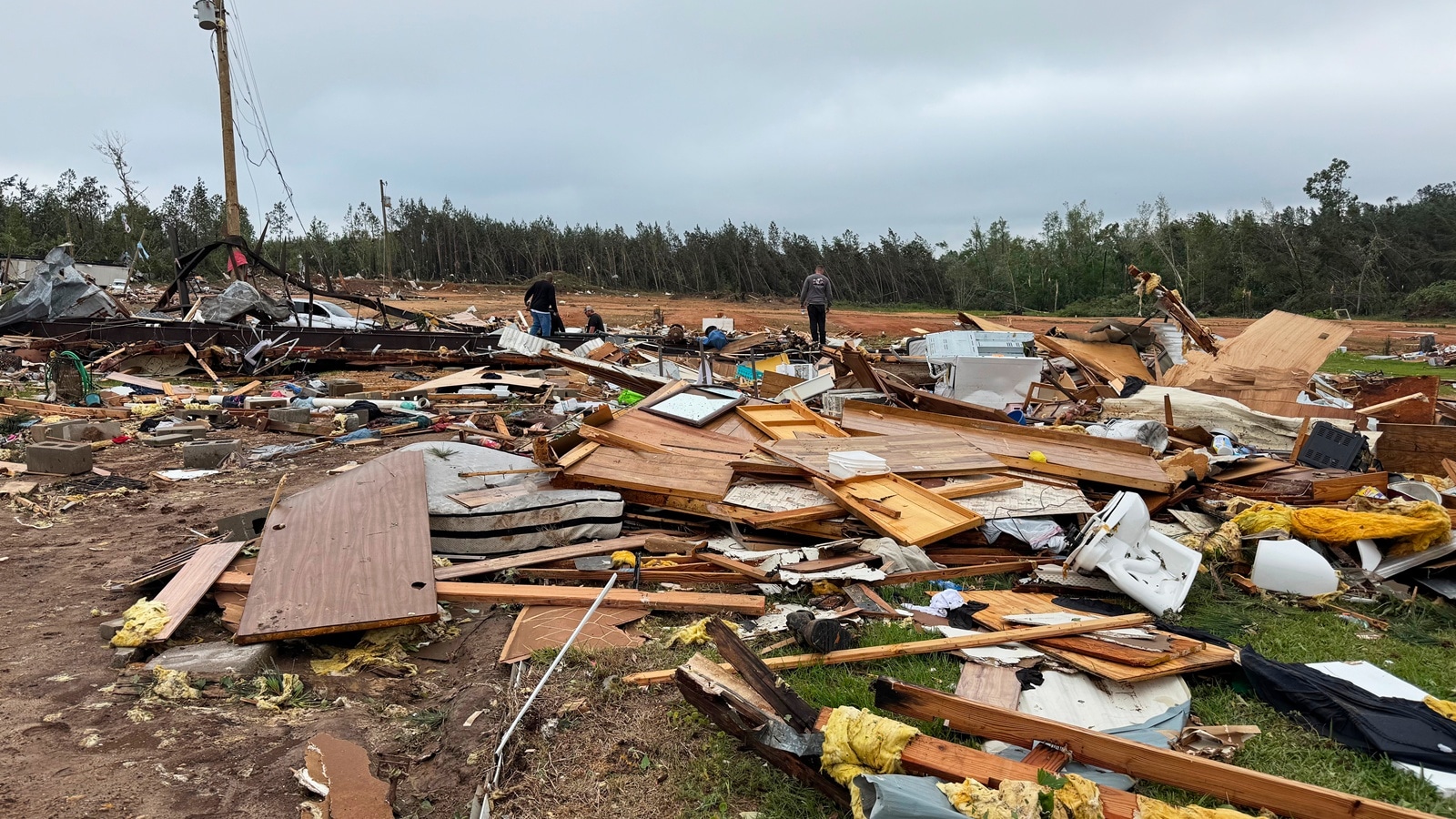
Mississippi just took a massive hit. Again. Severe storms and tornadoes tore through the heart of the state, leaving a trail of shattered glass and splintered wood across multiple counties. We’re looking at over 500 homes damaged or completely leveled. This isn't just a weather report. It's a wake-up call for anyone living in the Deep South. The reality on the ground is grim, and frankly, the way we talk about "Tornado Alley" is outdated.
The National Weather Service (NWS) confirmed that a series of powerful twisters skipped across the landscape, touching down with enough force to peel roofs off like tin foil. Emergency management officials are still tallying the cost, but the human toll is already clear. People lost everything in seconds. When you see a neighborhood where 500 families are suddenly homeless, you realize our current infrastructure is failing us.
The Shift to Dixie Alley is Real
For decades, everyone focused on Kansas and Oklahoma. That was the classic "Tornado Alley." But if you’ve been paying attention to the data from the National Oceanic and Atmospheric Administration (NOAA), you know the "Dixie Alley" across Mississippi, Alabama, and Tennessee is becoming the new ground zero. It's more dangerous here.
Why? It’s not just the wind speed. It’s the terrain and the timing. Mississippi is covered in trees and hills. You can’t see a tornado coming until it’s on top of you. In the Plains, you can see a funnel from miles away. Here, they're often rain-wrapped and invisible. These recent storms hit with that exact kind of stealth.
Nighttime tornadoes are another killer. Statistics show that tornadoes in the Southeast are more likely to occur at night compared to those in the Great Plains. When 500 homes get hit while people are sleeping, the lethality jumps exponentially. This latest system didn't care if it was dark out. It pushed through with a relentless moisture feed from the Gulf, creating the perfect recipe for disaster.
Five Hundred Homes is a Massive Recovery Hill
When news reports say "500 homes damaged," it sounds like a statistic. It’s not. That’s roughly 1,500 to 2,000 people whose lives just stopped. Local officials in Hinds and Rankin counties are seeing the brunt of it. We’re talking about EF-2 and EF-3 level damage in some pockets. That means winds topping 130 mph.
I’ve seen how these recovery efforts go. The first 48 hours are pure adrenaline and search-and-rescue. Then the reality sets in. The power grid is trashed. Water lines are broken. The supply chain for building materials—already stretched thin in 2026—will be pushed to the brink. If you're one of the homeowners affected, you aren't looking at a few weeks of repairs. You're looking at a year or more of fighting insurance companies and waiting for contractors.
The Mississippi Emergency Management Agency (MEMA) is coordinating with FEMA, but federal aid takes time. It’s a bureaucracy. The immediate burden falls on the neighbors and the local churches. That’s the Southern way, sure, but it shouldn’t be the only way. We need better pre-disaster mitigation.
Why Our Building Codes Are Failing Us
Let's be honest. A lot of the homes lost in this recent Mississippi outbreak weren't built to handle this. We keep building with 20th-century standards for 21st-century storms.
The "Fortified Home" standard exists for a reason. It involves using ring-shank nails, sealed roof decks, and better anchoring systems. It costs maybe $1,000 to $3,000 more during initial construction. Compared to the cost of a total loss, that’s pocket change. Yet, many counties in Mississippi still don’t mandate these tougher codes. We’re literally building houses that are designed to fall apart when the wind hits 100 mph.
If we don't change how we build, we'll keep writing these same headlines every spring and fall. The atmosphere is holding more energy. The Gulf is warmer. The storms are getting more frequent. 500 homes today could easily be 5,000 tomorrow if a cell tracks five miles further into a high-density area like Jackson.
The Mobile Home Vulnerability Gap
We have to talk about mobile homes. Mississippi has one of the highest percentages of manufactured housing in the country. These units are death traps in a tornado. Even with tie-downs, a mobile home isn't safe in an EF-2 storm.
During this latest sweep, a significant portion of the "damaged homes" were manufactured units. When a tornado hits a trailer park, it doesn't just damage the homes; it pulverizes them. We need more community storm shelters. It’s a policy failure that we allow high-density mobile home parks to exist without a reinforced concrete bunker within 100 yards of every resident. Expecting someone to jump in a car and drive to a public shelter when the sirens are already blaring is a death sentence.
Stop Relying on Sirens Alone
If you think the outdoor siren is your primary warning system, you’re making a mistake. I’ve talked to so many survivors who said they never heard the siren. They aren't meant to be heard indoors. They’re for people at the park or on the golf course.
You need a redundant system. A NOAA weather radio with a battery backup is non-negotiable. Your phone is great, but towers go down. A weather radio listens directly to the NWS transmitters. It will wake you up at 3:00 AM when the world is ending outside.
What You Should Do If Your Area Was Hit
If you’re in the path or helping those who were, the work is just beginning. Don't wait for the government to tell you what to do.
- Document everything. Before you move a single piece of debris, take 500 photos. Take video. Your insurance adjuster will try to lowball you. Evidence is your only leverage.
- Watch for "Storm Chasers." Not the weather geeks—the contractors. Fraudsters flood Mississippi after these storms. If a guy shows up in a truck with out-of-state plates offering a "special deal" on a new roof if you pay upfront, tell him to keep driving.
- Check the gas lines. Even if your house looks okay, the shifting ground and debris can stress gas connections. If you smell eggs, get out.
- Secure your property. The law generally requires you to prevent further damage. Tarp the roof if it’s safe. Board up broken windows. Save the receipts for the plywood and tarps; the insurance company has to reimburse you for "mitigation of loss."
The recovery in Mississippi is going to be long. 500 homes represent 500 stories of survival, but also 500 points of failure in how we prepare for the inevitable. The storms aren't going away. They’re getting stronger. It’s time we started acting like it.