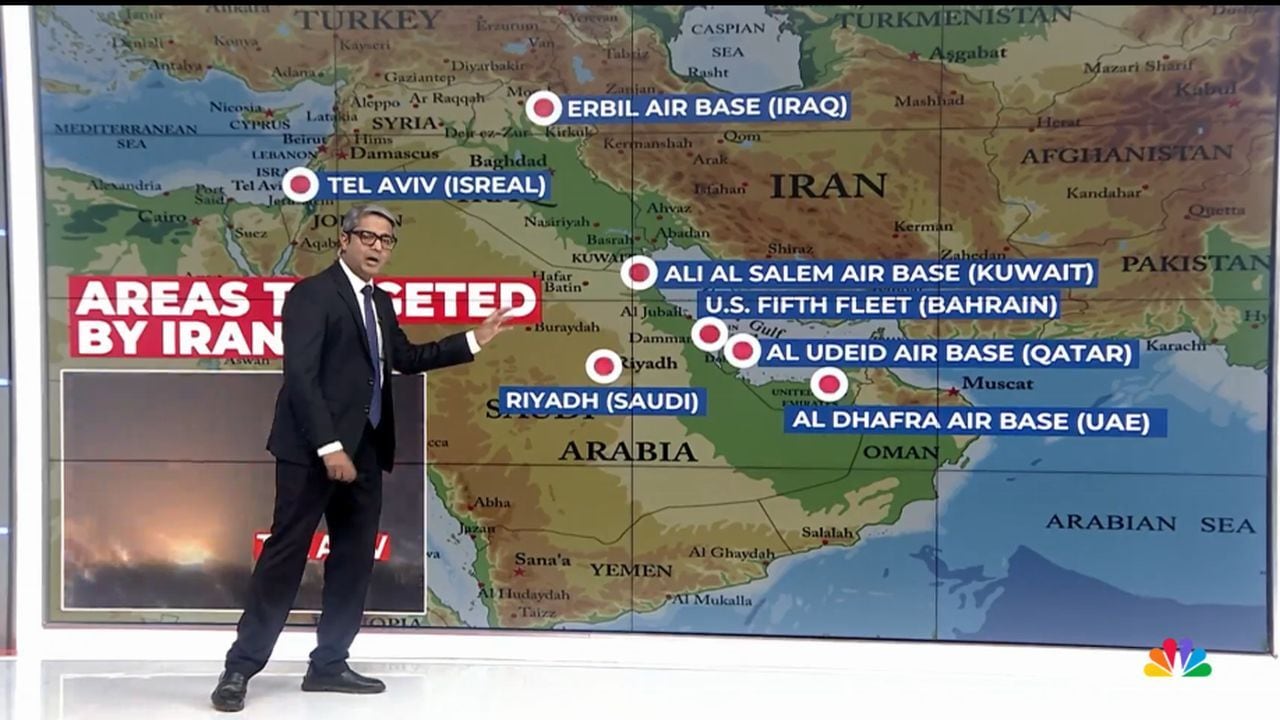
Military analysts love a good scoreboard. They count the intercept rates, they measure the craters, and they conclude that because 90% of a drone swarm was swatted out of the sky by a Phalanx CIWS or a Patriot battery, the attack was a failure. They are wrong. They are looking at the tactical "win" while ignoring the strategic bankruptcy of the Western defense model.
When you watch footage of Iranian Shahed-136 drones flickering over regional bases, you aren't watching a military strike. You are watching an economic stress test. And the West is failing it.
The conventional narrative—the one peddled by defense contractors and retired generals on cable news—is that Western air defenses are a "shining shield." They point to the high interception rates as proof of superiority. But in the world of modern attrition, an interception is often just a very expensive way to lose a war.
The Math of Economic Asymmetry
We have entered an era where the cost of the bullet is exponentially higher than the cost of the target. This is the fundamental truth that the "lazy consensus" ignores.
A Shahed-136 drone costs roughly $20,000 to $50,000 to produce. It’s essentially a lawnmower engine strapped to a fiberglass wing with a GPS chip. To knock it down, a US-led coalition often employs an AIM-9X Sidewinder, which runs about $450,000 per shot, or a RIM-162 ESSM, which clears $1 million.
Do the math. Even with a 100% intercept rate, the defender is losing. Iran is trading "junk" for the exhaustion of high-end Western munitions stockpiles that take years, not weeks, to replenish. When a $20,000 drone forces the launch of a $2 million interceptor, the drone has already completed its mission before it even explodes.
I have watched defense budgets balloon while our actual capacity to sustain a high-intensity conflict shrinks. We are specialized for a world that no longer exists—a world where we have the luxury of using gold-plated hammers to kill flies. Iran knows this. They aren't trying to level a base; they are trying to bankrupt the logistics chain that supports it.
The Illusion of "Precision"
Critics often point to the lack of "damage" at these bases as evidence of Iranian incompetence. They see a crater in a dirt field 50 meters from a hangar and laugh. They shouldn't.
Precision is a Western obsession. In the Iranian doctrine of "saturation," the goal isn't necessarily to hit the bullseye. The goal is to force the defensive system to engage.
Modern integrated air defense systems (IADS) have a finite "channel of fire." This means a radar system can only track and engage a specific number of targets simultaneously. By launching a mix of slow-moving drones, subsonic cruise missiles, and ballistic missiles, Iran isn't just trying to "get through." They are trying to find the saturation point where the computer says "Error" and the human operator freezes.
Psychological Attrition and the "Base-as-a-Target" Fallacy
Western media treats a US base as a static fortress. It isn't. It’s a political asset.
Every time a siren goes off at a regional hub, the political cost of the US presence in the Middle East ticks upward. It doesn't matter if the missile hits a mess hall or a sand dune. The result is the same: soldiers in bunkers, disrupted operations, and a headline that reads "US Base Under Attack."
The "People Also Ask" sections of the internet are filled with queries like, "Can US air defenses stop Iranian missiles?" The answer is "Yes, mostly," but that’s the wrong question. The right question is: "Can the US afford to keep stopping them indefinitely?"
The answer to that is a resounding no. Our industrial base is optimized for "just-in-time" delivery of complex systems. We build thirty highly advanced missiles a year; Iran can build three thousand "dumb" ones in the same timeframe. In a war of attrition, the side that can afford to be wrong more often usually wins.
The Technological Trap
We have fallen into a trap of our own making. We believe that better tech equals better security.
Imagine a scenario where a state-of-the-art radar system, costing hundreds of millions, is blinded by a $500 jammer or overwhelmed by a swarm of drones made from parts ordered on Alibaba. This isn't a theoretical threat; it is the current reality of the Red Sea and the Levant.
The Western military-industrial complex is incentivized to build the most expensive solution possible. This works great for shareholder dividends, but it's catastrophic for a commander in the field facing a thousand incoming targets. We are bringing a sniper rifle to a riot.
Rethinking the Defense Paradigm
If we want to actually "win" these exchanges, we have to stop measuring success by how many drones we shot down. We have to start measuring success by how much it cost us to do it.
- Move toward Directed Energy: We need lasers and high-powered microwaves. If the cost per shot isn't measured in cents rather than millions, we are doomed to lose the economic war.
- Accept Proportional Damage: This is the hardest pill for politicians to swallow. Sometimes, it is better to let a cheap drone hit an empty warehouse than to fire a missile that costs more than the warehouse itself.
- Decentralization: If a base is too big to defend, it's too big to exist. We need smaller, mobile footprints that don't offer the "prestige" target value of a massive installation.
The Harsh Reality
Iran isn't "failing" because their missiles missed a specific building. They are succeeding because they have forced the most powerful military in history to play a game where every "win" brings us closer to exhaustion.
The drones are the distraction. The missiles are the distraction. The real weapon is the bill.
Stop looking at the satellite photos of the craters. Start looking at the inventory levels of the interceptor magazines. That is where the war is being won, and right now, it isn't being won by us.
Get off the "intercept rate" high. It’s a vanity metric that will get people killed when the magazines finally run dry.
Burn the playbook. Start counting the cost.
Would you like me to analyze the specific manufacturing bottlenecks for Patriot missile interceptors compared to the production scaling of the Shahed-136?