The illicit flow of petroleum products from Iran into Pakistan's Balochistan province represents a highly optimized, informal supply chain operating under conditions of extreme geopolitical distortion. While media narratives frequently framing this phenomenon emphasize the physical peril of the couriers (locally known as Zamyad drivers or motorcycle Zamyad operators), a structural analysis reveals a highly rational economic ecosystem. This trade is driven by a profound price differential, sustained by localized institutional equilibrium, and executed through a multi-tiered logistics network designed to absorb significant operational risk.
Understanding this network requires stripping away the sensationalism of border enforcement and analyzing the precise economic mechanics, cost functions, and structural dependencies that govern the Pakistan-Iran fuel arbitrage.
The Financial Engine: Dissecting the Price Differential
The fundamental driver of this illicit market is price arbitrage created by asymmetric state interventions. Iran maintains some of the heavily subsidized fuel prices globally, designed to insulate its domestic population from the effects of international sanctions and economic isolation. Conversely, Pakistan relies on heavily taxed, import-dependent refined petroleum products to secure state revenue through the Petroleum Levy and General Sales Tax (GST).
This disparity creates a structural price wedge. The profit margin of the smuggling network is dictated by a specific net arbitrage equation:
$$\text{Net Arbitrage Margin} = P_{\text{Pak}} - (P_{\text{Iran}} + C_{\text{Log}} + C_{\text{Rent}} + C_{\text{Risk}})$$
Where:
- $P_{\text{Pak}}$ is the market price of fuel in Pakistan’s informal or formal retail sectors.
- $P_{\text{Iran}}$ is the procurement cost at the Iranian source.
- $C_{\text{Log}}$ represents the physical transportation and logistics costs (fuel for transport, vehicle maintenance, labor).
- $C_{\text{Rent}}$ represents the economic rents paid to state and non-state actors to facilitate transit through checkpoints (informal taxation).
- $C_{\text{Risk}}$ is the quantified cost of asset loss, physical injury, or interdiction.
Because $P_{\text{Iran}}$ is suppressed artificially and $P_{\text{Pak}}$ remains tied to international crude benchmarks and domestic fiscal burdens, the net margin remains highly positive despite substantial increases in $C_{\text{Log}}$ and $C_{\text{Rent}}$. This ensures a continuous flow of capital into the borderlands to finance the trade.
The Three Tiers of the Smuggling Supply Chain
The logistics network is not a monolithic entity; it is a highly segmented, decentralized hierarchy where risk and reward are distributed based on capital ownership and localized access.
+-------------------------------------------------------------+
|                     Tier 1: Wholesalers                     |
|  - Secure large volumes at Iranian distribution nodes       |
|  - Own bulk storage facilities near the border              |
+-------------------------------------------------------------+
                              |
                              v
+-------------------------------------------------------------+
|                    Tier 2: The Couriers                     |
|  - Drivers of modified blue Zamyad pickups and motorcycles |
|  - Absorb maximum physical and operational risk             |
+-------------------------------------------------------------+
                              |
                              v
+-------------------------------------------------------------+
|             Tier 3: Retailers and Distributors              |
|  - Manage roadside dispensaries and urban distribution      |
|  - Integrate smuggled fuel into formal provincial economies  |
+-------------------------------------------------------------+
Tier 1: Capital Wholesalers and Border Brokers
At the apex sit individuals or syndicates with the liquidity to secure large volumes of fuel at Iranian distribution nodes. These actors possess the political capital to navigate the complex security apparatus on both sides of the border. They operate bulk storage points in proximity to the frontier, managing inventory levels to hedge against sudden border closures or enforcement crackdowns.
Tier 2: Tactical Couriers (The Riders and Drivers)
This tier constitutes the operational backbone and absorbs the highest concentration of risk. It utilizes two main vectors of transport:
- Modified Blue Zamyad Pickups: These Iranian-manufactured vehicles are retrofitted with oversized fuel bladders or plastic drums, carrying up to 2,000–3,000 liters of fuel across rugged terrain.
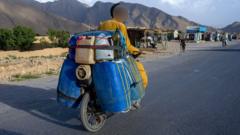
- High-Capacity Motorcycles: Employed in hyper-arid, mountainous corridors impassable by four-wheel vehicles. These motorcycles are outfitted with lateral metal frames holding multiple blue jerrycans, transporting 200–400 liters per trip.
Couriers operate on a piece-rate compensation structure. They do not own the commodity; they sell their risk tolerance and navigational expertise.
Tier 3: Retail Distributors and Regional Hubs
Once the fuel crosses into Pakistani Balochistan, it undergoes immediate decentralization. It moves from frontier dump sites to roadside dispensaries (often operating out of plastic barrels with hand-cranked pumps) and is eventually integrated into the broader provincial economy, reaching transport hubs in Karachi and Sindh.
Risk Management and the Cost Function of Transit
The physical environment—characterized by temperatures exceeding 50°C (122°F) in summer and highly fractured mountainous terrain—acts as a natural barrier that shapes the cost function of the logistics network. Heat introduces a critical physical risk variable: thermal expansion and volatility.
Petroleum products transported in unvented, improvised plastic containers under direct sunlight experience rapid vaporization. This increases internal pressure within the containers, turning the transport vehicles into highly volatile explosive hazards. The probability of catastrophic vehicle loss due to spontaneous combustion or minor kinetic impacts shifts the risk premium ($C_{\text{Risk}}$) upward during peak summer months.
To mitigate this, the supply chain shifts its temporal operational patterns:
- Nocturnal Transit Operations: Logistics corridors switch exclusively to night operations to minimize thermal exposure.
- Topographical Exploitation: Couriers utilize dried riverbeds (nallas) and mountain defiles as solar shielding and concealment from aerial or vehicular border patrols.
- Speed Maximization: The operational doctrine favors high-velocity transit over rough terrain to reduce the duration of exposure to both environmental heat and law enforcement interdiction zones. This behavior increases mechanical failure rates, creating a secondary market for specialized mechanics and spare parts in remote frontier towns.
Institutional Equilibrium and Informal Taxation
A common analytical error is viewing this trade as a breakdown of state authority. In reality, it functions through a highly structured, informal institutional equilibrium. The state apparatus on both sides of the frontier does not lack the capacity to halt the trade; rather, it participates in a calculated policy of managed enforcement.
The border region suffers from acute underdevelopment, low industrial diversification, and a lack of alternative livelihoods. If the state enforces absolute border closure, it risks destabilizing the socio-economic fabric of Balochistan, potentially fueling local insurgencies or widespread civil unrest. Therefore, the illicit fuel trade serves as an informal social safety net funded effectively by the distortion of Iranian subsidies.
The mechanics of this managed enforcement rely on structured rent-seeking. Checkpoints along major transit arteries function as informal toll stations. The rents collected at these points are distributed through institutional hierarchies, transforming enforcement mechanisms into co-opted stakeholders in the continuity of the trade. The network remains stable because the cost of these rents ($C_{\text{Rent}}$) is lower than the cost of formal compliance, yet high enough to satisfy the economic incentives of the local security apparatus.
The Macroeconomic Paradox: Subsidizing the State via Smuggling
The systemic impact of Iranian fuel smuggling on Pakistan’s broader economy presents a profound macroeconomic paradox.
On one hand, the formal downstream oil sector suffers significant damage. Licensed Oil Marketing Companies (OMCs) lose market share in regions adjacent to smuggling corridors, leading to reduced corporate tax revenues and underutilization of formal refining capacity. The state loses hundreds of millions of dollars annually in uncollected customs duties, the Petroleum Levy, and sales taxes.
On the other hand, the informal fuel supply serves as an economic buffer for low-income consumers and small businesses. In Balochistan and parts of Sindh, smuggled Iranian diesel provides energy at a cost significantly below the national regulated retail price. This lowers input costs for:
- Agricultural Sector: Reducing the operational costs of tube wells and tractors.
- Logistics and Freight: Lowering transport costs for goods moving between remote provincial centers.
- Power Generation: Providing affordable fuel for localized diesel generators in areas disconnected from the national electrical grid.
Consequently, any aggressive, unmitigated state enforcement campaign targeting the fuel network creates an immediate inflationary shock in the local economy, increasing production costs and depressing consumer demand.
Structural Vulnerabilities and Long-Term Viability
The long-term sustainability of the Iran-Pakistan fuel arbitrage network faces structural threats from shifting domestic policies rather than tactical border enforcement.
Iranian Subsidy Reform
The most acute vulnerability to the network is the potential rationalization of fuel prices within Iran. Faced with persistent economic sanctions and fiscal deficits, the Iranian state has repeatedly attempted to reduce domestic fuel subsidies or tighten digital rationing systems. Any sharp increase in domestic Iranian fuel prices directly compresses the price wedge, reducing the net arbitrage margin. If the procurement cost rises to a point where it can no longer absorb the high logistics ($C_{\text{Log}}$) and rent ($C_{\text{Rent}}$) costs, the network will experience a systemic contraction.
Border Fencing and Hard Enforcement Infrastructure
Pakistan's ongoing initiatives to fence the 909-kilometer border and install electronic surveillance assets fundamentally alter the geography of smuggling. This infrastructure forces the trade to consolidate. Instead of utilizing dozens of porous mountain passes, the flow must navigate a limited number of high-capacity transit points. This consolidation increases the leverage of state actors at those points, driving up the cost of informal rents ($C_{\text{Rent}}$) and making low-volume couriers economically unviable.
Strategic Interventions for Market Stabilization
Policymakers seeking to address the structural distortions of the informal fuel economy cannot rely on kinetic interdiction or border militarization; these measures merely increase the risk premium and drive up the informal rents. Instead, formalizing the economic reality of the borderlands requires a sequenced policy framework.
The state must establish localized, legalized import zones along the frontier where fuel can be brought in through formal channels but taxed at a preferential, concessionary rate. This rate must be calculated to compete directly with the informal cost function:
$$\text{Concessionary Tax Rate} < C_{\text{Rent}} + C_{\text{Risk}}$$
By ensuring that the cost of formal registration and lower-tier taxation is less than the cumulative cost of bribes and asset loss, the state can incentivize Tier 1 wholesalers to transition into the formal economy. This captures revenue, stabilizes supply chains, and preserves local livelihoods without triggering an inflationary shock.
Simultaneously, the capital captured through these concessionary import regimes must be ring-fenced and reinvested directly into the border districts. Prioritizing the development of off-grid solar infrastructure and modernized agricultural processing centers will systematically decouple the local population's economic survival from the volatility of cross-border petroleum arbitrage.