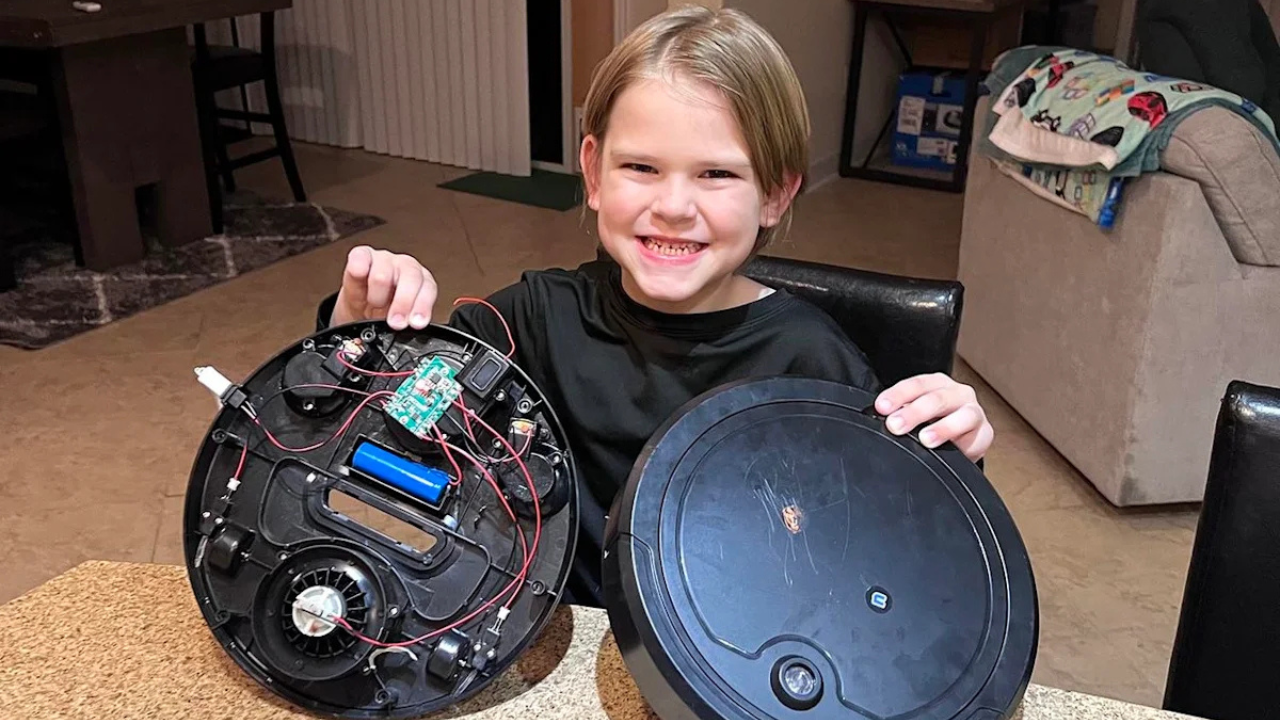
Monetizing hyper-specific passions on digital platforms requires a fundamental alignment between asset acquisition cost, technical skill accumulation, and multi-channel audience engagement. While mainstream media often contextualizes the story of an eight-year-old operating a YouTube brand around novelty, a structural analysis of Wyatt’s World of Roombas reveals a classic blueprint for lean operational efficiency and vertical integration in content businesses.
Understanding this framework allows creators and digital strategists to replicate the underlying mechanisms of niche audience capture without requiring enterprise-level capital investment.
The Unit Economics of Salvage Sourcing
A media brand focused on consumer electronics typically faces a steep cost barrier: hardware acquisition. For standard technology review channels, capital expenditure scales linearly with the volume of products evaluated. The subject of this analysis bypassed this economic constraint entirely by exploiting a negative-cost supply chain.
The inventory acquisition strategy operates on a pure salvage model, structured as follows:
- Zero-Cost Asset Sourcing: By establishing local collection nodes through community networks, neighbors, and word-of-mouth recommendations, the operation acquired over 50 unit assets (robotic vacuums) at a marginal cost of zero dollars.
- Arbitrage of Discarded Utility: Consumers frequently discard first-generation or broken hardware due to the high transaction costs of official repairs relative to the depreciated value of the machine. The creator captures this lost utility.
- Supply Scalability: Because the local community acts as a decentralized supply chain, inventory scales naturally with brand visibility. As local awareness grows, the inflow of broken units accelerates, lowering the average acquisition cost per asset to zero.
The Technical Lifecycle and Value-Add Pipeline
Once an asset enters the inventory, it undergoes a structured remediation process. The technical viability of the brand rests on basic mechanical diagnostics that can be broken down into specific component failures. Most consumer robotic vacuums suffer from common, predictable wear patterns rather than catastrophic systemic failure.
The mechanical restoration framework relies on identifying and correcting four primary systemic bottlenecks:
Power Delivery Optimization
Lithium-ion or Nickel-Metal Hydride batteries degrade predictably over cycles. Total system failure often stems entirely from a depleted cell rather than circuit board damage. Diagnosing voltage retention and swapping standard battery cells acts as the initial layer of asset rehabilitation.
Mechanical Kinematics
Drive wheels and brush modules frequently seize due to high friction caused by the accumulation of micro-debris (hair, dust, carpet fibers). Disassembling the gearboxes, clearing mechanical resistance, and lubricating moving parts restores 100% mechanical efficiency at a near-zero component cost.
Sensor Calibration and Maintenance
Optical cliff sensors and infrared wall-following arrays malfunction when obscured by dust or scuffed by impact. Surface cleaning or basic polycarbonate polishing corrects navigation errors, returning the unit to baseline operational autonomous routing.
By systematically applying this diagnostic protocol, the creator transforms discarded consumer electronics from zero-value liabilities into functional, high-utility operational assets.
The Multi-Channel Revenue Engine
The core business architecture leverages these restored physical assets to feed an integrated content and merchandising flywheel. The business does not rely on a single monetization stream; instead, it utilizes a multi-layered monetization structure that extracts value from three distinct sources.
                  [ Community Donations ]
                             │
                             ▼
                 [ Restored Hardware Asset ]
                             │
       ┌─────────────────────┼─────────────────────┐
       ▼                     ▼                     ▼
[ YouTube AdSense ]    [ Intellectual Property ]  [ E-Commerce Merchandise ]
- Low CAC Content      - Children's Book         - Custom Niche Apparel
- High-Retention Ops   - Plushed Characters      - Audience Monetization
1. Low-CAC YouTube Content Architecture
The content engine relies on a highly compelling concept: visual scale and technical mastery. The production cost of videos—such as operating 50 autonomous vacuums simultaneously—is exceptionally low because the hardware assets were obtained for free. This high-density visual asset creates an immediate hook, driving algorithmic distribution and lower customer acquisition costs (CAC) for subscribers.
2. E-Commerce and Niche Merchandising
Audiences built around extreme niches show high affinity but low product availability in traditional retail markets. The brand filled this gap by launching a specialized merchandise store featuring custom apparel and accessories. Capturing up to $1,800 in monthly profit demonstrates the viability of shifting from passive ad-supported revenue to direct-to-consumer physical product sales.
3. Intellectual Property Upstreaming
The final layer of value extraction occurs through the codification of the brand narrative into original intellectual property. Co-authoring a children's book (Robbie the Robot Vacuum and His Big Adventure) and designing a corresponding plush toy transitions the business from a service/review channel into an IP licensing vehicle. This allows the business to scale independently of physical repair throughput.
Strategic Constraints and Operational Scaling Risk
Despite the high efficiency of this model, structural limitations restrict exponential scale. Understanding these vulnerabilities is critical for evaluating the long-term viability of small-scale creator brands.
The first bottleneck is time and labor constraint. The repair process is fundamentally manual and un-automated. Because asset value relies on individual physical restoration, throughput is limited by the number of hours the creator can devote to diagnostics. Without hiring external technical staff, scaling inventory past a certain threshold becomes impossible.
The second limitation is geographical sourcing density. A local community can only generate a finite volume of discarded robotic vacuums. To continue scaling the hardware pipeline, the business must pivot from localized collection to digital or regional reverse-logistics frameworks (e.g., sourcing broken lots on eBay), which introduces shipping costs and degrades the zero-cost asset acquisition model.
To transition this enterprise into a highly scalable media operation, the strategy must pivot away from manual repair as the primary driver of growth. The physical workshop should be repositioned exclusively as a laboratory for intellectual property creation. By documenting the repair process to license instructional materials to educational institutions or stem programs, the operation can decouple its revenue generation from physical labor, shifting the business from a localized repair model to a scalable, global educational brand.